
Related videos:
The reports recently published by have brought up a hypothesis that is already sparking debate in political circles and among sectors of Cuban civil society.
According to this information, Washington may be exploring an economic agreement with Havana that would include gradual reforms in the economy, increased interaction with the Cuban private sector, and a possible departure of the ruling Miguel Díaz-Canel.
One of the most striking aspects of the scenario described by the American newspaper is that the Castro family would remain on the island, while a new phase of economic relations with the United States would begin.
The formula suggests a limited political change combined with a progressive economic opening, something that some analysts have described as a kind of “,” referring to the reform process that partially transformed the Soviet system in the 1980s.
However, that approach raises several fundamental questions.
The first point is that focusing the debate on Díaz-Canel's departure might have very limited political significance. Since his appointment in 2018, the leader has been widely perceived as a political administrator within a system where real power is not concentrated in the formal presidency.
The center of gravity of power in Cuba lies within much deeper structures: the Communist Party, the State security apparatus, and the military-industrial complex that controls a significant portion of the national economy.
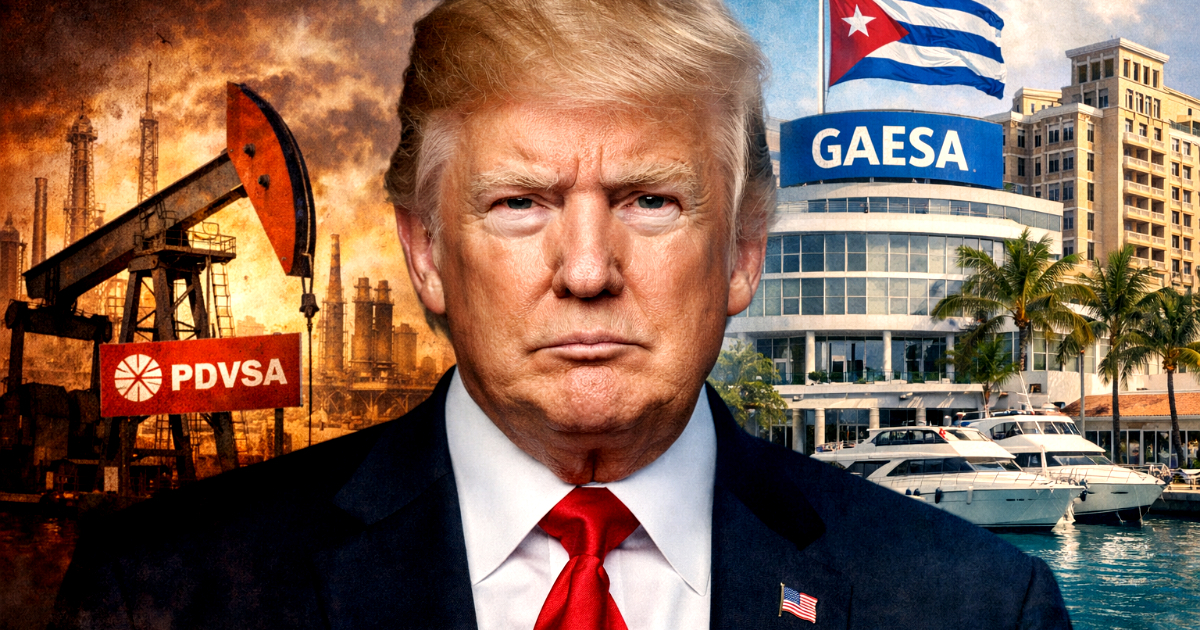
That economic framework has a code name: GAESA (Grupo de Administración Empresarial S.A.).
The military conglomerate controls strategic sectors of the Cuban economy, from tourism and ports to retail, remittances, and numerous financial operations.
Several of these sectors —such as tourism, energy, or port activities— are mentioned in reports by USA Today as potential areas where Washington could ease restrictions or facilitate economic agreements.
Various analyses estimate that the group under the direct control of the Castro leadership manages a substantial portion of the country's foreign currency income (approximately 70% of the dollarized economy).
In practice, GAESA functions as the financial backbone of the Cuban political system.
Therefore, several observers point out that Díaz-Canel's departure would not necessarily alter the real balance of power, especially if the political and economic structures built over decades by Castroism remain intact.
The presence of the Castro family on the island also adds another dimension to the debate. Although Fidel Castro passed away in 2016 and Raúl Castro formally stepped down from his public positions, the institutional legacy and the networks of power and patronage built over decades continue to hold significant influence within the system.
That point becomes even more relevant when observing the Venezuelan precedent.
In the case of Venezuela, the strategy attributed to Washington was not limited to politically pressuring chavismo. The central element was to neutralize the regime's main source of funding: oil.
The logic behind this strategy is clear: as long as an authoritarian regime retains control over its main source of income, it also maintains the ability to finance its political apparatus, its security structure, and the networks of power that ensure its survival.
Applied to the Cuban case, that same logic leads to another inevitable question.
If oil was the strategic resource in Venezuela, in Cuba, that role is played by GAESA.
The military conglomerate concentrates a significant portion of the foreign currency entering the country and articulates the link between political power, the state economy, and emerging business sectors.
Even the expansion of the Cuban private sector in recent years has not completely altered that framework. Many small and medium-sized enterprises depend directly or indirectly on infrastructure, imports, or financial circuits controlled by the State itself or by entities linked to the military apparatus.
For this reason, some analysts believe that an economic opening that does not disrupt GAESA's control over strategic sectors could end up indirectly reinforcing the very system it seeks to reform.
This issue also connects with the broader framework of U.S. foreign policy in the Western Hemisphere.
In recent years, Washington has once again emphasized the strategic importance of Latin America and the Caribbean within its national security policy. In this context, several analysts discuss a contemporary reinterpretation of the historic Monroe Doctrine, aimed at reaffirming American influence in the region and limiting the presence of rival powers such as Russia or China.
Cuba occupies a unique position within that geopolitical landscape.
For decades, the regime has maintained close political and military ties with Moscow, in addition to growing economic relations with Beijing.
From that perspective, a central strategic question arises: if the goal is to reduce hostile centers of influence in the hemisphere, can that objective be achieved without transforming the power structures that have sustained the Cuban system for over six decades?
The answers are not simple.
Some experts argue that strengthening the Cuban private sector could create internal pressures capable of transforming the system from within. Others believe that gradual economic reforms could pave the way for subsequent political changes.
But there is also the opposite precedent: regimes that have managed to adapt to economic reforms without losing essential political control.
In this context, the debate sparked by the reports from USA Today centers on a fundamental issue.
If the change is limited to an economic opening without altering the military conglomerate's control over the main sectors of the economy, the result could be a reorganization of the system rather than its transformation.
And that's where the parallel with Venezuela becomes meaningful again.
If the strategic principle was chavismo without oil, the inevitable question for Cuba would be another: Can a real transition exist without achieving a castrismo without GAESA?
Filed under: