
Related videos:
The protests that shook the city of Morón last Friday continue to generate repercussions even within sectors connected to the state apparatus.
The official and rescuer Aris Arias Batalla, responsible for operations and rescue at MINSAP in Santiago de Cuba, shared a message warning about the risks of firing shots into the air, a police practice that, as admitted by state-run media, was used in response to the protests.
On Facebook, Arias described this type of action as a potential danger for the population.
"Shooting into the air is not a 'joke' or an innocent tradition. It is an act of criminal negligence that turns the shooter into a public danger, capable of killing someone miles away, without seeing them and with no way to control the impact," he wrote.
Although the official avoided directly mentioning the Police, his comment explicitly refers to media reports and government profiles that claimed the agents fired shots into the air to disperse the protesters.
That detail is significant.
While the official narrative has tried to present those shots as a legitimate measure to "restore order," Arias himself warns that this is an extremely dangerous action that can result in the death of innocent people.
An indirect critique from within the establishment
In a second post, Arias explained in greater detail why shooting into the air poses a serious risk.
He emphasized that bullets do not disappear after being shot into the sky. They rise propelled by the explosion, reach a peak, and then return to the ground driven by gravity, accelerating as they descend.
When they fall, they do so at speeds that can be fatal, between 90 and 150 meters per second, enough to penetrate a person's skull.
"A falling bullet is not like a coin or a stone," he emphasized.
Arias outlined the unpredictable nature of such gunfire, as the bullet can travel several kilometers before falling, meaning it can strike anywhere: a street, a home...
In other words, an action supposedly intended to control disturbances can end up posing a risk to any citizen who is not even participating in the protest.
Were there shots fired or not?
The official's statements come amid a heated controversy regarding what happened during the protests on Friday in Morón.
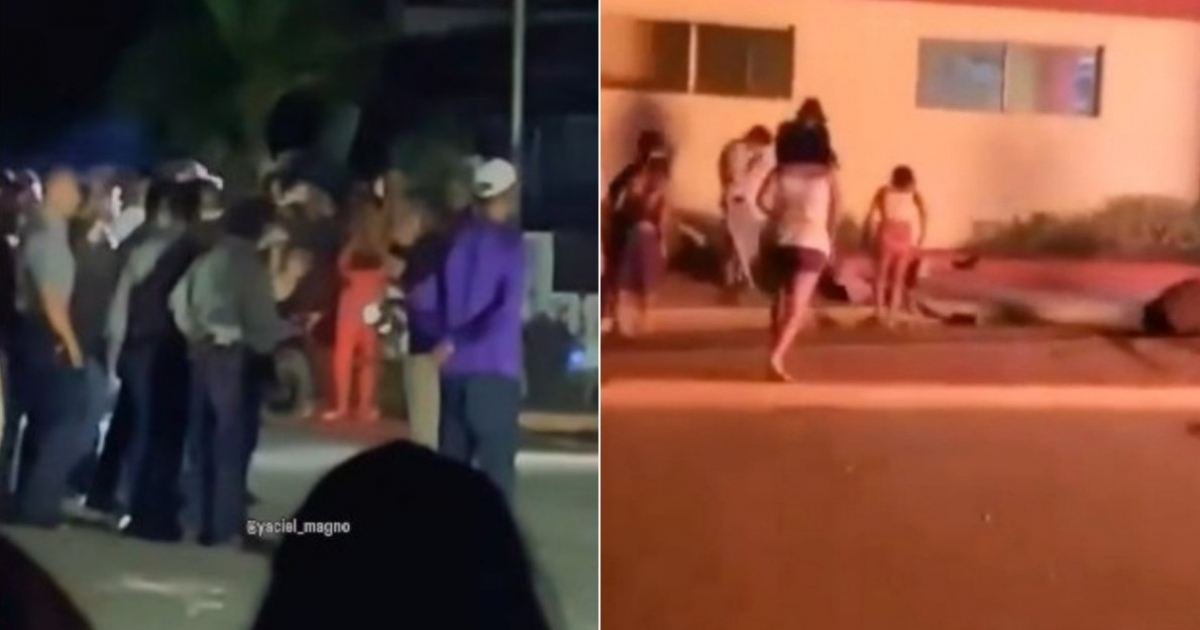
In front of the municipal headquarters of the Communist Party, a young man fell to the ground after a gunshot was heard. Videos circulating online show how other people rushed to assist him and quickly took him away on a motorcycle.
Those present at the scene assert that the young man was hit by a bullet, a claim that the authorities deny.
The official newspaper Vanguardia reported on X that "there were no injuries from gunfire. The shots were fired into the air to disperse the uprising."
That same explanation was repeated by the official journalist Francisnet Díaz Rondón, who denied that shots were fired directly at demonstrators but acknowledged that there were gunshots.
An implicit recognition
Arias's intervention introduces an uncomfortable element to the official narrative.
Based on those same government publications, the official takes for granted that shots were indeed fired into the air.
And from that point, he issues his warning: that type of action is neither harmless nor acceptable from the standpoint of public safety.
Although it avoids a direct confrontation with the authorities, its analysis ultimately questions the practice that the state media themselves had presented as an appropriate response to the protests.
Protests amid a deep crisis
The events in Morón reflect the atmosphere of increasing tension permeating the country.
The combination of prolonged blackouts, food shortages, inflation, and the deterioration of basic services has led to an increase in social discontent across various regions of the island.
In response to this situation, the state apparatus has reacted by increasing surveillance and deploying police forces to contain any public demonstrations.
However, incidents like the one in Morón demonstrate just how much that strategy can lead to high-risk situations, especially when firearms are used—albeit supposedly "in the air"—in populated areas.
Arias' warning, coming from a figure close to official structures, highlights an uncomfortable reality: even within circles connected to the system, there is concern about the methods used to quell the growing social unrest.
Filed under: