
Related videos:
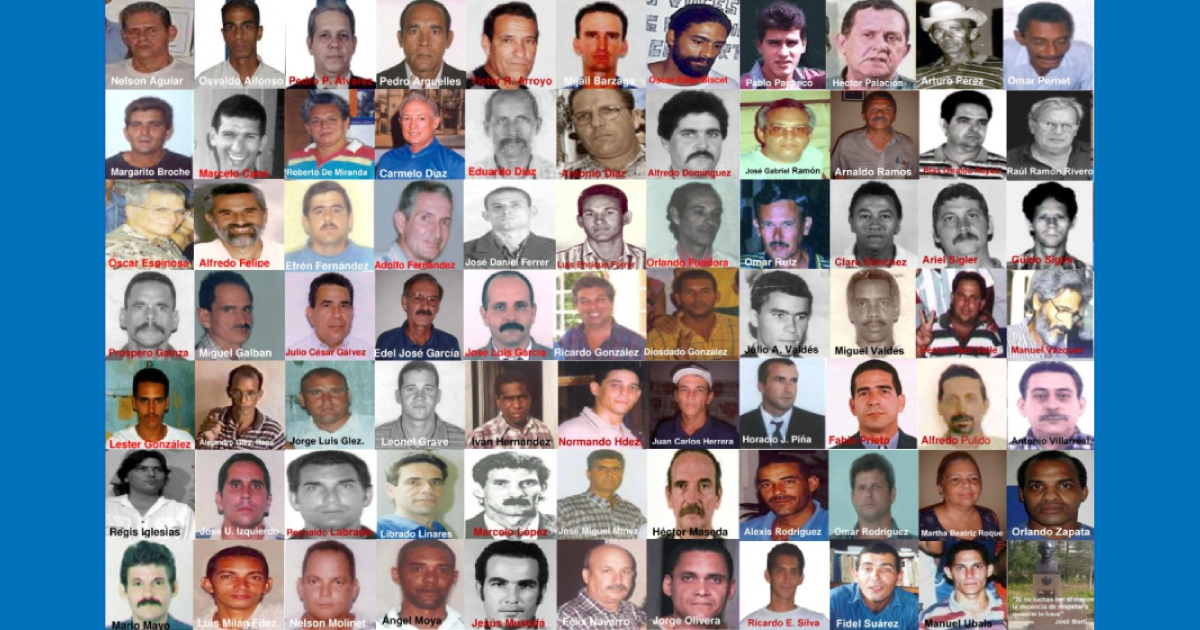
March 18, 2003 marked one of the darkest episodes in Cuba's recent history. Within a matter of days, 75 peaceful opponents were arrested, subjected to summary trials, and sentenced to long prison terms. That operation, known as the Black Spring, was not an excess or a mistake. It was a deliberate act of political revenge.
Twenty-three years have passed. And there is still something that has not been stated clearly enough: that was not justice. It was punishment. I was one of those 75. In my case, the prosecutor requested 18 years in prison. I was sentenced to 14. I served five due to my thoughts. Not for a violent act, not for a common crime, but for thinking, for writing, for engaging with others, for refusing to accept silence.
And it is not an interpretation. It is stated in my sentence that I share with three other political prisoners.
Whoever reads this document carefully will find that the "facts" supporting the condemnation are nothing more than activities typical of any citizen in a free society: contacting others, accessing information, communicating, expressing opinions. However, all of this was presented as evidence of activity against the State. In other words, what was being punished was not a crime, but independence.
The legal term used —“acts against the independence or territorial integrity of the State”— sounds serious, even belligerent. But when stripped of the official political veneer and observed in light of the actual facts, what remains is something much simpler and much more unsettling: in Cuba, thinking is a crime.
My case did not end with my release from prison. I was never liberated. I was exiled. My departure from the country was forced, "definitive," as defined by State Security. There was no real offer or alternative to stay in Cuba. An exile that had an added cruelty in my case: I was expelled the day after my mother's death.
That detail is not insignificant. Because it shows that it was not just about punishing a behavior, but about breaking the person. However, there is another dimension to this story that continues to be ignored. For years, and rightly so, there has been talk of the properties confiscated by the Cuban regime. However, I notice that there is little discussion about the lives confiscated. About those of us who lost years of freedom, were separated from our families, and expelled from our country.
Many of us have not lost a business or a farm. In my case, I lived for many years without hope, and when I rebelled against that dispossession, I ended up losing five years of my life in prison. I also lost the right to live in my land. This raises a question that remains unanswered: if we talk about restoring property, why not also talk about restoring lives?
My story, along with that of many others, cannot be separated from a broader reality. In my case, I was born in 1958 and never owned real property. I lived in a house that the government gave to my father, which had previously belonged to a man who left the country. Later, it was divided, and each child received a portion. And that’s where we lived. That’s where our children were born, and the children of our children.
Many people marketed these stories as if they were proof of social justice. To me, looking back over the years, it seems like evidence of something else: organized precariousness. Because that wasn’t ownership. It wasn’t security. It wasn’t a life grounded in something that belonged to you. It was living within a chain of dispossession that predated it and continued afterward.
First, the original owner lost the house. Then another family arrived, not as normal homeowners in a normal country, but as occupants within a twisted system. And then we, the children, came, who inherited not a house but fragments. A room. A division. An arrangement. A life built on the provisional. And then the grandchildren, who inherit the ruins of what was once a home and a society.
And then comes the question that truly exposes the whole mess: if we return to Cuba, where do we return to? What is our place? The house that was once someone else's? The house torn apart? The house that today will surely belong to someone else because of that same chain of necessity, arbitrariness, and disorder?
That's why there's an inevitable question: if I return to Cuba, where do I return to?
That question encapsulates the failure of a system that not only stripped original owners of their rights but also condemned entire generations to live without legal security, without clear property, and without a place to fully belong.
If one day the issue of justice in Cuba is taken seriously, it will not be enough to speak only of confiscated property. It will be essential to include the victims. Those of us who have been imprisoned, exiled, silenced, stripped of our rights.
I am not asking for compassion. I am speaking of justice. And that justice is rooted in a fundamental principle: if the confiscation of property warrants compensation, political imprisonment does as well. If the dispossession of assets must be acknowledged, then exile and the destruction of families must also be recognized.
It has been 23 years since the Black Spring, but the debt remains unchanged. And as long as the victims are not fully recognized, as long as the complete truth is not acknowledged, any discourse about justice in Cuba will remain incomplete. It was not just about imprisoning 75 individuals. It was about attempting to break an idea. And that idea, the idea of freedom, still stands strong.
Alejandro González Raga is a former political prisoner and the executive director of the Cuban Observatory of Human Rights (OCDH).
Filed under:
Opinion article: Las declaraciones y opiniones expresadas en este artículo son de exclusiva responsabilidad de su autor y no representan necesariamente el punto de vista de CiberCuba.