
Related videos:
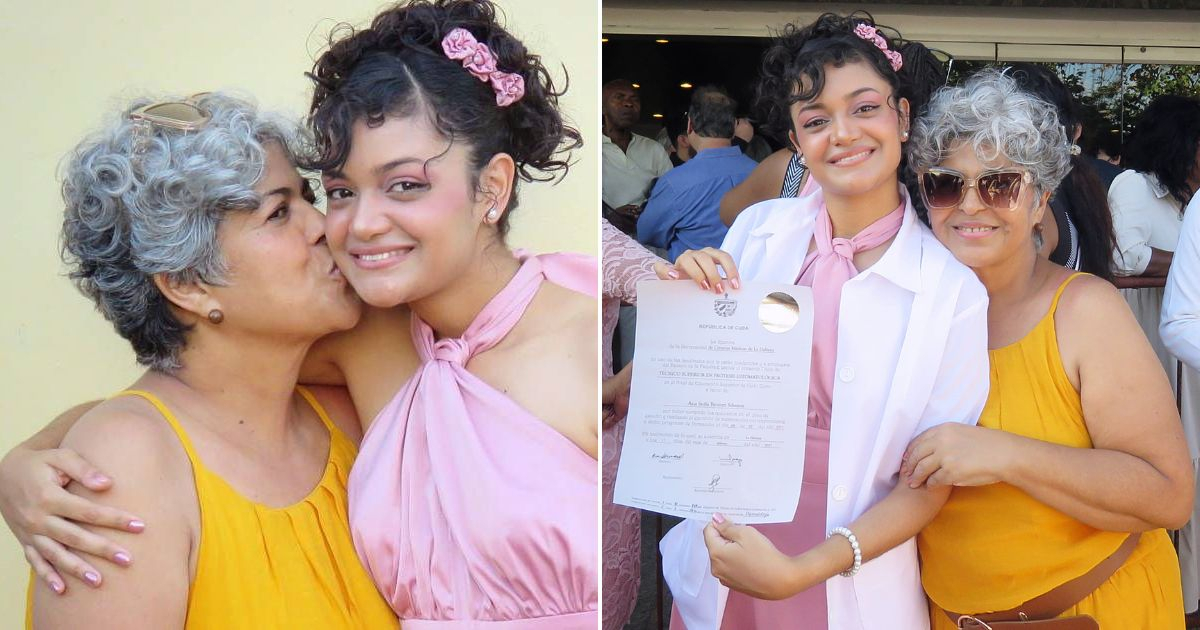
The human rights organization Cubalex published today a legal analysis regarding recording the police, concluding that it "is not a crime, it is a citizens' right," in direct response to the criminal proceedings initiated against influencer Anna Sofía Benítez Silvente, known as Anna Bensi, and her mother, Caridad Silvente Laffita.
Both were placed yesterday under house arrest with a ban on leaving the country and restrictions on interprovincial movement, after being charged with the alleged crime of "acts against personal and family privacy, one's own image and voice, another person's identity and their data," as defined in Article 393 of the Cuban Penal Code (Law 151/2022), which provides for penalties of two to five years in prison.
The case originated on March 10, when Caridad Silvente filmed two men in civilian clothing who came to her home to deliver a police summons with obvious irregularities: the document referred to a "Captain Alberto" without a last name, the signature belonged to a "Captain Rafael," and the reason section was left blank.
Her daughter posted the video on social media, where journalist José Raúl Gallego identified the sub-officer Yoel Leodán Rabaza Ramos, badge number 179542, who is now claiming to feel "threatened" after the revelation of his identity.
Subsequently, Caridad Silvente was interrogated for two hours by State Security agents at the police unit in Alamar, Havana, where she was threatened with five years in prison, accused of being a "bad mother," and her daughter was labeled as a "counter-revolutionary" who takes orders from the United States.
Regarding that episode, Caridad Silvente emerged from the interrogation with threats of imprisonment and under precautionary measures.
Anna Bensi was formally charged last Tuesday at unit 27 of the PNR in Alamar, where she was also subjected to a body search without the presence of her lawyer.
"They checked my hair, they had to take off my hairstyle, my blouse, my pants, they touched my shoes to see if I had anything," the young woman recounted.
Regarding this case, Cubalex dismantles the regime's arguments based on the Cuban legal framework itself.
The organization recalled that Article 101 of the 2019 Constitution requires state bodies to act transparently and submit to public oversight, and that Article 326 of the 2021 Criminal Procedure Law permits recordings made by private individuals as valid evidence.
It is important to add that the right to privacy protects family life and the home, not a public official acting in a public space, and that the Inter-American Court of Human Rights has established that public officials are subject to greater social scrutiny.
Defense attorney Roberto Ortega Ortiz also submitted a document to the Prosecutor's Office that could invalidate the entire procedure: Article 394.1 of the same Penal Code requires a direct complaint from the offended party to pursue this type of crime, not a police report.
Cubalex classifies house arrest as a "violation of the principle of legality" and "psychological torture and social control," and concludes that the process "seeks to silence the citizenry."
The case transcended borders and was picked up by the international press, including the Spanish newspaper El Mundo.
Similarly, the United States Embassy in Havana also publicly questioned the actions of the regime and warned that officials involved in abuses could be included in the "QuitaVisas" policy.
Anna Bensi, for her part, would not back down: "I know you are looking for a justified way to come at me. I'm not afraid of you, you don't intimidate me, and I'm not going to be silenced because I am simply exercising my right to express myself."
Filed under: