
Related videos:
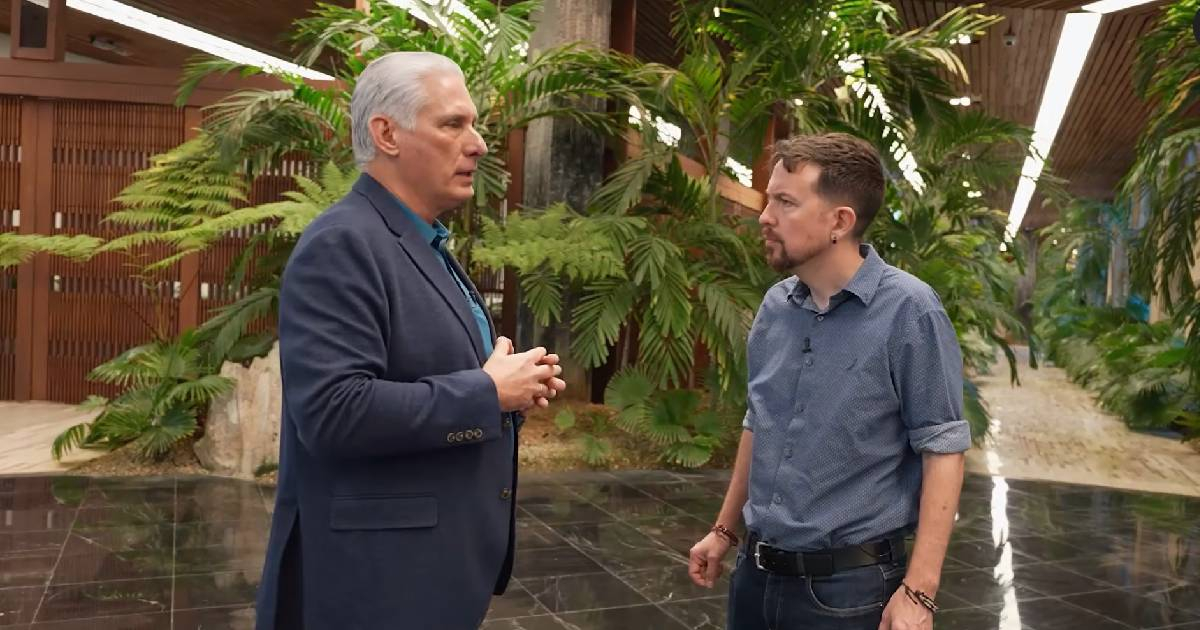
Miguel Díaz-Canel confirmed that Raúl Castro is leading the dialogue process that the Cuban regime is maintaining with the administration of Donald Trump, in exclusive statements to former Spanish Vice President Pablo Iglesias.
"People have tried to speculate that there are divisions within the leadership of the revolution. There we explained that under the leadership of the Army General, who has earned his position in this country, he is the historical leader of the revolution, even though he has stepped back from his responsibilities. However, the prestige he holds before the people, history, and his contributions cannot be denied," he affirmed in an interview at the Palace of the Revolution.
He added that "under that guidance, under that direction, which is a collegiate direction led by him and is in collaboration with the rest, our officials held recent conversations with officials from the Department of State."
"There are people who possess leadership not because of their positions but because of their history and experiences. He is one of those who has led alongside me and collaborated with other instances of the party, the government, and the State on how we should guide this dialogue process, should the dialogue process take place," affirmed Díaz-Canel about the role of the former leader who is 94 years old.
In response to the question of what the U.S. was asking for in those discussions, Díaz-Canel stated that "that moment has not yet arrived"; however, he mentioned that topics on the table include investments, how the U.S. can participate in the Cuban economy, and immigration issues, among others.
Díaz-Canel himself described the process as long and in its initial stages: "It is a long process, we are in the initial phases of that process."
Regarding his relationship with Raúl Castro in this context, he noted: "We talk frequently, I keep him updated, he is attentive."
The regime stated its willingness to address investments, migration, the fight against drug trafficking, and terrorism, but Díaz-Canel drew a red line: any conditions that affect sovereignty, independence, or the Cuban political system would be unacceptable, he pointed out.
On March 10, the regime formally denied the existence of negotiations with the White House. On March 13, it confirmed them.
The context that explains this acceleration is an unprecedented economic crisis: the capture of Nicolás Maduro on January 3 interrupted the supply of Venezuelan oil, which Cuba critically depends on, and on January 29, Trump signed Executive Order 14380 imposing tariffs on countries that supply crude oil to the island.
The Cuban electrical grid collapsed in recent weeks, leaving ten million people without electricity.
The Cuban-American Republican congressman Mario Díaz-Balart confirmed that the U.S. is having discussions with multiple individuals close to Raúl Castro, "at the highest level, but they are not negotiations," comparing the contacts to those maintained with Maduro's circle prior to his capture.
The New York Times, citing four sources, reported that Washington explicitly demands the departure of Díaz-Canel as a condition for progress. This Wednesday, the AP agency informed that a member of the Castro family could be the successor to Díaz-Canel in the context of a possible transition.
Filed under: