
Related videos:
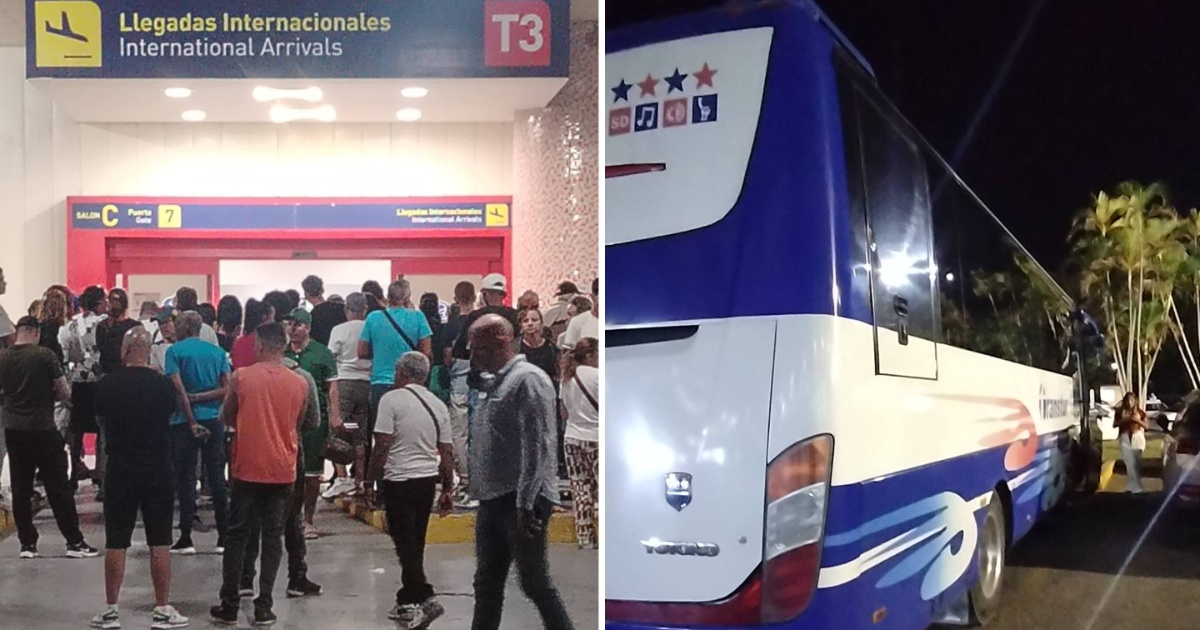
While public transportation in Cuba is experiencing one of its worst collapses in decades, with routes suspended, trains operating at a minimum, and an extreme fuel shortage that has paralyzed much of the country, at the José Martí International Airport in Havana, there is at least one transport option for travelers arriving from abroad.
According to a testimony shared on Facebook, a bus charges five dollars to take passengers to central areas of the capital.
The existence of this service, however, has not been presented as a stable solution nor widely communicated, and it has generated controversy among users who claim that it is not always available or only works on a specific terminal.
The implicit accusation in that contrast highlights a growing inequality on the island: there is not enough transportation for the population that commutes daily for work, studies, or necessity, yet relatively organized options emerge for those who arrive in Havana with foreign currency in their pockets.
That perception gained strength following the post by internet user Rick Reyna, who recounted that upon arriving from Monterrey on a Vivaaerobús flight at 8:30 in the evening, he found “on the right hand side,” a bus parked in front of door 7.
According to his testimony, he paid five dollars and the vehicle dropped him off at Parque Central in 42 minutes, while other passengers continued on to Habana Libre.
From there, he added, he took a bike taxi for 500 Cuban pesos, approximately one dollar, so the entire journey to his destination cost him six dollars. He also stated that private taxi drivers were charging between 50 and 70 dollars.
But the very exchange on social media dismantles the idea that this service solves the problem or is guaranteed for anyone arriving at the airport.
Among the comments from internet users, several contradict this view and assert that the bus "is not always available" and that there is also not enough information available within the airport or in official offices to guide passengers.
One of them summarizes the situation like this: "for those who need it, it's a mystery." Another specifies that this option would be available in Terminal 3, but not in Terminal 2.
And a third person openly rejects the image of normality, stating that “it is extremely difficult to find transportation” and that, if one manages to do so, it is “excessively expensive.”
That episode becomes particularly significant when placed against the broader backdrop of transportation in Cuba.
The Minister of Transport, Eduardo Rodríguez Dávila, acknowledged in the official program Mesa Redonda the severe deterioration of the sector, though he attributed much of the crisis to the so-called "energy blockade" by the United States.
However, even in that official explanation, internal structural problems were revealed: low technical availability, lack of lubricants, deteriorated infrastructure, and a system unable to maintain basic services.
The practical result, according to the document, has been a drastic reduction of services across the country.
Rodríguez Dávila specified that the national buses operate with only one departure daily, the trains run just once every eight days, and the ferry to Isla de la Juventud has been reduced to two trips per week.
Many other transportation services were directly suspended. At the local level, authorities have attempted to alleviate the collapse with improvised measures, such as the use of "medibuses" to transport more than 70,000 passengers, the reorganization of electric tricycles, and the involvement of private operators.
Some essential services have also been prioritized, including the transportation of more than 12,800 students from special schools and about 2,900 dialysis patients.
The government has accompanied that acknowledgment of the disaster with new promises.
Among the projections for 2026, the minister announced the assembly of 50 microbuses and 50 hearses, the distribution of 150 electric tricycles for municipalities, the arrival of the first urban electric buses with charging stations powered by renewable energy, 400 electric cars for dialysis services, and the installation of charging stations with solar panels along the national highway and other high-demand areas.
But those promises stand in contrast to a reality marked by years of deterioration without visible structural solutions.
The crisis is not recent
Beyond the official discourse, the collapse of transportation is not a recent phenomenon and cannot be explained solely by external factors.
For decades, the lack of maintenance, the obsolescence of the vehicle fleet, the scarcity of spare parts, and poor planning have progressively weakened the system, bringing it to its current state.
The data is compelling: state passenger transport in Cuba plummeted by 93% between January and September 2025, a decline that illustrates the scale of the collapse.
In practice, this means that traveling within the country has turned into a daily odyssey. In many cities, services have nearly disappeared entirely.
In Havana, there were recent moments when all urban routes were suspended due to a lack of fuel.
In Ciego de Ávila, out of 135 bus routes, only two are operational, while trains have been completely halted due to a lack of diesel.
At the national level, cancellations also affect interprovincial travel: in Las Tunas, virtually all bus departures were suspended, leaving only a night service to Havana.
The consequences for the population are severe. Waiting for several hours has become common, and in many cases, it’s not even possible to find transportation, even if you pay.
The increase in ticket prices, which can multiply in just a few days, has made mobility an unattainable luxury for many Cubans.
In the absence of real solutions, many people end up walking long distances, using bicycles, or relying on an informal market where prices can take up a huge portion of their monthly salary.
Filed under: