
Related videos:
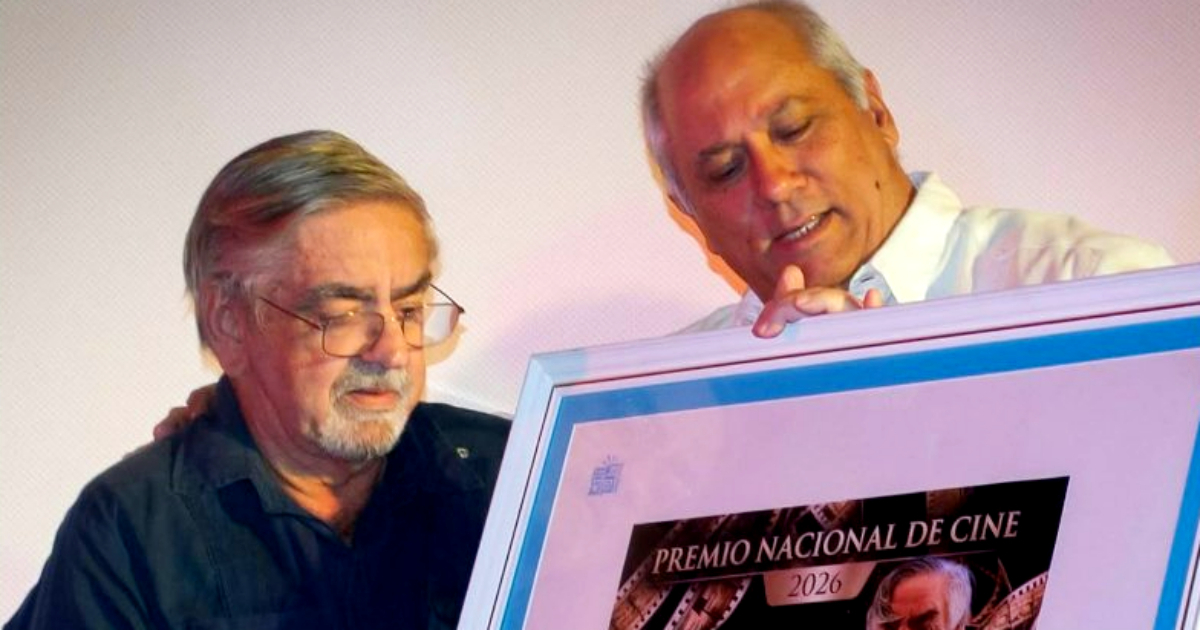
The Cuban Institute of Cinematographic Art and Industry (ICAIC) awarded the National Film Prize 2026 to the critic, historian, and cultural manager Luciano Castillo.
On the occasion, homage was also paid to the centenary of the filmmaker Julio García Espinosa and it included the restored screening of the classic “Aventuras de Juan Quin Quin.”
Castillo (Camagüey, 1955) has developed a long career within the cultural institutions of the Cuban state, establishing himself as one of the most recognized figures in the preservation and promotion of national cinema.
He currently directs the Cinemateca de Cuba, an entity affiliated with ICAIC, from where he has promoted efforts in archiving, restoration, and film programming.
The award, presented by the minister of culture of the Cuban regime, Alpidio Alonso Grau and the president of ICAIC, Alexis Triana, recognizes a career that began in the film club movement in the 1980s and 1990s, particularly with the founding of the "Glauber Rocha" film club in Camagüey.
Later, Castillo held responsibilities at the International School of Film and Television (EICTV), where he directed the "André Bazin" media center and participated in audiovisual dissemination spaces in official media.
More than a critic in the traditional sense, his profile has been defined by historiographical work and cultural mediation, focused on the memory of Cuban cinema.
His work has contributed to systematizing key stages, authors, and processes of national cinematography, especially following the emergence of ICAIC after 1959.
The award ceremony takes place in a complex context for Cuban audiovisual, marked by debates over censorship, independent production, and institutional reforms.
However, Castillo has maintained a low public profile, avoiding controversies and not taking visible positions in the sector's main conflicts.
In recent years, the Cuban audiovisual sector has been marked by increasing tensions, highlighted by the Assembly of Cuban Filmmakers (ACC), a space that has brought attention to structural issues such as censorship, the lack of a legal framework for independent production, and exclusionary practices within institutions.
These demands have highlighted the rift between a segment of the industry that seeks greater creative autonomy and a state cultural apparatus that maintains mechanisms of control over film production and exhibition.
During the event, the ICAIC highlighted Castillo's "ongoing work in the preservation of film heritage" and his contribution to audience development.
The recognition reaffirms his role as a key figure in the continuity of the cultural model associated with the ICAIC, focused on historical preservation and the legitimization of the cinematic legacy of the so-called "revolution."
Filed under: