
Related videos:
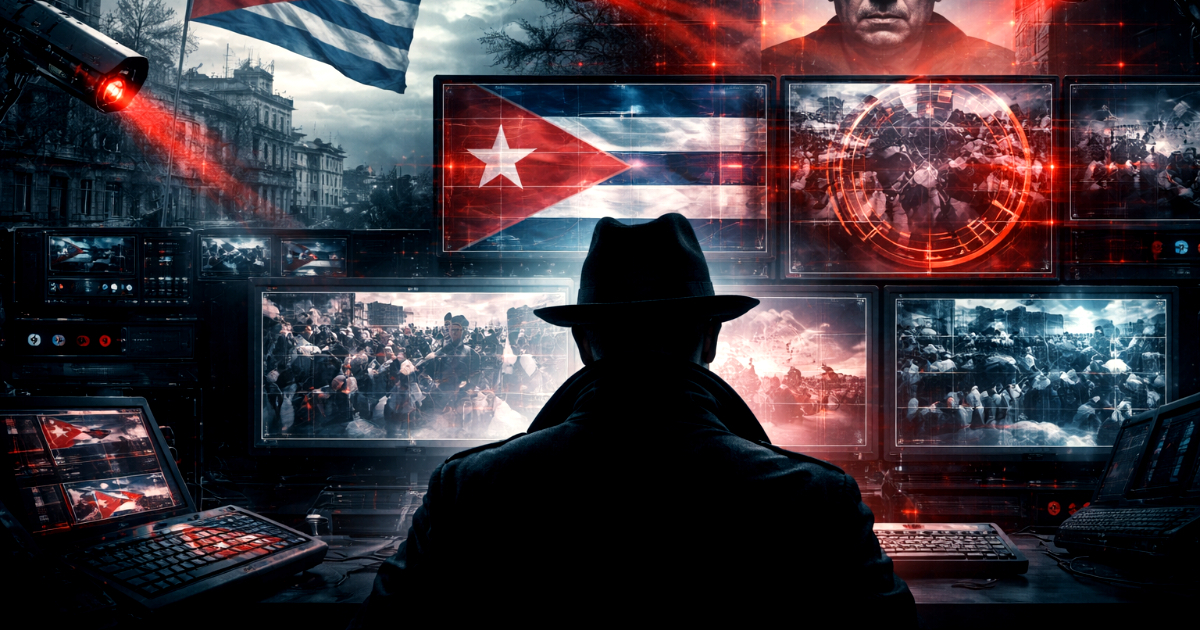
The latest article from Granma, authored by Raúl Antonio Capote, aims to portray Cuba as a victim of a sophisticated international media manipulation operation.
However, upon examining its arguments and silences, a deep contradiction emerges: the very apparatus that denounces the “cognitive war” has, for decades, been one of its main executors within the island.
The text by Capote relies on legitimate concepts from communication theory —framing, agenda setting, gaslighting— to construct a narrative in which Cuba emerges as the target of an external symbolic offensive.
In abstract terms, none of this is false: the media influences, selects topics, and frames reality. The problem lies elsewhere. The problem is who is speaking, from where they are speaking, and, above all, what they choose not to disclose.
Because if there is a system that has rigorously applied these techniques for over six decades, it is precisely the Cuban media model.
In the island, there is no free press or informational plurality. All national media outlets answer to the Communist Party, which determines what is published, what is omitted, and how each event is interpreted.
That is, essentially, agenda setting: deciding what is talked about and what is not. And in Cuba, for example, little—if anything—is said about spontaneous protests, the growing social unrest, or the daily despair caused by blackouts, shortages, and economic decline.
The article from Granma claims that the digital campaigns “did not achieve real mobilization.” However, it omits an uncomfortable fact: the protests have not disappeared; they have transformed.
They are more fragmented, more local, less visible in the official narrative, but they persist. Neighbors who spend hours in the street without electricity, banging pots, public protests. They do not fit into the narrative of “chaos induced from the outside,” and that is why they become invisible.
That is also framing: not directly denying reality, but framing it in a way that it loses political significance.
Moreover, the text accuses external actors of trying to "sow doubts" among the population. But one must ask: who has historically cultivated distrust in Cuba? Who has built a discourse for decades that contradicts the daily experiences of citizens?
When a person experiences scarcity, inflation, and deterioration, and at the same time hears about "creative resistance" and "progress," the dissonance is not caused by a foreign campaign, but rather by the gap between official discourse and reality.
That is the true domain of gaslighting: making citizens doubt their own experiences. And in this area, the Cuban propaganda machine has a long history.
This is compounded by an element that cannot be overlooked: the figure of the author himself. Raúl Capote is not an independent analyst but a former agent of State Security linked to operations against journalists and opponents.
His voice is not that of a neutral observer, but rather that of someone trained within a structure specifically designed to control narratives and neutralize dissent. This does not automatically invalidate his arguments, but it does require us to read them for what they are: pieces of a political discourse, not an impartial academic analysis.
The article emphasizes that there is a gap between the "media agenda" and "material reality," and presents this gap as evidence of the failure of the alleged external campaigns.
However, that same gap can be interpreted in the opposite way: as evidence that the official narrative no longer manages to contain or explain what people are experiencing.
Today, the Cuban regime does not control the narrative as it used to. Social media, connectivity —although limited— and the diaspora have broken the information monopoly.
Reality circulates through alternative channels, and the official discourse competes, increasingly less effectively, with direct testimonies and shared experiences.
In this context, Capote's argument reveals something deeper: a self-interested redefinition of what qualifies as “evidence.”
If there is no massive, coordinated, and national uprising, then —according to this logic— there is no significant discontent. Everything else is minimized, fragmented, or ignored.
But that standard is deceptive. It sets an almost impossible threshold: only a total social outbreak would be valid proof of rejection. Everything else is disqualified from the outset.
And here the uncomfortable question arises.
If local protests are disregarded, if everyday discontent is undervalued, and if the crisis is solely attributed to external factors, what kind of response does the regime expect in order to acknowledge that it has lost the trust of a significant portion of the population? A social outbreak?
And if that outbreak occurs, recent history offers little doubt about the response. It would not be dialogue or openness, but repression, criminalization, and control. It has happened before.
For this reason, rather than describing an alleged external "cognitive war," the article from Granma seems to reveal something else: the fear of a reality that can no longer be completely shaped from above.
At a time when the United States openly expresses its willingness to promote political change on the island, the insistence on denying internal discontent becomes even more problematic. Because it ignores an essential factor: no sustainable transformation can be built on the denial of social reality.
The final question is not whether there is external influence in the narrative about Cuba. The question is more basic and more urgent:
Is the regime willing to listen to gradual signs of discontent, or will it only acknowledge the problem when it manifests as a social explosion? And is that, in fact, the scenario it is helping to provoke?
Filed under:
Opinion article: Las declaraciones y opiniones expresadas en este artículo son de exclusiva responsabilidad de su autor y no representan necesariamente el punto de vista de CiberCuba.