
Related videos:
Sandro Castro is not an accident. Nor is he a stranger who one day decided to showcase himself on social media. He has lineage, context, and a position within contemporary Cuba.
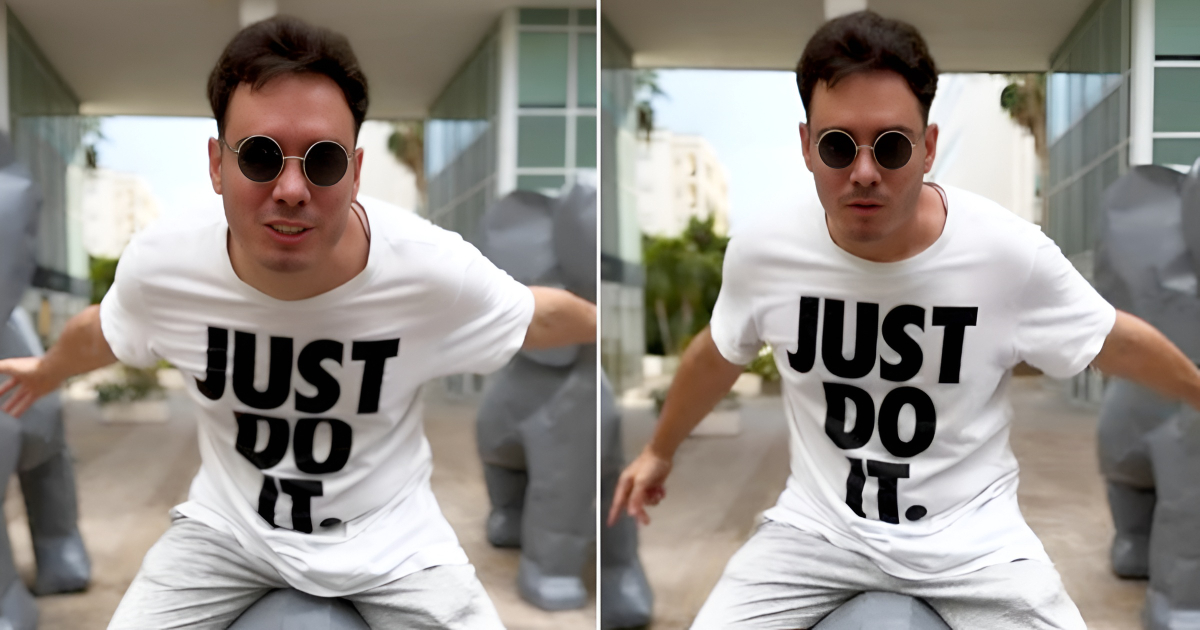
The "businessman," fashion influencer, "king of the night" or "prince of darkness" is the son of Alexis Castro Soto del Valle, one of the descendants of the dictator Fidel Castro, and grew up in the sheltered environment of an elite that preached austerity for decades while living outside of it.
He holds no public office and has no visible political responsibilities. His place is elsewhere: that of the heir without accountability, turned into a character thanks to his antics on Instagram.
But Sandro Castro cannot be understood solely by what he has done and is doing. He is explained, above all, by how he has been portrayed. The chronology is clear.
Before stepping into the media, Sandro Castro was already making appearances on social media. In May 2019, there was an initial trace attributed to the independent journalist Mario Vallejo, later cited by several outlets, although today it is not always easy to verify that original post firsthand.
On September 21 of that year, firmly grounded in documentary evidence, Diario de Cuba published the first verifiable article in an independent medium: the video where he fills his car's tank and says "thank God" amid a fuel crisis. There was already the core of the character: privilege, disconnection, and a display that is as natural as it is provocative.
CiberCuba comes weeks later, on November 2, 2019, with a seemingly minor note: Sandro dressed as Batman for Halloween. But that move is significant. The character ceases to be merely an anomaly associated with the Castro surname and begins to be treated as content.
The turning point arrives on February 27, 2021. The video of the Mercedes-Benz —the "little toy"— definitively establishes his public image. From that moment on, Sandro stops relying on a specific event and instead becomes a recurring narrative. It’s not just what he does, but what he represents every time he appears.
And that’s where the true process begins.
In the following years, the coverage by independent Cuban media —with CiberCuba leading in volume and continuity— turns every gesture into another piece of a story in the making: parties, videos, quotes, displays, exhibitions.
There is not a significant event behind every headline. What there is, is repetition. But that repetition is not neutral. It selects, amplifies, and frames.
Sandro is repeatedly established as a symbol of privilege amidst the crisis, as an expression of an elite disconnected from the real country, and as a constant mockery or provocation to the average Cuban.
In parallel, other media outlets like Diario de Cuba are beginning to introduce a more structural reading: it’s no longer just about what Sandro does, but rather what his existence means within the system.
Thus, almost imperceptibly, the character changes in nature. They transition from an individual to a category. By the time the international profiles arrive, the work is already done.
El País presents him as a grandchild influencer who embodies the contradictions of late Castroism. New York Times includes him as a symbol of a Cuba where privilege coexists with scarcity. CNN goes a step further and places him in front of the camera, allowing him to discuss politics, the economy, and the country.
But that leap does not create the phenomenon. It confirms it.
Sandro Castro does not become relevant because he is covered by the international press; the international press covers him because he has been shaped into a recognizable figure within the Cuban independent media ecosystem for years.
And it is at this point that the inevitable question arises: what exactly is Sandro Castro?
An outsider mocking the system from within? Or a figure serving the interests of the regime and its elites, tolerated or promoted because they channel frustration without jeopardizing power?
The first hypothesis presents him as an uncontrollable heir, a failed product of the revolutionary narrative who openly displays the contradictions of the country.
The second positions him as a useful anomaly and an instrument of State Security: someone who distracts, who turns criticism into spectacle, and who operates with an impunity unattainable for any ordinary citizen.
Probably it is not completely either of those things. But it doesn't need to be. Because, from a media perspective, the result is the same. Sandro Castro works.
It serves as a symbol of inequality. It functions as content. It operates as a narrative shortcut to explain a complex reality in a single image: a surname, a body, a camera, and a country behind it.
And in that operation, there is a shared responsibility.
For years, the independent Cuban press did the right thing by exposing the contradiction represented by Sandro Castro.
But in that process, he also did something else: he turned it into a stable, recognizable, and exportable character. He followed it, amplified it, and endowed it with a symbolic weight that today far exceeds its actual actions.
It's not that the media invented Sandro. It's that they have established him. They have turned him into a figure who no longer needs to do anything extraordinary to remain relevant news.
In a country facing deep crises—economic, social, political—this shift is not insignificant. Because the more space a figure like Sandro Castro occupies, the less room there is for other stories that better explain what is happening in Cuba.
That's why the problem isn't Sandro. The problem is the proportion.
Sandro Castro is not the history of Cuba. It is merely an amplified distortion of that history. However, in a media ecosystem where repetition constructs reality, that distortion has ended up carrying an excessive weight.
First it was a curiosity. Then, a symbol. Now it is an exportable product. And the world consumes it as if it were Cuba.
In a dictatorship where millions of Cubans grapple with hunger, poverty, forced emigration, lack of rights, and daily suffocation, it is hard to ignore the disproportion.
While reality fragments into stories of blackouts, repression, and exodus, a character like Sandro Castro occupies a constant, reiterated, almost inevitable media space. It is not just what he shows, but what he displaces: other voices, other conflicts, other urgencies.
And this shift occurs at a particularly sensitive moment. With the increasing pressure from the United States on the regime and the lack of transparency surrounding discussions of a possible transition, an uncomfortable question begins to emerge: who will the interlocutors of that uncertain future be?
In that context, the sustained emergence of figures with the surname Castro —but with a seemingly more discreet or "normalized" profile— is no longer a minor detail. The coverage by El País, The New York Times, or CNN serves as clear indicators in this regard.
Sandro Castro, with his blend of frivolity, constant exposure, and ambiguous discourse, ultimately fits into that blind spot: he does not represent a break, but neither does he reproduce the classic language of power.
It is, in any case, a softened, de-ideologized, almost banal version of the most macabre surname in recent Cuban history. This is where the phenomenon takes on another dimension.
Because beyond what Sandro does or says, his repeated presence in the media space may be contributing —consciously or unconsciously— to something deeper: the symbolic erosion of the Castro surname and its possible reintroduction in a changing scenario through "cleaner," less confrontational, more assimilable forms for "capital," and possibly even more exportable.
And then the question moves from being part of a media reflection to becoming a political concern. It is no longer just about why there is so much talk about Sandro Castro, but rather for what purpose.
Cuba is facing the most important crossroads in its history, and we Cubans must see our struggle reflected in independent and international media through the ramblings of the last of the Castros.
Filed under:
Opinion article: Las declaraciones y opiniones expresadas en este artículo son de exclusiva responsabilidad de su autor y no representan necesariamente el punto de vista de CiberCuba.