
Related videos:
The rescue of the second crew member of the F-15E fighter shot down in Iran was not only a high-risk military operation in enemy territory, but also a mission with millions of dollars in aircraft costs, including the destruction of extremely valuable special operations planes.
The American military remained hidden for over 36 hours in a mountainous area of southwestern Iran, actively evading Iranian forces that were searching for him with the support of the Revolutionary Guard and mobilized civilians. During that time, he used his survival training, activated an emergency beacon, and constantly changed his position to avoid capture.
Meanwhile, the United States military monitored their location in real time and planned a combat search and rescue operation (CSAR) under extremely hostile conditions. The mission involved the deployment of dozens of aircraft and special forces, with air coverage, direct confrontations, and extraction in the combat zone.
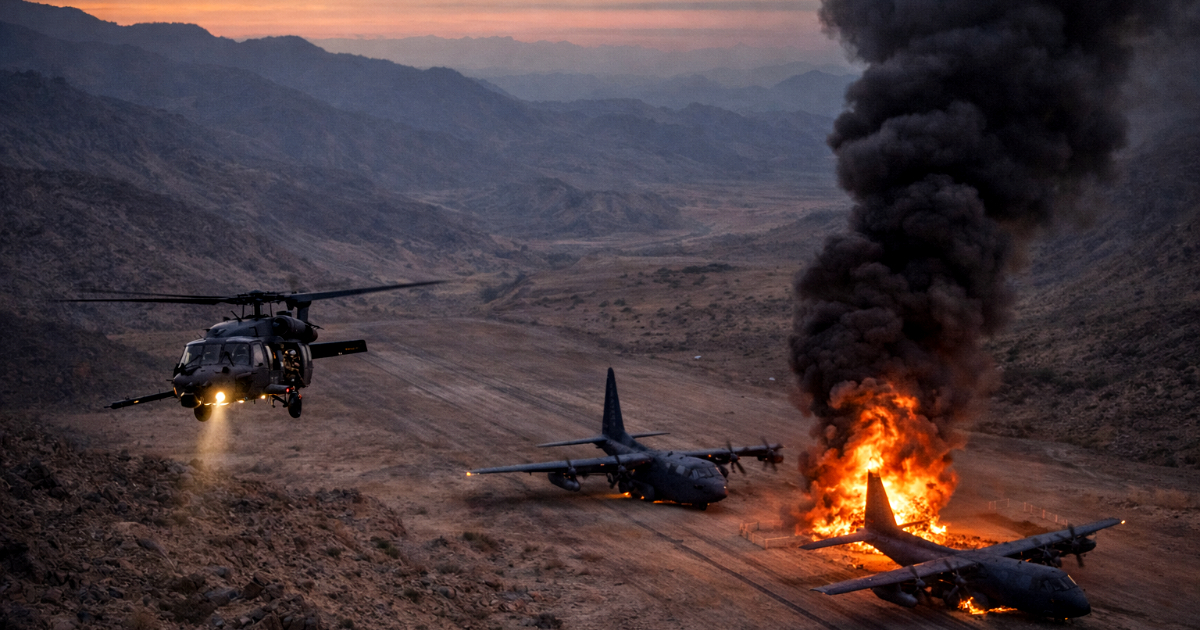
According to reports from media outlets such as The Wall Street Journal, The Guardian, and The Times, the operation involved HH-60 rescue helicopters, A-10 Thunderbolt II close air support aircraft, and C-130 and MC-130 aircraft for command, refueling, and special operations.
President Donald Trump described the mission as “one of the boldest in the history of the United States military.”
However, beyond the success of the rescue, several indications suggest that the operation was far from clean. Specialized media confirmed that at least two helicopters were damaged by Iranian fire, while an A-10 was hit during parallel operations, forcing its pilot to eject.
The most significant piece of information, according to reports published by The Wall Street Journal and other international media, is the deliberate destruction of at least two MC-130J Commando II aircraft by the United States.
These special operations aircraft, valued between 90 and 110 million dollars each, would have been immobilized or compromised on the ground within Iran, which forced their self-destruction to prevent them from falling into enemy hands.
This is in addition to the loss of the own F-15E that was shot down, with an estimated cost of between 30 and 35 million dollars, as well as the damages to other aircraft involved in the operation. Altogether, and according to estimates based on standard Pentagon costs, the rescue could have resulted in material losses exceeding 200 million dollars, depending on the actual extent of the damages.
Despite this, the White House has insisted on presenting the mission as a total success, highlighting that both crew members were rescued alive. However, the discrepancies between the official version and independent reports suggest that the operation was conducted under much greater pressure than has been publicly acknowledged.
The episode highlights both the operational capacity of the U.S. military and the growing risks of a conflict that continues to escalate in intensity, complexity, and cost.
Filed under: