
Related videos:
The Cuban leader Miguel Díaz-Canel stated that he is not afraid for his personal safety amid the escalating tensions with the United States, a declaration that sounds more like a rhetorical challenge than a realistic assessment of the situation facing his own regime.
The statement, made in front of Newsweek, comes in a context where Washington has recently demonstrated its capacity for direct intervention. "I am not concerned about my personal safety. The leadership of the revolution is collective,” asserted the first secretary of the Communist Party as well.
The operations in Venezuela and Iran not only demonstrate military superiority but also the ability to carry out swift actions against the core of rival governments' power.
The Venezuelan situation is particularly uncomfortable for Havana. The capture of Nicolás Maduro in January 2026 revealed the weaknesses of a protection system that seemed strong on paper.
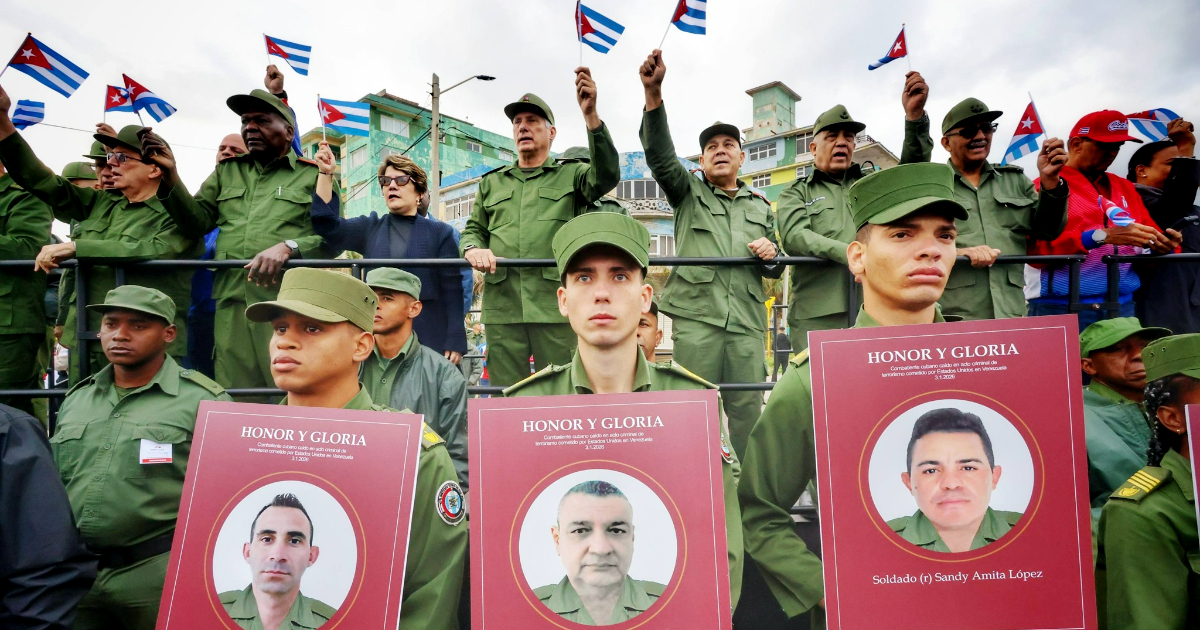
His security ring—structured in several layers with the presence of Cuban personnel—collapsed within hours under a high-precision operation, despite recent claims by the ruler asserting that they "contained" the Delta Force of the United States.
Dozens of escort members died —32 according to official figures— including Cuban personnel involved in the most sensitive levels of protection.
The lesson was clear: neither experience in internal control nor security schemes designed for domestic threats can withstand a high-level technological intervention.
In Cuba, the protection of Díaz-Canel falls under the Personal Security Directorate (DSP), a unit of the Ministry of the Interior (MININT) responsible for physically safeguarding the elite in power.
It is a highly specialized, discreet body selected for political loyalty, integrated into a larger system where State Security controls intelligence and risk prevention.
There are no official figures regarding its size or budget, but analysts agree that it is a small structure—consisting of hundreds or a few thousand personnel—designed to protect leaders, not to confront foreign military operations.
In this context, Díaz-Canel's assertion about the supposed "collective" leadership of the Cuban political system also generates skepticism.
Although power is formally presented as shared, in practice, it continues to gravitate around the historical core of the regime, heavily influenced by Raúl Castro's surroundings and military structures.
That reality introduces a key element: Díaz-Canel's role is not necessarily irreplaceable within the system. In a scenario of extreme pressure or negotiation, his continuation could depend on decisions made by that core of power, rather than his own will.
Thus, while the Cuban leader tries to project strength before the United States, recent precedents in the region and the nature of the very system he heads suggest a much more uncertain landscape.
Your personal safety, far from being guaranteed, depends on factors that have proven to be fragile in the face of large-scale intervention.
Filed under: