
Related videos:
The Orion capsule of the Artemis II mission left the gravitational influence of the Moon on Tuesday and is now on a definitive course for Earth, where its four crew members are scheduled to splash down in the Pacific Ocean on Friday.
The control center of NASA confirmed the milestone during the official broadcast: "Orion has left the lunar sphere of influence; that is, the point at which the Moon's gravitational pull is strongest."
This moment marks the instant when the capsule transitions from being dominated by lunar gravity to being primarily attracted by Earth, with the expected splashdown on Friday at 8:07 PM Eastern Time in front of the coast of San Diego, California.
On board are Commander Reid Wiseman, Pilot Victor Glover, and Specialist Christina Koch, all from NASA, along with Specialist Jeremy Hansen from the Canadian Space Agency.
The mission has achieved a series of historic milestones since it launched last Wednesday from Cape Canaveral, Florida, for a ten-day journey that marks the return of humans to lunar orbit after more than half a century.
On Monday, the Orion spacecraft became the first crewed mission to orbit the Moon since Apollo 17 in December 1972, ending over 53 years without human presence in lunar orbit.
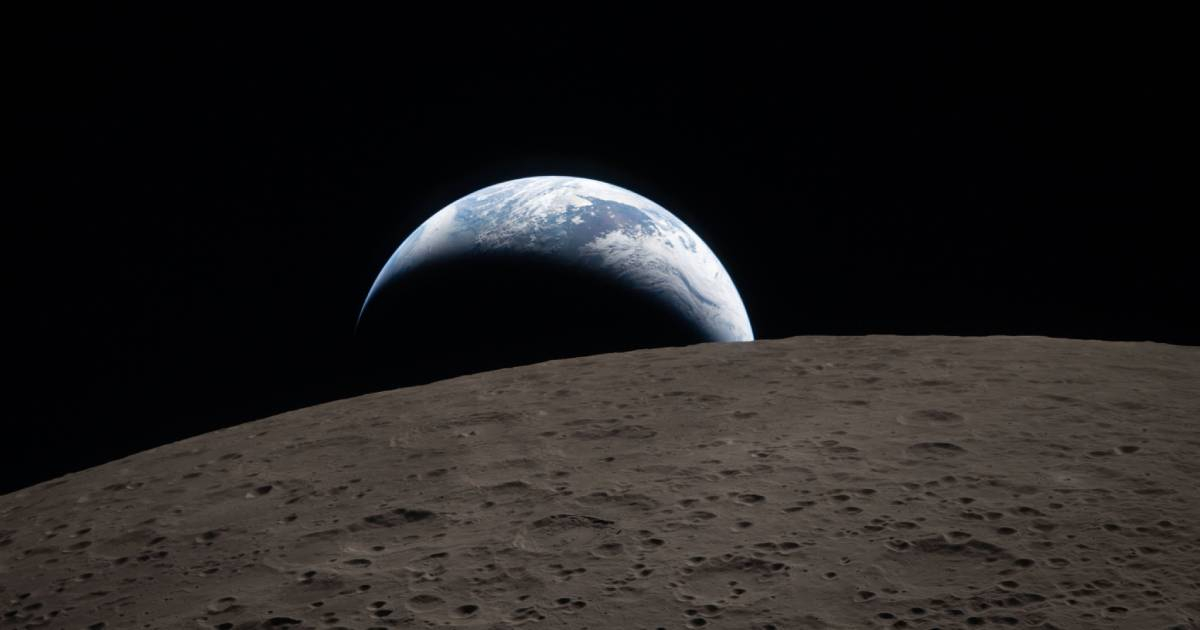
Although the four astronauts did not descend to the surface, they flew over the satellite for seven hours, taking photographs and describing what they saw to NASA experts in Houston, Texas.
At its closest point, the spacecraft came within 6,545 kilometers of the lunar surface and spent 40 minutes without communication with Earth while crossing the far side of the satellite.
After reestablishing contact, the specialist Christina Koch said, "It's wonderful to hear Earth again."
The mission also set the record for the farthest distance reached by humans from Earth, at 406,771 kilometers, surpassing the mark held by Apollo 13 since April 15, 1970, an achievement officially recognized by Guinness World Records.
From lunar orbit, the crew also observed a total solar eclipse that lasted between 50 and 60 minutes, about seven times longer than from Earth, during which they documented six flashes caused by meteoroids impacting the lunar surface.
After leaving the lunar influence, the crew held a video conference with NASA astronauts Jessica Meir, Jack Hathaway, and Chris Williams, and Sophie Adenot from the European Space Agency, who are aboard the International Space Station.
Artemis II is the second mission of the Artemis program, following the uncrewed flight in 2022, and precedes the upcoming stages of the program: the first crewed lunar landing since 1972 is planned for Artemis IV in 2028, with the long-term goal of establishing a permanent presence on the Moon and laying the groundwork for Mars exploration.
Filed under: