
Related videos:
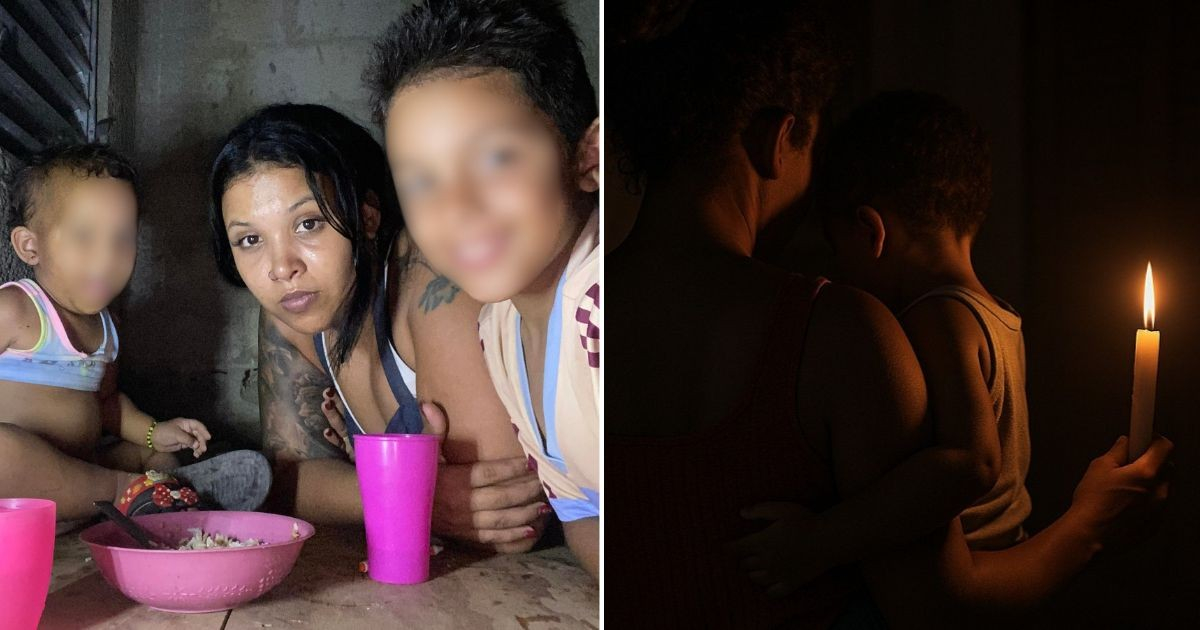
A Cuban mother identified as Evelyn Perera posted on social media an image and a testimony that encapsulates in a few lines the drama that millions of families in Cuba are experiencing: she and her two children —a baby about one or two years old and a child around eight to ten years old— having dinner by the light of a lantern, with food cooked over charcoal.
"Look at us closely. This is not a scene from another time; it is the reality of today: my children and I under the glow of a flashlight, trying to make a dinner in the dark seem 'normal' when it is a disrespect to their childhood," Perera wrote in his post.
The scene, far from being exceptional, reflects a routine that has established itself in Cuban households after years of energy collapse.
"It has become customary for us to cook with charcoal and eat in the shadows, as if life itself is slowly fading away," the mother added, describing the situation as "outrageous" and lamenting that her children learn "to recognize the smell of charcoal before they experience the relief of a well-lit home."
The testimony of Evelyn Perera comes in the context of an unprecedented energy collapse.
The National Electroenergetic System of Cuba completely collapsed on March 16, the sixth total blackout in just 18 months, leaving the entire island without electricity, as noted by the Spanish newspaper El País.
Weeks earlier, a failure at the Antonio Guiteras power plant had left nearly seven million people without electricity in ten of the 15 provinces of the country, including Havana, the cited media outlet emphasized.
In many provinces, outages exceed twenty hours per day. In places like Consolación del Sur and Marianao, more than thirty consecutive hours without electricity have been recorded.
On December 8, 2025, 62% of the national territory was left without electricity service, with a maximum impact of 2,084 megawatts.
The causes are structural: thermoelectric plants over forty years old, a lack of diesel and fuel oil, and the definitive cutoff of Venezuelan oil supply starting in January 2026, when the last tanker from that country arrived.
Since then, Cuba has been unable to replenish that fuel.
Due to the lack of electricity and extreme rationing of liquefied gas—many households can only purchase one cylinder per year—cooking with charcoal has become the only alternative for millions of families. A bag of charcoal costs 1,500 Cuban pesos.
The impact on children is one of the most documented aspects by Cuban civil society on social media. Mothers have reported that their children attended exams without having slept a whole night due to the lack of electricity.
Specialists warn that prolonged blackouts cause anxiety, irritability, insomnia, and a forced maturation in children, in a context that several testimonies compare to—and in some respects exceed—the Special Period of the 1990s.
"My heart aches to see them like this, growing up in shadows and inheriting a scarcity that they did not seek," concluded Evelyn Perera her post, with a phrase that summarizes what the Cuban dictatorship has normalized for an entire generation of children.
Filed under: