
Related videos:
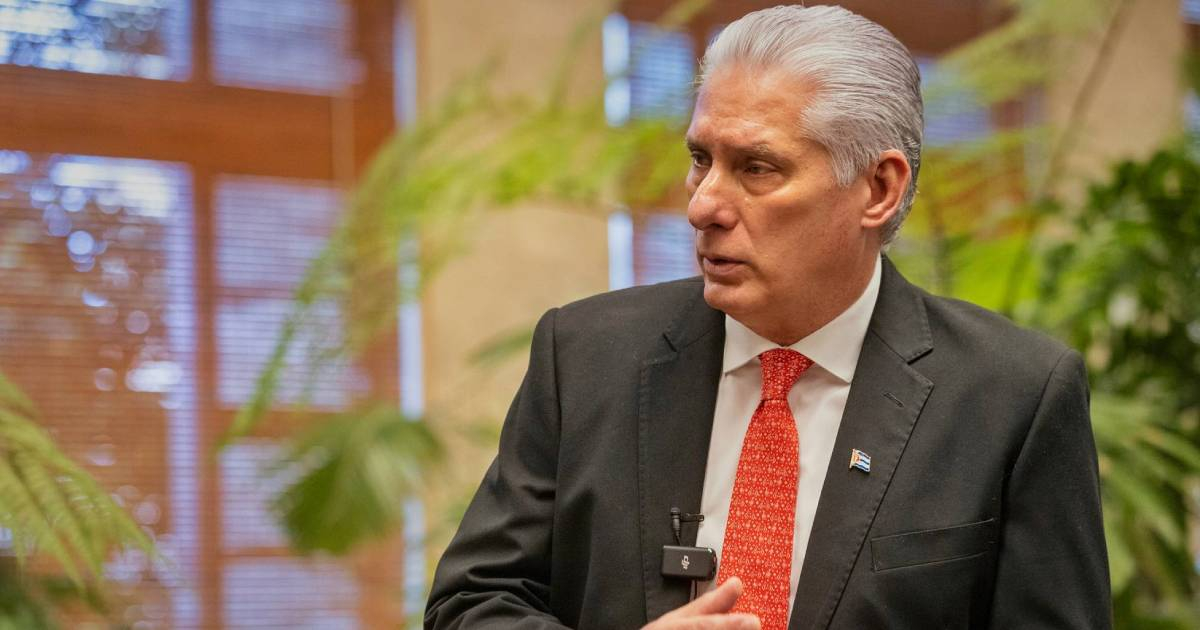
Miguel Díaz-Canel declared that he feels satisfaction and admiration for the role of the Communist Party of Cuba (PCC) over the past 67 years, in an interview granted to the magazine Newsweek —the first with a U.S. media outlet since 2023— conducted at the Presidential Palace in Havana.
In response to the question of whether the PCC remains the best guarantee for the well-being of the Cuban people, Díaz-Canel stated: "I feel satisfaction and admiration for the role that the Communist Party of Cuba has played over the past 67 years. Under a constant aggression, subjected to sanctions, coercive measures, a policy of maximum pressure, and a blockade, this party has been able to lead as the guiding force of our society."
The ruler also described the internal structure of the regime as based on "monolithic unity, ideological cohesion, and revolutionary discipline," and asserted that because of this, "betrayal becomes extremely difficult."
The laudatory speech sharply contrasts with the documented reality. In January 2026, Díaz-Canel himself acknowledged before provincial assemblies of the PCC the "lack of real unity", "bureaucratism," and the "inertia" of the party as factors exacerbating the crisis, urging a "change of mentality."
The Cuban economy contracted by 5% in 2025, according to the Center for Cuban Economic Studies (CEEC), the official body that described the model as "exhausted and without effective levers." This marks the third consecutive year of decline, with a total drop of over 15% since 2020.
Díaz-Canel himself admitted in the same interview that more than 90,000 Cubans are waiting for surgeries, including over 11,000 children, although he attributed the situation to the U.S. embargo rather than the regime's policies.
While the ruler celebrates the party's achievements in healthcare, over 30,000 doctors have emigrated in the last three years, and 255 out of 395 essential medications were missing in January 2025, according to documented data. The education system began the 2025-2026 school year with a shortage of 24,000 teachers nationwide.
The "monolithic unity" that Díaz-Canel invokes as a strength has its counterpart in unprecedented repression figures. Cuba reached a record of 1,214 political prisoners in February 2026, according to the organization Prisoners Defenders. In January 2026, 953 protests were recorded on the island—the highest number in the recent history of the country, according to the Cuban Observatory of Conflicts—and in March 2026, protesters burned the municipal headquarters of the PCC in Morón, Ciego de Ávila.
The 2019 Constitution enshrines the PCC in its Article 5 as the "unique, Marti-inspired, Fidelist, Marxist, and Leninist, organized vanguard of the Cuban nation" and declares the one-party system irrevocable, closing off any legal avenue for political alternation.
More than one million Cubans have emigrated since 2021, reducing the population from 11.3 million to between 8.6 and 8.8 million by 2025, in the largest exodus in the island's recent history.
The United States Secretary of State, Marco Rubio, responded this Tuesday to Díaz-Canel's statements following his threat of guerrilla warfare with a single phrase: "I don't think much about what he has to say."
Filed under: