
Related videos:
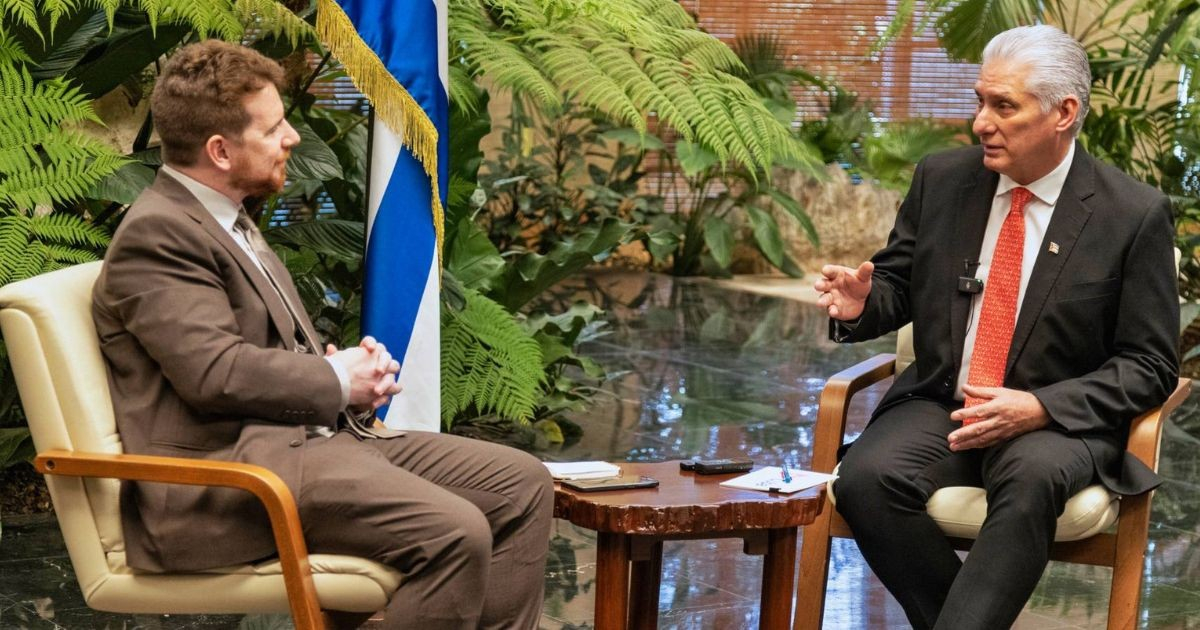
Miguel Díaz-Canel stated this Tuesday that Cuba is facing an ideological, cultural, and media war driven from abroad, in an interview given to the American outlet Newsweek, the first that the Cuban leader has given to a U.S. media outlet since 2023.
The statement arose when journalist Tom O'Connor, senior Foreign Policy writer for Newsweek, asked how long Cuba could realistically sustain itself and what message he had for Cuban Americans who see this moment as an opportunity for regime change.
Instead of responding directly, Díaz-Canel turned to the argument of informational manipulation: "There is a lot of media manipulation and a lot of pressure. We are facing an ideological, cultural, and media war. There is a huge media intoxication. A great deal of hatred has been sown, especially on digital networks."
The Cuban leader also stated that the reforms his government claims to be implementing "are not known in the United States, or are denied, or are not reported," presenting this alleged misinformation as part of a deliberate strategy to discredit the Revolution.
This narrative is not new in the regime's discourse. In March 2025, Díaz-Canel had already drawn a distinction between a "real Cuba" that is resilient and a "virtual Cuba" dominated by what he called "a media campaign to discredit the revolution, fueled by hate, slander, lies, and reputational assassination," in a speech at the University of Havana.
What the Cuban leader describes as "media intoxication" is, in fact, a crisis that is widely documented by international organizations.
The Cuban economy contracted by 5% in 2025, accumulating a decline of more than 15% since 2020.
Blackouts affect 64% of the country, with outages in some areas exceeding 25 hours a day. The organization Justicia 11J documents at least 760 people deprived of liberty for political reasons.
The regime itself enforces the Decree Law 370, which fines those who publish "information contrary to social interest," and the Foreign Agents Law, approved in May 2025, has intensified the repression against independent journalists and activists.
The Inter-American Press Association warned in February about the systematic repression against independent expression spaces in Cuba.
The response from Secretary of State Marco Rubio to Díaz-Canel's statements was brief, as reported by Rubio to Díaz-Canel's statements was brief: "I don't think much about what he has to say."
The regime has systematically used the framework of "media warfare" to delegitimize the criticisms of activists, independent journalists, and citizens documenting the crisis on social media, while keeping over 760 political prisoners behind bars, according to the latest data from Justicia 11J.
Filed under: