
Related videos:
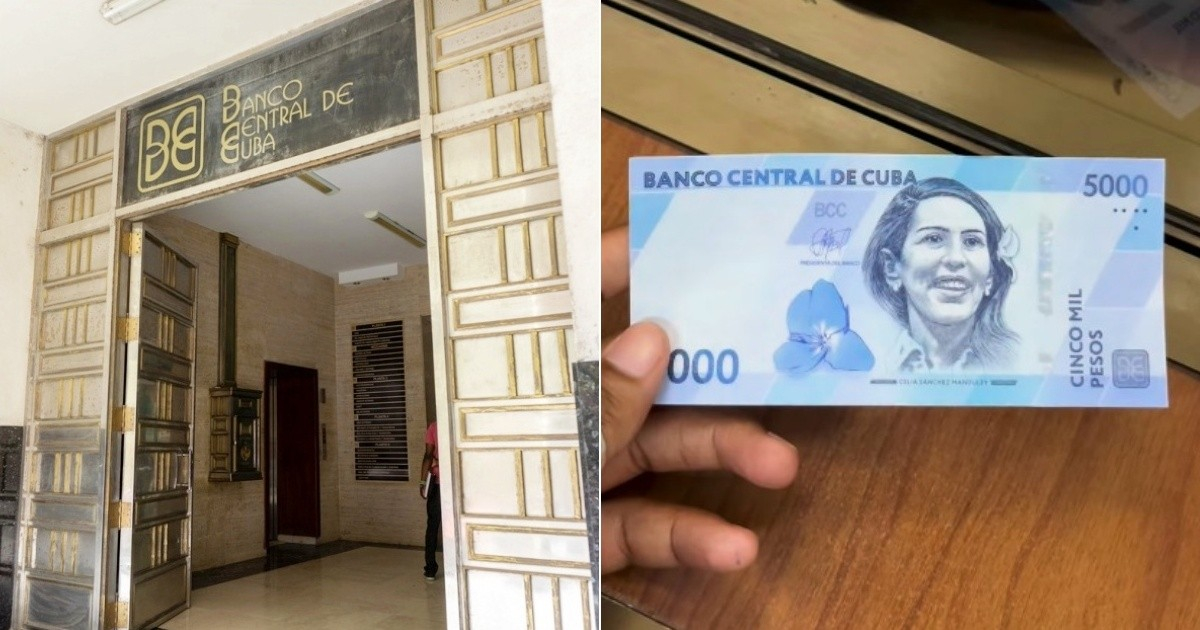
The issuance of 2,000 and 5,000 Cuban peso bills has sparked an immediate reaction among the population: concern, skepticism, and a question that is being repeated in the streets and on social media: do more bills mean more inflation?
While many Cubans directly associate the measure with a rise in prices, the Central Bank of Cuba (BCC) has addressed this reasoning. The institution insists that this relationship, although intuitive, is not so straightforward.
According to a specialist from the Directorate of Economic Studies of the BCC itself, the idea that more banknotes automatically imply more inflation is “a reasonable intuition, but incomplete.”
The Central Bank recognizes that one of the most widespread misconceptions is the belief that money is created when banknotes are printed. However, it argues that in practice, the opposite occurs.
“Money is not created in a printing press”, explains the official analysis, which emphasizes that in modern systems —including the Cuban one— most money arises as accounting entries in banks.
In this regard, the BCC emphasizes a key idea: "banknotes do not create money; they are the 'visible face' of money that already existed."
This means that when a person withdraws cash from their account, they are not generating new money, but rather converting digital balance into paper. The total amount of money in the economy, according to this logic, does not change.
How money is actually created in Cuba
The organization describes three fundamental ways in which money enters circulation:
-Bank credit, when banks approve loans and generate new balances in accounts.
-The state's expenditure, through the sale of debt to the Central Bank and its subsequent use in payments.
-The conversion to cash, which does not create money but transforms it.
Regarding this last point, the BCC is categorical: “it is the only one that produces physical banknotes, but […] DOES NOT CREATE NEW MONEY.”
So, why issue high denomination bills?
The response from the Central Bank points to a different issue: the shortage of cash amid a high demand for physical money.
In a context characterized by inflation, economic informality, and technological limitations, the use of cash continues to be predominant in Cuba. This creates tensions between the money available in banks and the cash accessible on the streets.
“The logical solution [...] is to expand the monetary cone,” explains the specialist, meaning to introduce higher denomination bills to facilitate transactions.
Far from being the cause of the problem, the BCC argues that this measure is a consequence of the current context and that, “far from creating inflation, this measure adapts the payment system to an inflation that already exists.”
Inflation, crisis, and implicit recognition
However, the very issuance of these banknotes occurs against the backdrop of a critical economic situation.
The Central Bank has acknowledged that the decision is directly related to the rise in prices and the increased circulation of money.
As the director of issuance and securities of the BCC, Julio Antonio Pérez Álvarez, admitted recently, the goal has been "to respond to the demand created by the increase in prices and the rise in circulation."
In practice, this implies an implicit acknowledgment of the declining purchasing power of the Cuban peso, which in the informal market hovers around 520 CUP per dollar, while wages remain virtually stagnant.
The perception on the street: Another reality
Despite the Central Bank's technical explanation, the public reaction has been predominantly critical.
Phrases like “my salary in a bill” or “a piece of paper doesn’t solve anything” reflect a widespread perception: that the new bills do not address the underlying problem.
For many Cubans, the reasoning is more straightforward: if higher denomination bills are increasingly needed to buy the same things, it’s because money is worth less.
And although the BCC insists that “the distribution of cash [...] is a reflection of the ability to generate income,” in practice, the phenomenon is influenced by deeper factors: a lack of trust in the banking system, the expansion of the informal economy, and inflation that erodes wages day by day.
More bills, but not more solutions
The debate, at its core, is not just technical, but profoundly social.
The Central Bank argues that the new banknotes do not generate inflation, but rather respond to it. However, in everyday life, where prices continue to rise and money buys less and less, the distinction between cause and effect becomes less relevant.
Because, beyond how money is created, what defines citizens' perception is how much they can buy with it. And in today's Cuba, that capacity continues to decline.
Filed under: