
Related videos:
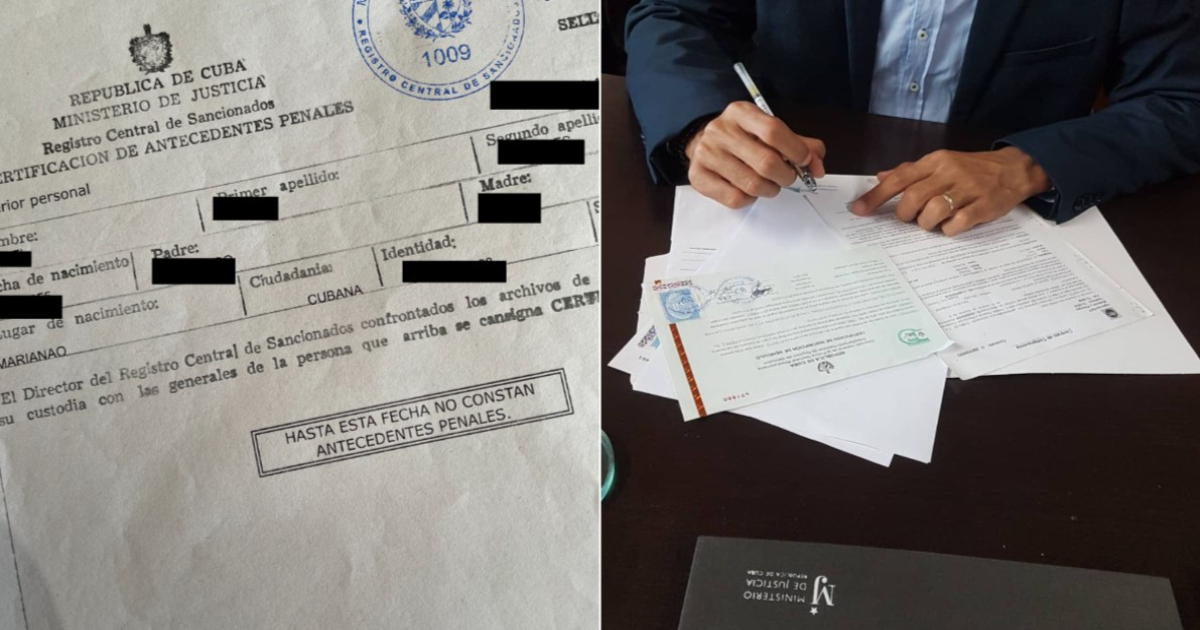
The Ministry of Justice of Cuba (Minjus) published official information on Monday regarding how to obtain and legalize the Criminal Record Certificate for use abroad, a process that has become essential for thousands of Cubans amid the ongoing migration crisis.
According to the Minjus, as stated by the Cuban News Agency, the document " in the country, and is essential for immigration, employment, or academic procedures abroad."
The from Minjus establishes that criminal background certifications are valid for one year, starting from the date of their issuance.
However, most recipient countries require that the document be issued within a period not exceeding six months, so the Cuban validity of one year is not always sufficient in practice.
In order for the certification to be valid abroad, it must be obtained through the National Organization of Collective Law Firms (ONBC), which issues it with a note for foreign use for individuals, an essential requirement for its subsequent legalization with the Minjus.
Since February 2025, Minjus has taken over the responsibility for the legalization of documents for use abroad, a duty that previously belonged to the Ministry of Foreign Affairs, according to the Agreement 10035 of 2024 from the Council of Ministers.
Payments for services and stamps can be made electronically, except when the destination is United States, a country that only accepts the physical stamp certifying the tax and generally does not require legalization by Minjus.
In terms of costs, residents in Cuba pay 1,250 Cuban pesos for obtaining and 375 CUP for legalization, plus the corresponding stamps.
For foreigners or permanently resident Cubans abroad, the fees amount to 52 dollars for obtaining and 16 dollars for legalization, with stamps in national currency.
In Cuba, there are five categories of certifications: national personal, national by organization, foreign personal, foreign by organization, and exempt, the latter requested by bodies related to judicial processes such as the Policía Nacional Revolucionaria, prosecutors, and courts.
Minjus urged that individuals with registered sanctions must ensure their records are cleared before applying for certification for foreign use, "in order to avoid delays in the process."
This warning is particularly significant as Cuban criminal records can automatically disqualify applicants in immigration processes to the United States, Mexico, and other countries.
The volume of legalized documents in Cuba increased from 442,564 in 2022 to 860,135 in 2024, reflecting the pressure that massive emigration has placed on the registration system and prompting regulatory reforms in recent years.
The Ministry announced that it will soon address the procedure for the cancellation of criminal records, as part of its public information actions regarding legal procedures of citizen interest.
Filed under: