
Related videos:
The ruler Miguel Díaz-Canel sparked a wave of outrage on social media by blaming the capitalist system for "buying" the talent of young Cubans who emigrate, ignoring the fact that his own stepson resides and studies at an expensive private university in Madrid.
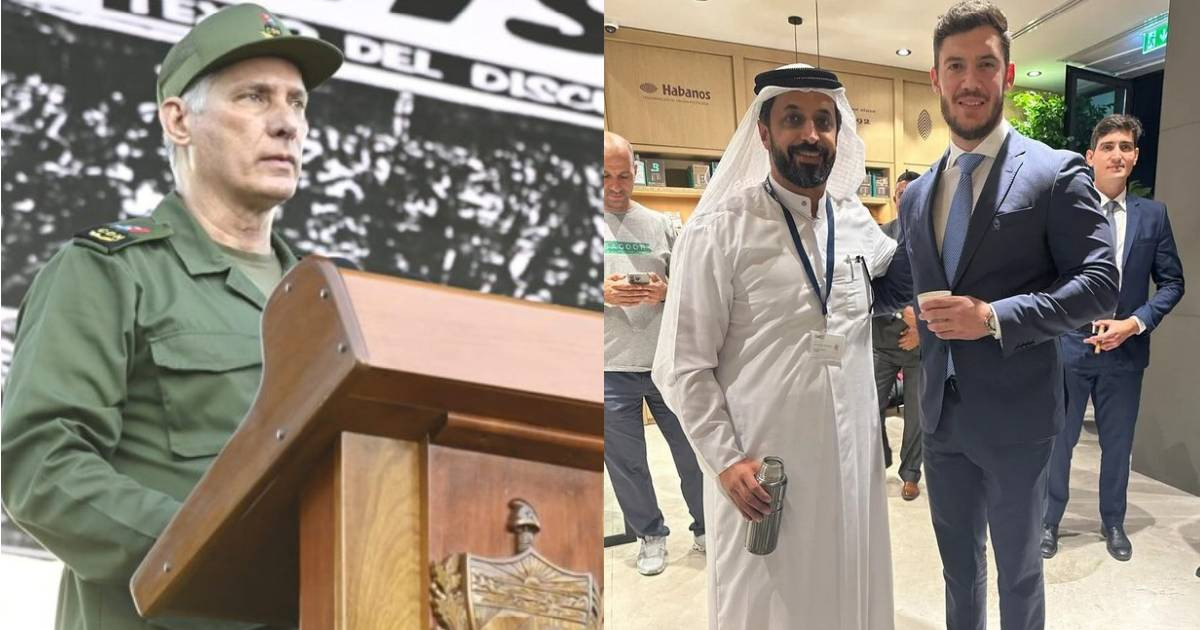
This Thursday, the leader delivered a speech at the corner of 23 and 12 in El Vedado, Havana, during the event commemorating the 65th anniversary of the proclamation of the socialist nature of the Cuban revolution.
There he stated that the exodus of professionals represents "a very painful wound" because it involves young people educated for free in our schools and universities, whose skills and talents are being purchased by capitalism without any investment from them.
The reaction on Facebook was immediate and overwhelming. In this regard, the user Lara LP summed up the feelings of thousands.
"Look at how Canel is a hypocrite, criticizing young people who studied 'for free' in Cuba and then emigrate to capitalism, when that is exactly what his stepson Manuel Anido Cuesta did," wrote on his Facebook profile.
Anido Cuesta, son of Díaz-Canel's wife, Lis Cuesta Peraza, resides in Madrid on a student visa and is enrolled in a program at IE University Business School, one of the most expensive private institutions in Spain, with tuition fees exceeding 12,300 euros per year, according to information confirmed in June 2025.
The monthly cost of living for Anido Cuesta in the Spanish capital exceeds 2,000 euros, while the average salary in Cuba hovers around 16 dollars per month.
This pattern repeats among the ruling elite. The son of Prime Minister Manuel Marrero was photographed on vacation in Spain in January 2024, while the daugher of the head of the Business Administration Group S.A. (GAESA) resides and works in Panama.
For their part, numerous Cubans directly questioned the argument of free education. According to Anamar Santinez, "the issue is that neither education nor healthcare is free as they claim; in the end, you pay for it along the way and more than you should."
Marlens Catalá was more straightforward. "I financed my university education by working for the government of Cuba for six years in agricultural work, five days a week, on a scholarship and far from my family. Then for thirty years, I worked for very little pay. I don't owe them anything," she stressed.
Ine Sera pointed out the double standards of the regime, stating, "we emigrate because there is no freedom in our country, while your children can legally emigrate to study in Europe so they don't have to validate their degrees, and their qualifications can be recognized anywhere."
The demographic data confirms the extent of the exodus that the leader laments without taking responsibility. According to various estimates, between 2021 and 2025, nearly two million Cubans emigrated, and in 2024, the net migration was 251,221 people less, which brought the island’s population to 9,748,007 inhabitants, the lowest level since 1985.
30% of emigrants are between 15 and 34 years old, and independent surveys indicate that 93% of Cubans would leave the country if they could.
Horacio Nancy Chang closed the debate with a phrase that summarized the collective sentiment. "The entire Cuban people have been paying and continue to pay with painful sacrifice, with blood, with imprisonment, discrimination, inequality, repression, exploitation, exile, and separation from families. Young people face a future of misery and blackouts, while the elite enjoy life in luxury," he concluded.
Filed under: