
Related videos:
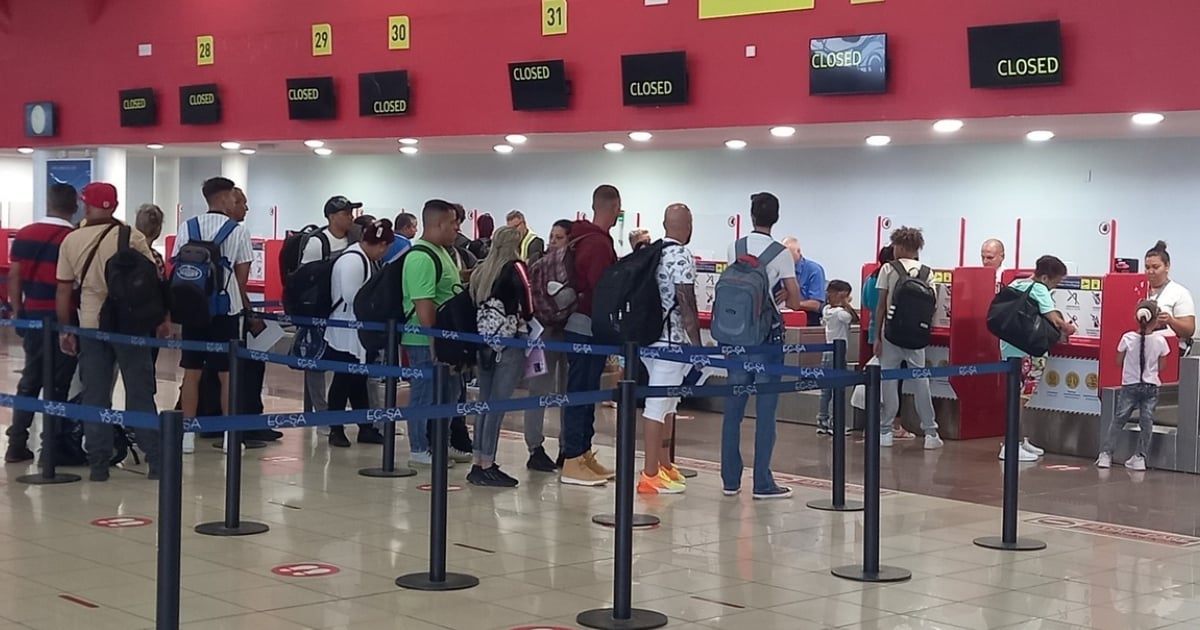
A survey conducted by CiberCuba on Facebook revealed the extent of the desire to emigrate among Cubans, with 93% of participants stating they would leave the country tomorrow if given the opportunity. Only 5% said they would not, and 2% claimed they had already attempted.
In total, more than 4,400 people participated in the consultation, which sparked an intense debate with hundreds of comments and reactions. Many express hopelessness, pain over family separation, and the urgency to escape a crisis that seems never-ending.
"Not tomorrow, right now", wrote a user, while another Cuban stated she would leave "without thinking twice, with my children and my husband, even Haiti works for me, I’m not asking for much. Just to get out of this hell". Others acknowledge that only family ties hold them back: "I would leave right now... my parents are elderly and sick, that's the only thing that stops me".
There were also those who expressed the hope of not having to emigrate: “I wouldn’t leave my Cuba, but I pray to God every day to free it so I can be happy and for many who, like me, never wanted to leave but had to do so, to return,” commented an internet user.
Poverty drives mass exodus
The survey results align with the latest data from the Cuban Observatory of Human Rights (OCDH), which reveals that 89% of Cubans live in extreme poverty and that 78% want to emigrate or know someone who does.
Blackouts, food crisis, cost of living, low salaries, and shortage of medications are the main concerns of the population, while only about 3% mention the U.S. embargo as a problem. Instead, the majority points to internal deterioration as the cause of the crisis.
The report warns that eight out of ten people cannot meet their basic needs and that food insecurity affects the elderly the hardest.
An exodus that empties the island
Despair is already evident in the official figures, with more than 250,000 Cubans who emigrated in 2024, according to data from the National Office of Statistics and Information (ONEI). Independent studies raise the number to over half a million people in that year alone, placing Cuba among the countries with the highest rate of depopulation in the world.
The economist Juan Carlos Albizu-Campos compares this reduction to that of countries at war, while the aging population and low birth rate further worsen the situation.
The Cuban psychologist Roxanne Castellanos Cabrera recently warned that behind every departure lies a profound emotional burden. “Many people have left, carrying mountains of guilt and suffering”, she explained, emphasizing that family fracture, with children, parents, and grandparents separated by migration, leaves wounds that are difficult to heal.
The specialist noted that reunification and remote support have become the backbone of thousands of households, but also evidence that, for many, Cuba has ceased to be a project of the present and future.
In this context, the results of the CiberCuba survey seem less like a surprise and more like a reflection of daily life on the streets of the island. As one user summarized in the comments: “That question doesn't need to be asked, we all know the answer.”
Frequently asked questions about the migration and social crisis in Cuba
Why does a large majority of Cubans want to emigrate from the country?
A survey revealed that 93% of Cubans would leave the country immediately if given the chance. The main reasons include hopelessness due to the economic and social crisis, characterized by extreme poverty, constant blackouts, food shortages, and lack of medicine. The situation is further worsened by family separation and the perception of an uncertain future on the island.
What is the current economic situation in Cuba according to surveys?
According to the Cuban Observatory of Human Rights, 89% of Cubans live in extreme poverty. Critical factors such as blackouts, the food crisis, the high cost of living, and low wages are the main concerns, presenting an economic landscape that drives many to consider emigration as the only solution.
What measures are suggested to address the crisis in Cuba?
The Cuban Observatory of Human Rights suggests that the situation in Cuba can only improve with structural reforms. This includes the adoption of a market economy, respect for private property, free enterprise, legal security, and foreign investment. Without these changes, the economic and social crisis will persist, affecting the majority of the population.
What is the perception of Cubans towards the current government?
A survey from the Cuban Observatory of Human Rights indicates that 92% of Cubans disapprove of the government's performance. This disapproval is even stronger among the youth, with only 3.39% rating the regime positively. The constant blackouts, the food crisis, and the lack of basic services are factors that fuel this discontent.
Filed under: