
Related videos:
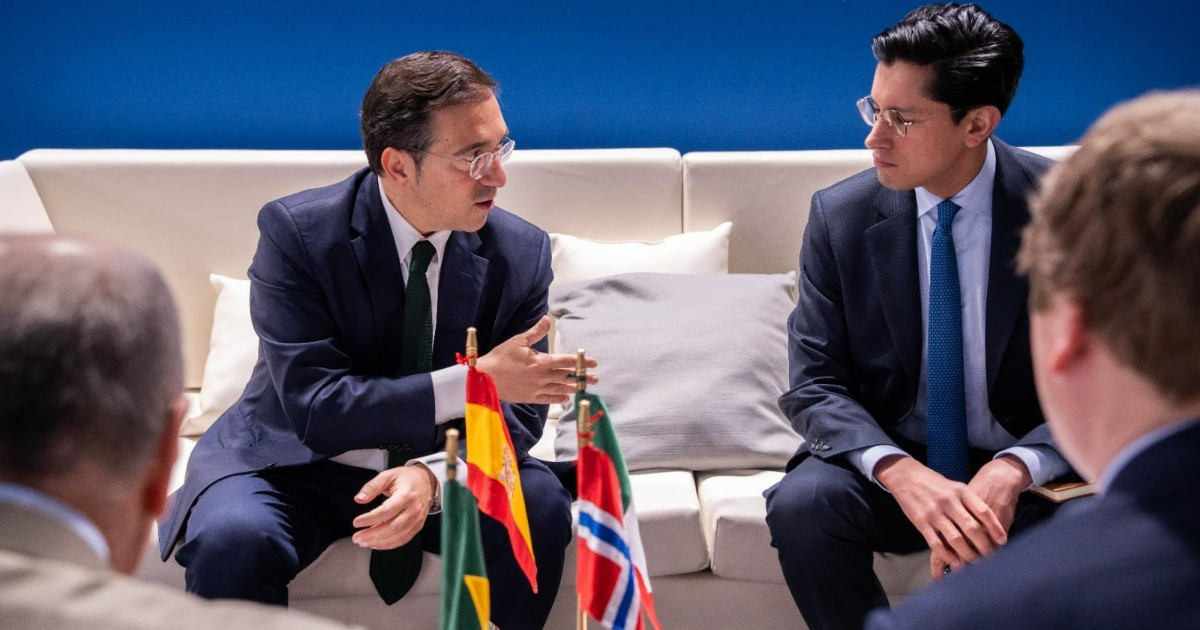
The Minister of Foreign Affairs of Spain, José Manuel Albares, once again resorted to a formula that is as convenient as it is empty to refer to the Cuban tragedy.
“Only the brotherly Cuban people can freely decide their future,” he wrote on his social media after meeting with his counterparts from Brazil, Mexico, and Norway to discuss the “critical humanitarian situation” on the island.
The phrase, in a gray diplomatic tone, nonetheless contains a deep contradiction. Because if there is one thing that has defined Cuban reality for more than six decades, it is precisely the impossibility of its people freely deciding anything.
Speaking of free will in a single-party dictatorship, without competitive elections, without freedom of the press, and with hundreds of political prisoners, is not diplomatic prudence: it is a form of evasion.
And in the case of Spain, this language also ends up being an implicit form of complicity.
The fiction of "free choice"
The underlying problem is not semantic, but political. In Cuba, there are no minimum conditions for citizens to choose their leaders, organize freely, or express dissent without fear of reprisals.
The protests of July 11, 2021, made it clear what it costs to raise one's voice: mass arrests, disproportionate sentences, and an intact repressive apparatus that keeps hundreds of Cubans in prisons for whom Spain has hardly raised its voice, including artists like Luis Manuel Otero Alcántara or the Grammy Latino-winning rapper, Maykel Osorbo.
In that context, stating that "only the Cuban people can decide their future" amounts to ignoring—or concealing—that this people is deprived of the basic tools to do so. It is shifting an impossible responsibility to those who lack the freedom to exercise it.
It is not a neutral phrase. It is a way to whitewash the absence of freedoms under an apparently respectful rhetoric.
Spain knows perfectly well what is happening
The most concerning thing is that it is not a matter of ignorance. Spain is well aware of the nature of the Cuban regime. Not only because of its shared history but also due to decades of diplomatic, economic, and political relations at the highest level.
Albares himself recently welcomed the regime's chancellor, Bruno Rodríguez Parrilla, in Madrid. There is no lack of information here, but rather a deliberate decision to maintain a carefully ambiguous language that avoids any real confrontation.
It is the same pattern that has characterized Spanish policy towards Cuba for years: to timidly acknowledge democratic shortcomings, but without taking a clear stance that would disturb the power in Havana.
The result is a discourse that, under the guise of balance, ends up being deeply asymmetrical: demanding in rhetoric, but harmless in practice.
The real effect: prolonging the status quo
What is achieved with this type of statements? Certainly not improving the situation of Cubans.
This language contributes to several concrete effects. First, it indirectly legitimizes the regime, treating it as a normal interlocutor in a context where there is no political normalcy. Second, it deactivates the possibility of firmer international pressure, diluting responsibilities into abstract formulations.
And third, it sends a devastating message to civil society and dissent: Europe, and especially Spain, is not willing to go beyond words.
Meanwhile, the reality on the island continues to deteriorate. Chronic economic crisis, power outages, shortages of food and medicine, and massive emigration are emptying the country. Talking about "deciding the future" under these conditions is not only ironic; it is cruel.
From dialogue to complacency
Albares' position is not an anomaly, but rather the continuation of a historical line.
Spain has opted for a strategy based on dialogue, conversation, and normalization for decades, trusting that economic openness and political contact would lead to gradual changes.
But those changes have not arrived.
What has indeed occurred are concessions, specific mediations—such as the releases in 2010—and a growing economic integration that has benefited companies and the very structure of the Cuban state.
However, the structures of power, political control, and repression have remained virtually intact.
The policy of "influence from within" has ultimately become, in practice, a policy of adaptation to the regime.
The misalignment with the United States
This approach has also been reinforced by a constant misalignment with the United States' policy towards Cuba.
While Washington—especially under harsher administrations—has opted to increase political and economic pressure on the regime, Spain and the European Union have preferred to act as a counterbalance.
That stance is justified in the name of rejecting unilateral sanctions or the extraterritoriality of laws like Helms-Burton. However, in practice, it has also provided Havana with a way to gain political and economic breathing room.
It is not about defending U.S. policy uncritically, but about acknowledging an undeniable fact: without any form of real pressure, authoritarian regimes have no incentives to change. And Europe, with Spain leading the way, has systematically chosen not to exert it.
The result is a paradox: while human rights violations are condemned in official speeches, a framework of relations is simultaneously maintained that does not impose significant costs on the regime for those same violations.
An obvious double standard
The attitude towards Cuba contrasts with the firmness that Spain and the EU display in other contexts. In scenarios where distinct geopolitical interests exist, the language shifts, the demands become tougher, and the measures are put into action.
With Cuba, on the other hand, a caution bordering on indulgence prevails.
That double standard erodes the credibility of Spanish foreign policy regarding human rights. It conveys the idea that principles are not universal but negotiable based on strategic or economic interests.
Spain as part of the problem
The tweet from Albares is therefore not just a simple diplomatic gesture. It reflects a policy that, instead of contributing to a solution, helps to perpetuate the problem.
By insisting on empty formulas such as the "free will of the Cuban people" without addressing the conditions that make it impossible, Spain positions itself in a comfortable yet sterile stance. It avoids conflict, preserves its interests, and keeps channels of dialogue open, but at the cost of renouncing an effective defense of fundamental rights.
Ultimately, this approach not only fails to promote real changes. It also contributes to prolonging the agony of millions of Cubans who continue to wait for something more than words.
Because without pressure, without clear conditions, and without the political will to demand accountability, no transition is possible. And as long as Spain continues to bet on ambiguity, it will remain, to a greater or lesser extent, part of the problem.
Filed under: