
Related videos:
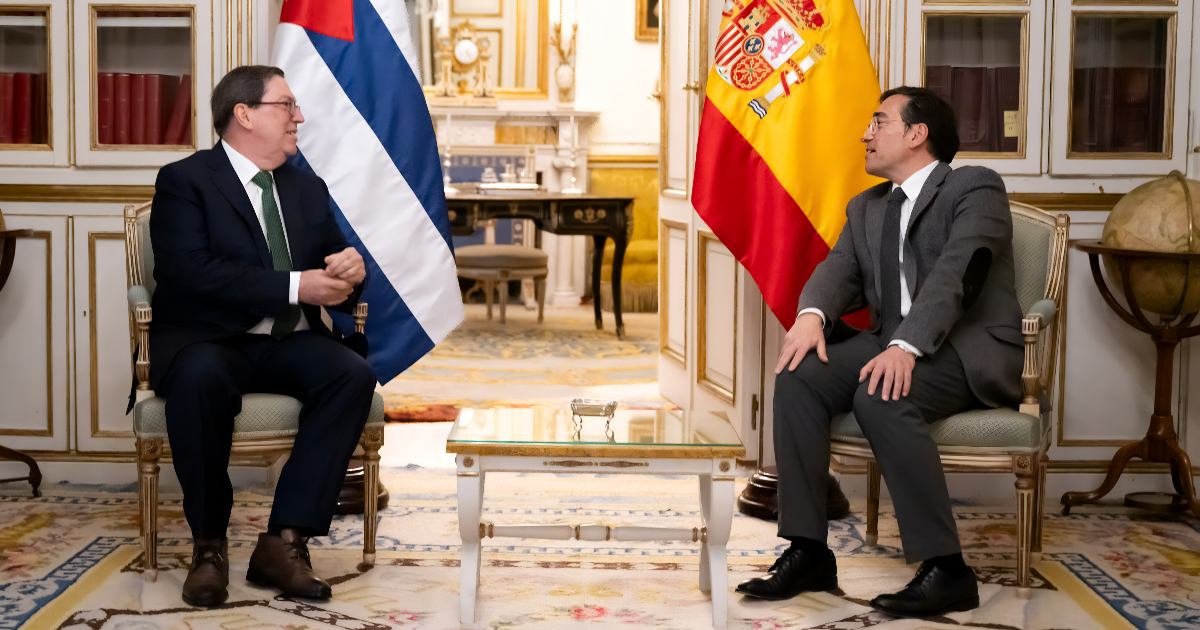
The recent visit of the Cuban Foreign Minister, Bruno Rodríguez Parrilla, to Madrid included an unusual detail in Spanish diplomatic language: the Ministry of Foreign Affairs emphasized that the meeting with José Manuel Albares occurred “at his request”.
It is not a common formula, nor is it innocent. When examining the history of high-level contacts between the Cuban regime and Spain, a striking pattern emerges: these diplomatic initiatives coincide with particularly sensitive moments for power in Havana.
In a context of renewed hemispheric pressure and a less cohesive European Union in its relationship with Washington, the visit takes on a significance that goes beyond mere protocol.
The detail that is not accidental
In diplomacy, words carry weight. Official communications are usually drafted using neutral formulations: “bilateral meeting,” “working meeting,” “official visit.” That is why it is noteworthy that the Spanish Ministry opted to specify that the meeting took place “at his request”, meaning it was initiated by the Cuban chancellor.
The phrase does not add substantial information about the agenda —economic situation, Spanish companies, humanitarian aid— but it does set a framework: it was Havana that called.
This is not the first time that an official Spanish statement highlights the initiative of the Cuban regime, but it is not a common practice either.
The clearest precedent can be found in April 2017, when a statement from La Moncloa regarding the meeting between Mariano Rajoy and Rodríguez Parrilla indicated that the meeting took place “at the request of the Cuban authorities”.
Two different Spanish governments, two distinct contexts, but one significant coincidence: the explicit statement that it was the power in Havana that requested the meeting.
When a formula is selectively repeated, it ceases to be anecdotal.
2008, 2017, 2026: Diplomacy in Times of Adjustment
The review of the Cuban chancellor's main visits to Madrid in recent years suggests a telling temporal pattern.
In 2008, the year when Raúl Castro officially succeeded the dictator Fidel Castro in the leadership of the State, the previous visit of the then Cuban Foreign Minister, Felipe Pérez Roque, to Spain took place.
That moment marked the first dynastic change within the Cuban political system since 1959. The transition was meant to project stability and continuity to the outside world, and Madrid was a key European interlocutor.
In 2017, when Rodríguez Parrilla was received at La Moncloa "at the request of the Cuban authorities," the regime was in another delicate phase.
In December 2016, the Political Dialogue and Cooperation Agreement between the European Union and Cuba was signed, which replaced the Common Position of 1996. At the same time, Donald Trump had just arrived at the White House, and there was uncertainty about the future of the thaw initiated by Barack Obama.
Internally, Raúl Castro had announced that he would not continue beyond 2018, paving the way for the succession that would culminate in the appointment of Miguel Díaz-Canel. It was a moment of external and internal realignment.
The visit of 2026 takes place in an even tenser scenario. The capture of Nicolás Maduro by U.S. forces, the establishment of an interim government in Venezuela, and the intensification of hemispheric pressure on the Cuban regime have altered the regional balance.
This is compounded by a structural economic crisis on the island, characterized by energy shortages, a collapse of public services, and rising social unrest. In this context, the diplomatic initiative towards Madrid cannot be interpreted as merely a ceremonial exchange.
The pattern does not solely demonstrate vulnerability, but it does suggest that the regime activates its Spanish diplomacy during transitional phases or strategic pressure.
A less cohesive Europe
The other element that gives meaning to the visit is the change in the European environment.
For decades, the annual vote in the UN General Assembly against the U.S. embargo was a nearly unanimous consensus among European countries.
However, in the last vote, support for the resolution was lower than in previous years, and several European countries chose to abstain, while one voted against it alongside the United States.
Although the resolution was passed again by a large majority, the gesture revealed an unprecedented fragmentation within the European space.
That fact does not imply an automatic alignment of Europe with Washington, but it does reveal greater caution and a diversity of positions.
In the current hemispheric context, no strong European statements have been made that confront the United States' strategy towards the Cuban regime head-on. The European Union maintains its framework of institutional dialogue with Havana but avoids direct clashes with the White House.
Compared to other moments of bilateral tension between Washington and Havana—when Europe reacted with greater cohesion against U.S. measures considered extraterritorial, such as the Helms-Burton Act—the current scenario has a lower profile and is less confrontational.
This is not the first time that the Spanish government has chosen to handle such meetings discreetly.
In September 2025, during the UN General Assembly in New York, Albares met with Rodríguez Parrilla, but did not share images of the meeting on his social media, unlike what he did with other bilateral meetings held on the same days.
The contrast suggested a desire to maintain the dialogue without granting it prominent political visibility, as emphasized by El Debate.
The timing adds another layer to the scenario. Just days before Rodríguez Parrilla's visit, the new U.S. ambassador, Cuban-American Benjamín León Jr., took office in Madrid, and in his first message, he emphasized President Trump's foreign policy and the priority of U.S. interests in Latin America.
The presence in the Spanish capital of a representative closely linked to Washington's hemispheric strategy underscores that Madrid has once again become a crossroads between the diplomacy of the Cuban regime and U.S. pressure.
For the Cuban regime, which has historically sought a political counterbalance to the United States in Europe, this development is significant.
Relative solitude and defensive diplomacy
Talking about "isolation" requires precision. The Cuban regime is not globally isolated: although dwindling, it still maintains ties with Russia, China, and other like-minded regimes. However, in the European sphere, its margin appears narrower than in the past.
The combination of factors —fragmentation within the UN, a lack of European statements in direct defense against American pressure, and a geopolitical context dominated by the war in Ukraine and transatlantic priorities— creates a less favorable environment. Europe has not severed ties with Havana, but neither has it taken on the role of an active political shield.
In this context, the diplomatic initiative towards Madrid makes sense. Spain remains the principal European interlocutor for the Cuban regime due to its history, economic ties, and business presence. When Havana needs to convey messages, gauge positions, or strengthen support, Madrid is an essential stop.
The detail "at the request of this one" does not, by itself, prove isolation or a diplomatic collapse. However, it does indicate that the initiative came from a regime that, at key moments, seeks to anchor relationships within the European environment.
More than a formula
The visits of the Cuban chancellor to Madrid are not routine. They focus on moments of transition or pressure.
The 2008 transition, the prelude to the 2018 change, and the current hemispheric scenario demonstrate that the regime activates its Spanish diplomacy when it senses a need for external rebalancing.
In diplomacy, words are rarely chosen at random. Emphasizing that the meeting took place "at his request" introduces a nuance that positions the initiative in Havana. It is neither a condemnation nor a rupture, but it is a signal.
Today, with a more cautious and less cohesive Europe in relation to Washington, the Cuban regime does not find the same environment as in previous periods of tension with the United States. It may not be isolated in absolute terms, but its European support is no longer automatic or uniform.
When Havana calls Madrid, it often does so at times when it needs something more than just protocol. And this pattern, seen in perspective, conveys as much as the phrase that reveals it.
Filed under: