
Related videos:
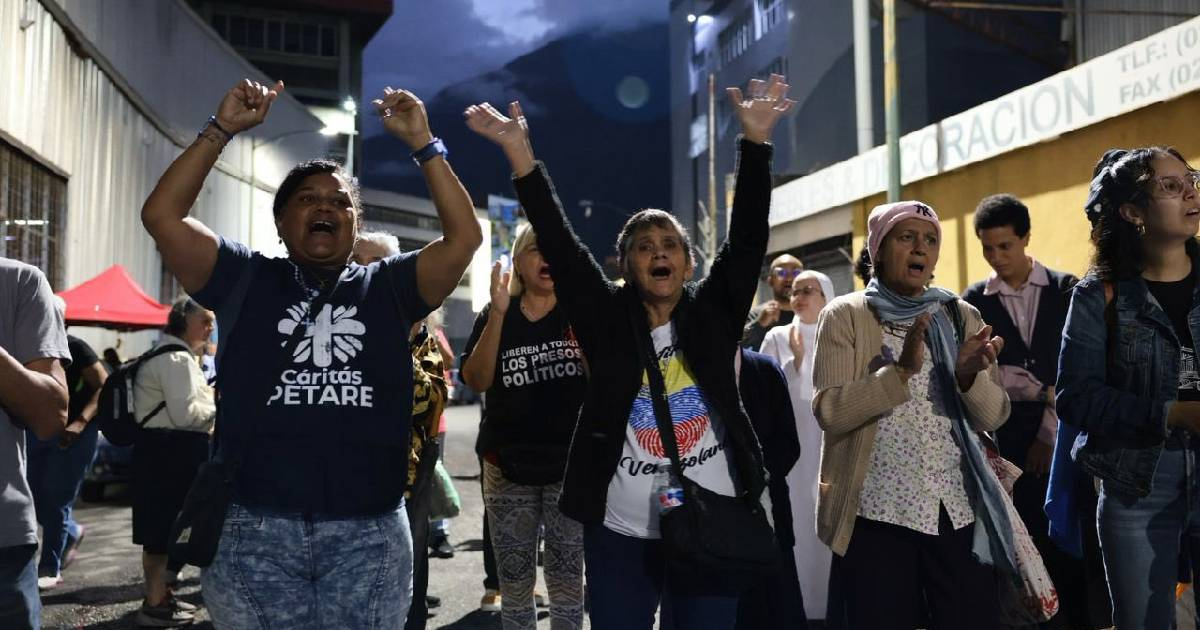
Family members of Venezuelan political prisoners completed this Saturday 100 days of continuous vigils outside the country's prisons, particularly in front of El Rodeo I in Guatire, while denouncing that the amnesty process approved in February is progressing very slowly and that the torture has not stopped.
The vigils began on January 8, five days after the capture of Nicolás Maduro by U.S. forces, when the president of the National Assembly and chief negotiator for Chavismo, Jorge Rodríguez, announced the "release" of a "significant number of individuals" as a "unilateral gesture" for "peace and coexistence."
One hundred days later, and with two months having passed since the approval of the Amnesty Law for Democratic Coexistence, family members assert that "lies, mockery, suffering, and re-victimization continue to prevail," as stated by Andreína Baduel from the NGO Committee for the Freedom of Political Prisoners (CLIPP), from outside El Rodeo I, according to the EFE report.
Baduel referred to that prison as a "torture center" where, in the last ten days, the cruel treatment has increased.
Each of the family members held a sign that read "100 days waiting for," followed by the name of their relative, while chanting: "Justice, justice, justice and freedom, they are all innocent, none are criminals."
The activist also reported that it has been 14 days of "arbitrary suspension of visits" to her brother Josnars Baduel, son of General Raúl Isaías Baduel, former Minister of Defense under Hugo Chávez who passed away in prison in October 2021.
He warned that Josnars' life "is at risk" as a result of "the tortures he has been subjected to," thus demanding proof of life and his immediate release.
El Rodeo I was also the detention site of the Argentine gendarme Nahuel Gallo, who was released in March and described the facility as a "place of psychological torture," as well as the French citizen Julien Février, who was released in early April after 15 months of detention.
The NGO Foro Penal updated the number of political prisoners in Venezuela this Saturday: 477 in total, of which 111 are in El Rodeo I.
This figure contrasts sharply with official data: the Venezuelan government claims to have granted amnesty to over 8,000 people, although the vast majority were under restrictive measures rather than being incarcerated.
Foro Penal only verifies 743 actual releases since January 8, of which only 187 can be directly attributed to the amnesty.
The authorities have also not published a list of the identities of those granted amnesty, despite the public request from the UN High Commissioner for Human Rights, Volker Türk.
Despite the accumulated exhaustion, Baduel stated that during this time "faith, resilience, and dignity have been strengthened": "Now more than ever, we are convinced that we are doing the right thing by saving the lives of our loved ones, and we will not tire of demanding the full and immediate freedom of all political prisoners, the cessation of torture, and justice."
Foro Penal has documented a total of 18,944 political detentions in Venezuela since 2014, a figure that reflects the extent of the repression accumulated over more than two decades of Chavismo.
Filed under: