
Related videos:
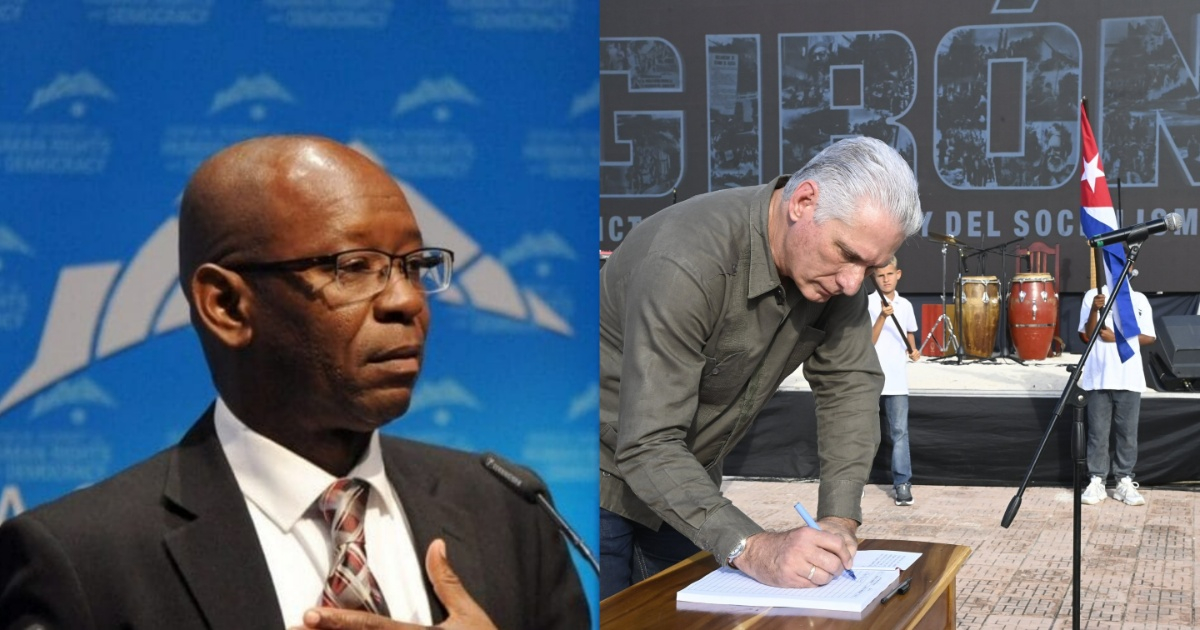
The opposition figure Manuel Cuesta Morúa questioned the legitimacy of "My Signature for the Fatherland" this Sunday from Havana, referring to the new mobilization by the regime in Cuba launched today to collect signatures in workplaces, educational institutions, and communities in support of the Declaration of the Revolutionary Government.
The initiative was presented by Cuban authorities as an act of sovereignty in the face of tensions with Washington, during the 65th anniversary of the Battle of Playa Girón. Díaz-Canel launched the campaign with his own signature and presided over the main event in Ciénaga de Zapata, Matanzas.
"In a situation where the unpopularity of the regime is extremely high, the government wants to show that it indeed enjoys popularity and is applying the logic of forcing people to sign to demonstrate to the world the support the government has, the followers the government has, that the revolution holds legitimacy, which in recent years has been waning and dying," stated Cuesta Morúa, president of the Council for Democratic Transition in Cuba.
The opposition leader warned that the regime seeks to send a message of internal cohesion to the world in response to pressure from Estados Unidos, but he predicted that the outcome might not be as anticipated.
"It will be interesting to see how far it can engage citizens, beyond those who feel obligated to participate because, at the end of the day, people are signing in another direction; people are signing for democratic change," he emphasized.
The anthropologist and historian Jenny Pantoja Torres was equally forceful in labeling the campaign as a "farce" and "manipulation," noting that participation does not stem from conviction but rather from economic desperation and institutional coercion.
"At this time of such misery and crisis in Cuba, I say that no one is obligated to that. But we cannot speak from our personal perspectives because, in reality, many people depend solely, as they have no remittances and no other resources, on a salary from the State," she specified.
Pantoja Torres also warned that the regime will publish the figures it deems appropriate: "Previously, they manipulated them even with the computers provided by the Joven Club, which are also state-owned, and all those figures are meant to suggest a supposed support from the Cuban people, but it is a farce."
On her part, intellectual and activist Miryorly García published a call on Facebook this Sunday urging Cubans not to participate in the campaign, appealing to civic consciousness and solidarity with the more than 1,200 political prisoners in Cuba.
"Distinguish yourself from continuing to be an accomplice, from giving support that they do not deserve, from allowing them to humiliate you, do not betray those who are imprisoned for being brave", wrote García.
The activist argued that collective abstention can reverse the dynamics of fear: "Whether you stand out can depend on them having more fear than the fear they try to impose on us through repression, that fear shifts to their side."
The campaign is launched in a context of extreme geopolitical tension: on Saturday, President Donald Trump stated in Phoenix that "very soon the great strength of the U.S. military will bring a new dawn for Cuba", not ruling out a possible military operation.
Cuba is also experiencing its worst crisis in decades, with power outages of up to 22 hours daily, salaries that do not exceed 16 dollars per month, and an economic contraction of 23% since 2019.
Filed under: