
Related videos:
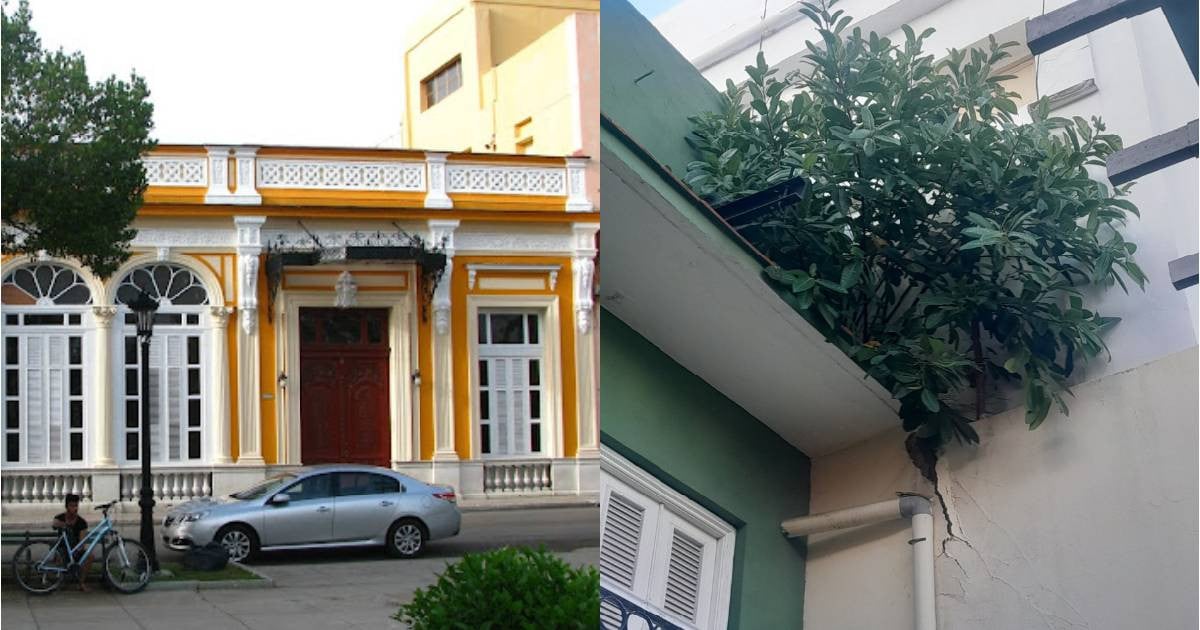
The uncontrolled growth of a bush over the structure of the José White hall, one of the most recognized heritage buildings in Matanzas, sparked criticism on social media following a public complaint this Saturday that highlighted the visible deterioration of the property due to lack of maintenance.
The alert was shared on Facebook by Ramón Recondo Pérez, a specialist at the Architecture and Engineering Projects Company of Matanzas, who posted a photograph showing a large plant growing directly on the facade of the building.
The foliage emerges from a crack in the wall, evidence of a prolonged period of neglect that allowed the vegetation to develop without being removed.
The image also shows a deep vertical crack just below the point where the plant originates. Architectural conservation specialists warn that the roots of this type of vegetation can act as wedges within the fissures of walls, gradually expanding and fracturing the concrete, brick, or facade cladding.
The damage is also reflected in the detachment of the plaster around the crack, indicating that the integrity of the surface is already compromised.
Very close to the affected area is a PVC rainwater downspout that could be damaged if the roots penetrate the joints of the drainage system or create blockages that cause leaks in the wall.
Recondo mocked the situation by referring to the place as "the new Botanical Garden of Matanzas," a critique aimed at the apparent indifference of those responsible for the property regarding the visible deterioration of the façade.
In her post, she questioned how it is possible for a plant of that size to have grown on the building without any measures being taken to remove it.
The complainant described the situation as a display of "indifference" towards one of the emblematic works of Matanzas' architectural heritage and expressed regret that a restoration that required significant effort and resources could deteriorate due to the absence of basic maintenance actions.
For several users who commented on the post, the issue is not due to a lack of resources but rather administrative negligence. Some pointed out that removing the invasive plant would only require a simple cleaning action, while others lamented that buildings restored with public funds are deteriorating again due to the absence of systematic maintenance.
The White Room, inaugurated in 1860 as the headquarters of the former Artistic and Literary Lyceum of Matanzas, has been one of the main cultural spaces in the city for over a century.
In its halls, the first Cuban danzón, "Las alturas de Simpson" premiered, one of the most representative pieces of Cuban cultural identity. Since 1968, it has borne the name of the 19th-century violinist from Matanzas, José Silvestre White (1835-1918).
The complaint highlights an issue that recurs in various parts of the country. The Teatro Sauto is facing vandalism, the use of its portals as a shelter, and a progressive deterioration that the authorities have been unable to stop, also in the city of Matanzas.
The situation is not exclusive to that province. The Gran Teatro de La Habana was displaying trash and individuals in a state of homelessness in its entrances, while the Convento de Los Escolapios was reported for total abandonment in another location in the interior of the country.
The pattern of institutional negligence towards Cuban historical heritage was also highlighted when it was revealed that the Carlos Baliño Museum had been closed since 2019, with no cultural authority having taken steps for its restoration.
The indifference towards the emblematic works of Matanzas Heritage, as termed by the complainant himself, summarizes a structural crisis in the preservation of Cuban cultural assets, where the lack of maintenance and absence of resources turn spaces that should be protected as part of the national collective memory into ruins.
Filed under: