
Related videos:
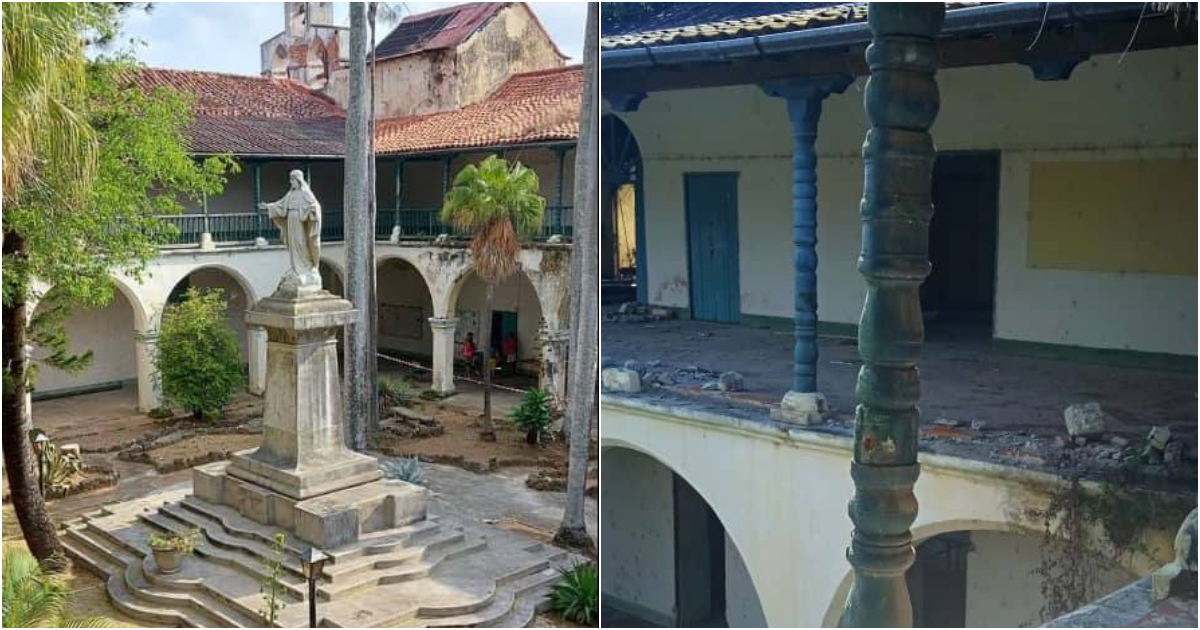
The actor and theater director Jorge Mederos Reyes reported the neglect of the Escolapios convent in the Havana municipality of Guanabacoa and accused the local government of allowing the looting and deterioration of a site declared to have high heritage protection.
Mederos, deputy director of the El Sótano theater and artistic director of the Centro de Teatro de La Habana, expressed on his Facebook profile his concern "as a Cuban, a Havanese, and from Guanabacoa" about the situation of the old convent of San Francisco Javier, known as Los Escolapios.
In his message, the artist acknowledged the difficulties the country is facing but emphasized that neither the U.S. embargo nor the national government is responsible for "the poor management of the municipal government of Guanabacoa with its heritage."
He recalled that the property, with Grade I Protection, is a symbol of Cuba's humanist and pedagogical tradition. It has been the training ground for generations of intellectuals, and its library, laboratories, and scientific collections have been national benchmarks.
During a recent visit, Mederos claimed to have witnessed the deteriorating condition of the buildings. “The intermediate floors no longer exist, the railings have disappeared, and the grilles and doors have been stripped with complete impunity,” he described.
According to him, only the theater group Océano —which occupies part of the complex— is trying to preserve the place, while the responsible state entity, Education, has neglected its areas.
“The municipal government is not taking action, despite reports from the Heritage Department and repeated complaints. Instead, it aims to remove the artists who are trying to protect the site,” she warned.
The actor lamented that the authorities ignore the risk of "an unlimited heritage massacre," and asked, "What is happening in Guanabacoa? Do we have to wait for the same thing that happened with the House of the Chains?"
He concluded his message with a phrase of indignation and sorrow: “This hurts an entire territory. It hurts history. It hurts the culture of a nation. It hurts Cuba, damn it.”
Recently, the priest Rodhin A. Colomar denounced on his social media what he described as an infringement on religious freedom in Santiago de Cuba.
According to what was explained on Facebook, access to the Santa María Church, located in the Veguita de Galo neighborhood, has been closed off, and stages and tables have been set up as if it were a park or a shopping center, disregarding that liturgies and religious services are held in that space on weekends.
It is alarming the number of public spaces, heritage sites, or emblematic places in Cuba that are abandoned and doomed to disappear due to a system unable to preserve them, immersed in official indifference and citizen resignation, who have become accustomed to deterioration amidst the economic crisis.
San Pedro Camping in Artemisa is suffering from deterioration and institutional neglect, with only half of its cabins operational. The issues include vandalism, illegal occupations, and lack of resources.
The San Rafael cemetery, in the city of Guantánamo, displays cracked graves, illegible or completely destroyed tombstones, as well as corroded marbles on the graves where the remains of heroes from the Liberation Army rest, reflecting institutional neglect, public ignorance, and systematic vandalism of a heritage site.
Another example is the El Arte printing house, in Manzanillo, one of the most important cultural symbols of eastern Cuba, which is suffering from neglect while its historical and editorial legacy crumbles amid state indifference.
The Máximo Gómez Airport in Ciego de Ávila, built with over 100 million pesos, is now a ruin without flights or purpose, where a public investment has been buried under the weight of negligence and absurdity.
In the municipality of Marianao, the former Oriental Park racetrack, a symbol of Havana's splendor, ended up as a state warehouse amidst the rubble.
In a state of significant deterioration are the well-known Cubanacán Art Schools, the unfinished project by Italian architects Vittorio Garatti and Roberto Gottardi along with Cuban Ricardo Porro, considered one of the most significant architectural works of the revolutionary period.
The once-glorious Casino Español de La Habana, located in the municipality of Playa; the iconic Teatro Musical de La Habana, and the former Hotel Venus in Santiago de Cuba, are just a few examples of the many cultural and architectural gems that have been destroyed.
Frequently Asked Questions about the Abandonment of Heritage Sites in Cuba
What is the current situation of the Los Escolapios convent in Guanabacoa?
The convent of Los Escolapios in Guanabacoa is in a state of total abandonment. Jorge Mederos Reyes has reported the deterioration of the building and the inaction of the municipal government regarding its looting and ruin. This site, declared of high heritage protection, is a symbol of Cuba's educational tradition, and its neglect reflects institutional indifference towards cultural heritage.
What other heritage sites in Cuba are in a state of abandonment?
In addition to the Los Escolapios convent, multiple heritage sites in Cuba are facing abandonment and deterioration. Examples include the Higher Institute of Industrial Design (ISDI) in Havana, the San Pedro camping site in Artemisa, and the San Rafael cemetery in Guantánamo. These places suffer from looting, vandalism, and a lack of conservation, which highlights a pattern of negligence towards the national heritage.
What has the Cuban government done regarding the maintenance of heritage sites?
The Cuban government has shown a clear lack of action and commitment to the maintenance of heritage sites. Poor management and official indifference have allowed the deterioration of many historical and cultural places. Authorities often make promises of solutions that do not materialize, worsening the condition of these structures and causing frustration among the public.
What impact does the abandonment of heritage sites have on Cuban society?
The abandonment of heritage sites in Cuba has a significant impact on national identity and culture, in addition to emotionally affecting local communities. The loss of these historical spaces represents a blow to the cultural and educational legacy of the country. Furthermore, it reflects the current economic and social crisis, where the population must confront the erosion of their heritage amid daily precariousness.
Filed under: