
Related videos:
There are slogans that age poorly. And then there's this one: "For the Homeland, the Revolution, and Socialism, we will always triumph." A phrase that in 2026 no longer sounds epic, but rather like an echo, like a telescreen from Big Brother. A worn-out recording playing on repeat while the country dims — both literally and metaphorically — into darkness.
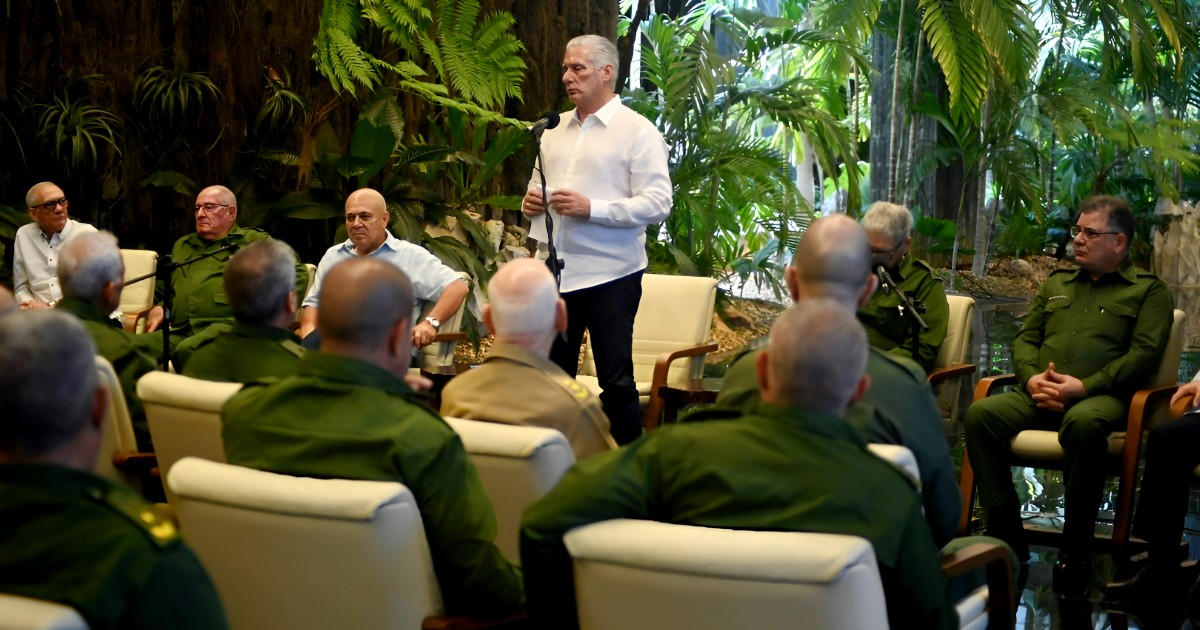
The latest show in the air-conditioned halls of Palacio brought together veterans, generals, Party officials, and carefully selected youth to repeat the script. Two hours of “heartfelt” exchange where, according to the official narrative, Cuba once again won... who knows exactly what.
Because the scene has an element of experimental theater. A hall filled with historical fighters, officials, and uniforms, discussing victories, missions, and epic tales, while outside reality insists on being less poetic: power outages, scarcity, mass emigration. But inside the Palace, no air enters. Neither criticism. Nor the truth.
Miguel Díaz-Canel, in his already worn-out role as a slogan reader, claimed that dignity and courage guarantee that “we will always triumph.” Curiously, they have been winning for decades, yet the country wakes up more defeated each day. Perhaps this is a conceptual victory, one that cannot be seen, eaten, or explained, but is celebrated nonetheless. From victory to victory until final defeat.
The event, of course, had all the ingredients of the ritual: Playa Girón, Angola, the fight against "bandits," the defense of Venezuela and the 32 military personnel who died in "unequal combat," imagined mercenaries landing on the keys… a collection of useful ghosts serving to justify the present.
Because if there is one thing that dominates this script, it is the constant need for enemies, whether real or fictitious, to uphold a narrative that can no longer stand on its own.
But the most fascinating aspect is not the content itself, but the insistence. The obsession with keeping alive an epic that now exists only in closed speeches and acts, increasingly dreary and grotesque. While real power operates in silence—amid discreet contacts, calculations, and survival strategies—the propaganda apparatus amplifies the volume.
This Saturday, the concept of “My Neighborhood for the Homeland” was discussed. An initiative that, translated into common language, consists of mobilizing the usual people to watch over, clean, produce, and, in the meantime, continue believing. Safe Neighborhood, Participative Neighborhood, Productive Neighborhood… what was missing was “Resigned Neighborhood,” which would be the most honest.
The idea that "the defense of the revolution starts in the neighborhood" sounds less like patriotism and more like social control named by failed spies and parakeets from Ñico López.
Let no one be without a task. Let no one be without supervision. Let no one be without repeating the slogan. Everything is very participatory, as long as participation means obeying without question.
And meanwhile, in parallel, another Cuba is emerging. One where the heirs to power —those of the "royal family"— are not organizing cleaning brigades, but rather exploring how to secure their place in the future. A Cuba where the key word is not “resistance,” but “negotiation.” Where the loudspeaker remains socialist, but the logic is increasingly patrimonial.
That is why these kinds of acts are no longer convincing: they reveal. They speak not of strength, but of fear. Not of conviction, but of necessity. The necessity to repeat a narrative that is unraveling, to invoke a "revolution" that no longer explains anything, to uphold a myth while reality takes a different course.
In the end, the phrase “we will always prevail” hangs in the air, like that cardboard Fidel with whom they now invite people to take selfies. Smiling, motionless, oblivious to the present.
A perfect symbol: the revolution turned into decoration. And power, as always, elsewhere.
Filed under: