
Related videos:
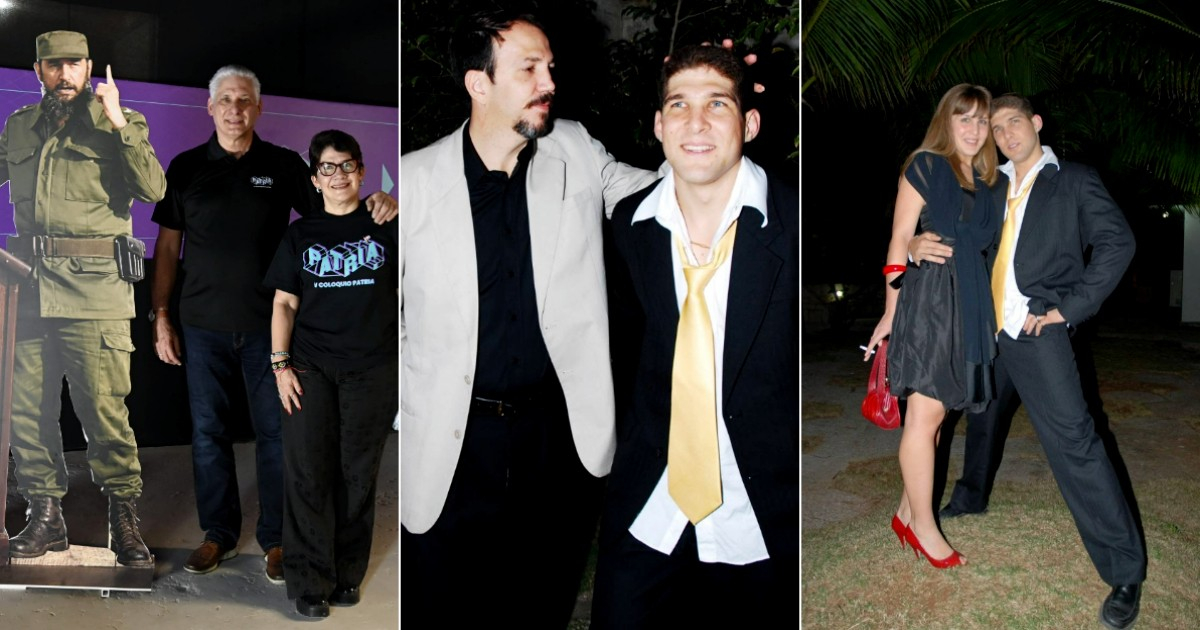
The scene is as absurd as it is revealing: Cubans posing with smiles next to the dictator Fidel Castro, rejuvenated by artificial intelligence, turned into a fair attraction at a propaganda event of the regime.
A "selfie" with the past. A portrait with a ghost. A country forced to look back while its future is being decided far from the cameras and public scrutiny, far from the polls and, above all, far from its own people, who remain silenced, repressed, and starving.
That cardboard Castro summarizes the current state of Castroism: an empty image, reproduced ad nauseam to sustain a narrative that no longer explains reality. Because while the ideological apparatus clings to the liturgy of the so-called "revolution," real power in Cuba operates on a different dimension: that of interests, negotiations, and the survival of an elite.
During decades, the regime has presented itself as a political and ideological project. Today, that façade is cracking. What emerges is not a "revolution" in crisis, but something much more recognizable: a family power structure that manages the country as if it were a property. Cuba is not a republic in transition, but rather a farm in the process of reorganization.
In that scheme, the formal institutions and their puppets —the presidency, the government, the Party, Díaz-Canel and La Machi, Gerardo Hernández and the News— function as a grotesque backdrop.
The effective power remains concentrated within the Castro environment and in the military-business network that controls the strategic sectors of the economy, with GAESA as the backbone. It is there that decisions are made, wealth is managed, and the future is defined.
What we are witnessing is not the end of the system, but its transformation. Castroism is evolving. It leaves behind the epic rhetoric to adopt a more pragmatic logic: that of a kleptocracy seeking to preserve itself.
It is no longer about instilling or exporting an ideology, but rather about protecting assets, ensuring continuity, and adapting to a new context without losing control.
In that "damage control" process, a new generation of the clan begins to occupy key spaces. Some operate in the shadows, acting as intermediaries or managing sensitive relationships.
They are the cases of El Tuerto (Colonel Alejandro Castro Espín) in his panopticon of repressive and intelligence services, and El Cangrejo (Raúl's bodyguard grandson, a hedonist from Hialeah with a Makarov, and messenger of epistles and gossip), Raúl Guillermo Rodríguez Castro.
Others rise in formal structures with a technocratic profile, like the "good" Oscar Pérez-Oliva Fraga, who is introduced with all his last names to demonstrate that he is not a Castro, but a logistics star, a "Chicago Boy" that has emerged spontaneously from the outskirts of Siboney.
And some, more visible, project a public image that combines provocation, luxury, and ideological ambiguity, like the trendy self-employed individual, the "prince of darkness and king of the night" who is interviewed by CNN and NBC, the "young revolutionary" nurtured differently than the "new man," a half-brained reformist, Sandro Castro.
They are not isolated actors, but rather parts of the same mechanism: that of the familial continuity of power.
In parallel, there are increasing signals —faint, opaque, but persistent— of contacts with the United States. These are not formal negotiations, but rather tentative approaches, exploratory conversations, discreet channels: backchannels learned from the KGB in its transformation into the FSB, to navigate the 5D chessboard of the Trump administration.
What matters is not its exact content, but its logic: Washington speaks with those it considers capable of making decisions, and these do not seem to be the visible institutional representatives of the Cuban state.
That dialogue, whether real or potential, reveals an uncomfortable truth: power in Cuba has never been fully institutional. It has always been mediated by networks of loyalty, control, and access, where family and the military and repressive apparatus have played a decisive role. Today, in a situation of deep crisis, that power seeks to reposition itself.
But the strategy is not linear. While channels to the outside are opened, the regime intensifies its internal narrative. Propaganda multiplies, the cult of the past is reinforced, and the myth of the "revolution" and its supposed social project is emphasized.
It's not nostalgia: it's control. It's the tool that allows a battered society to remain cohesive while the balances of power are reconfigured.
The objective seems clear: negotiate without surrendering the narrative, adapt without dismantling the system, change what is necessary so that nothing essential changes. A managed transition from within, where the same actors —or their heirs— retain the fundamental levers of political and economic power.
The closest precedent is not in Latin America, but in Eastern Europe. The post-Soviet Russia demonstrated how a system can mutate without disappearing: repressive structures are recycled, elites are transformed into oligarchies, and power is recently centralized under new forms. There is no rupture, but rather transformed continuity.
Cuba could be facing a similar scenario. A “transition” that does not arise from the will of the people, but from agreements between elites. A redesign of the system where economic openness coexists with political control. A reconfiguration in which the nation does not participate, but is subject to negotiation.
And therein lies the underlying problem. Because all of this happens behind the backs of Cubans, with Silvios asking for machine guns and Marreros proposing "creative resistances" amid comelatas and rancheras. Without shame, without transparency, without debate, without legitimacy. The country does not decide its own fate: others do it for him. As if it were a commodity. As if it were, indeed, an inherited property.
For this reason, the image of the selfie is not anecdotal. It is deeply symbolic. While the citizen poses with a cardboard Fidel, smiling and frozen in time, the real country — impoverished, exhausted, fragmented — is moving in another direction. A direction marked by undisclosed interests and unexplained agreements.
For years, there was talk of "revolution." Today, what remains is its wrapping, a bloody and foul-smelling shroud. Behind it, what emerges is something else: the administration of an inheritance, the management of a legacy, the continuity of a power that has never ceased to be private.
Cuba is not liberating itself from its past. It is witnessing how that past transforms to continue controlling. And while the regime offers selfies with ghosts, its heirs move silently forward, auctioning off the nation.
Filed under:
Opinion article: Las declaraciones y opiniones expresadas en este artículo son de exclusiva responsabilidad de su autor y no representan necesariamente el punto de vista de CiberCuba.