
Related videos:
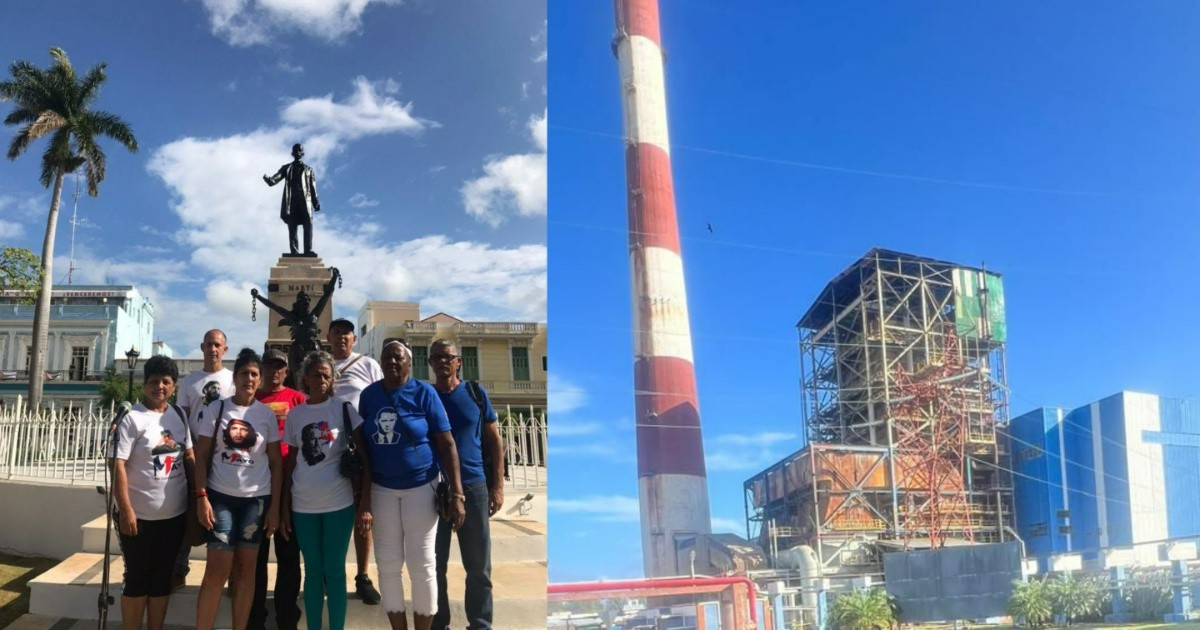
A representation of workers from the Antonio Guiteras Thermoelectric Power Plant (CTE) participated yesterday in the revolutionary reaffirmation event of the "My Signature for the Homeland" campaign at the Liberty Park in Matanzas, and the image sparked a wave of criticism and irony on social media.
The campaign, launched on April 19 coinciding with the 65th anniversary of the Battle of Playa Girón, aims to collect millions of signatures in support of the Declaration of the Revolutionary Government Girón is today and always, issued on April 17 by the regime of Miguel Díaz-Canel.
The official page of the plant on Facebook proudly announced: "A representation of the workers of the CTE Antonio Guiteras attended today the revolutionary reaffirmation event for the Homeland, against war and against the blockade, all gathered in the park of Liberty."
The irony soon erupted on social media: the Guiteras is precisely the most important thermoelectric plant in Cuba and the main culprit behind the massive blackouts that plague the island in 2026.
Only in the weeks leading up to the event, the plant suffered three serious breakdowns: a pipe rupture in the boiler on March 6 that left about six million people without power, a leak in the boiler on March 16 that caused a general blackout lasting 29 hours and 29 minutes, affecting 68% of the island, and a new puncture on April 6 that raised the deficit to 1,871 MW.
Cuba has experienced seven total collapses of the National Electric System in the past 18 months, with power outages in some provinces exceeding 20 hours a day.
The comments on social media came quickly: "When will they sign to bring electricity to Cuba?" was the question that encapsulated the widespread sentiment.
Other users were just as straightforward: "How can one overcome without food, without electricity, and without medicine? That makes no sense," and "Without food, without water, without electricity, with what strength will one overcome?"
The contrast between propaganda and reality was particularly striking given that the director of Guiteras, Rubén Campos Olmo, was promoted to the national management of Unión Eléctrica in March 2026, despite the multiple breakdowns that occurred under his management.
While the workers at the plant signed for the homeland, more than 200,000 Havana residents were without drinking water, as 87% of the supply system relies on electric pumps.
Opponents openly called for a boycott of the campaign. José Daniel Ferrer was emphatic: "With signatures or without signatures, they will go, they will fall soon, we will bring them down soon."
Manuel Cuesta Morúa, president of the Council for Democratic Transition in Cuba, questioned the success of the initiative due to the high unpopularity of the regime and the implicit coercion that it represents for workers and students.
Alina Fernández, daughter of Fidel Castro, captured the prevailing mood with a widely circulated phrase: "Decades living in misery due to an ideological madness".
Filed under: