
Related videos:
The Cuban regime has again fallen into an obvious contradiction: while its propaganda apparatus claims that “Cuba owes nothing to the United States,” its own official statements show that it has been willing to negotiate compensation for the properties confiscated since coming to power.
The difference is not insignificant. It is structural.
In a recent article, Razones de Cuba asserts emphatically that there is no “historical, moral, or political debt” to Washington, and presents any claim for compensation as absurd or illegitimate. The message is clear: Cuba has nothing to pay.
However, this position clashes directly with what the regime itself has maintained for years in diplomatic settings.
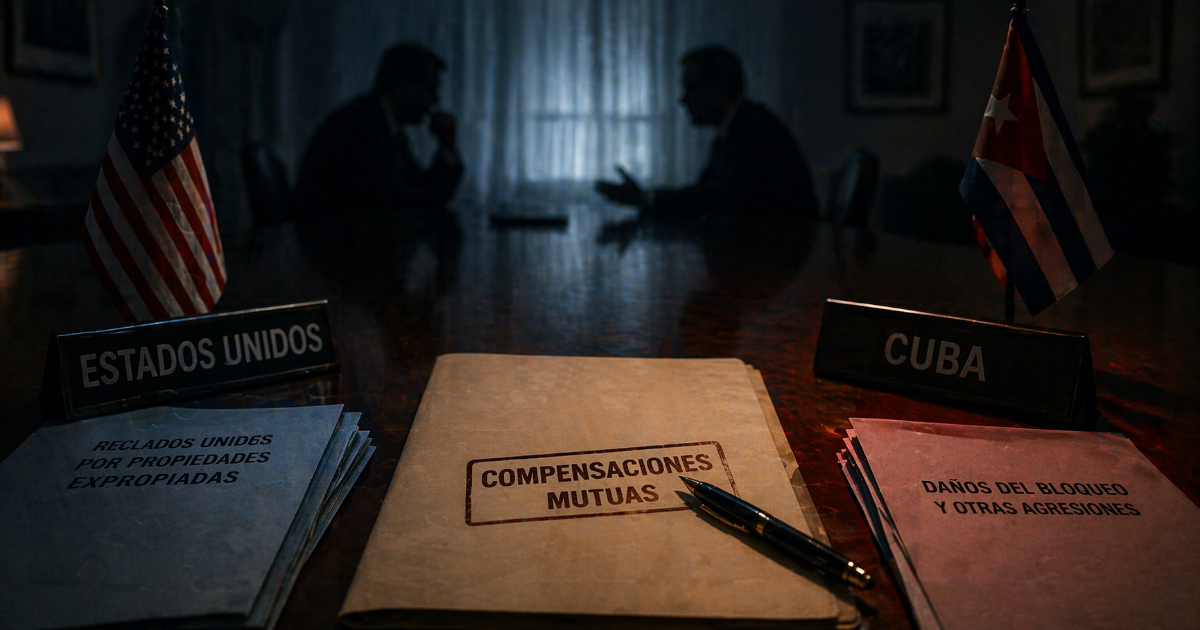
Since the bilateral thaw in 2015, Havana has recognized U.S. claims as a pending matter to negotiate. In official meetings between both countries, the topic of "mutual claims and compensations" was explicitly addressed, and senior officials from MINREX have repeatedly stated Cuba's willingness to reach a comprehensive agreement.
It is not about external interpretations. They are statements from the government itself.
Figures such as the late former Deputy Foreign Minister Abelardo Moreno and the current Deputy Minister Carlos Fernández de Cossío have publicly stated that Cuba is willing to negotiate compensations for U.S. citizens and companies affected by nationalizations, always within a framework that also includes Cuban claims for damages from the embargo.
That is to say, the regime does not deny the problem. It conditions it. And this is where the contradiction with the discourse of Razones de Cuba appears.
Because it is not the same to assert "we owe nothing" as it is to sit down and negotiate compensations, even if it is under the principle of reciprocity. The former is an absolute denial; the latter is an implicit acknowledgment that there is an economic conflict that requires a resolution.
Both positions cannot be held at the same time without creating inconsistency.
As with the recent meeting with U.S. officials in Havana, the regime is again employing two levels of discourse.
One approach is more pragmatic, aimed at international negotiation, acknowledging the existence of disputes and the need to resolve them. The other is more ideological, focused on domestic consumption, where any obligation is denied and the narrative of confrontation is reinforced.
The problem is that this duality no longer goes unnoticed.
In a context of deep crisis, where the country needs clarity rather than slogans, the Cuban citizens receive contradictory messages: on one hand, they are told that there is nothing to negotiate; on the other hand, negotiations are taking place. On one hand, all debt is denied; on the other, there is talk of compensations.
It’s not transparency. It’s political calculation.
If the regime truly believes that there is no debt to the United States, it should uphold that position at the negotiating table as well. Conversely, if it recognizes the need to discuss compensations, it should communicate this clearly, avoiding absolute statements that it later contradicts in practice.
Because denying in public what is negotiated in private does not strengthen a position. It weakens it. And, once again, it reveals a repeated pattern: one discourse for the outside and another for the inside. One to negotiate and another to unite. One to admit, another to distract and manipulate.
The result is the same: more opacity, more contradictions, and even less credibility.
Filed under: