
Related videos:
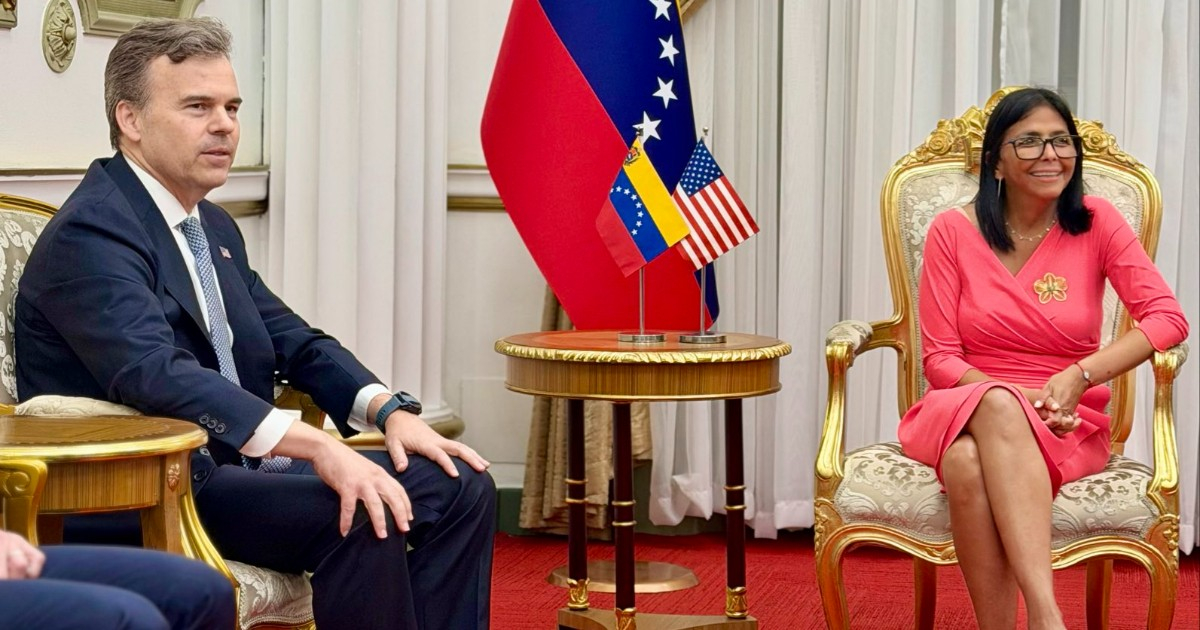
John Barrett, the new Chargé d'Affaires of the United States Embassy in Caracas, met this Friday with the interim president Delcy Rodríguez and reiterated the importance of continuing to implement the three-phase plan of President Trump to achieve results that benefit both countries.
Barrett had arrived in Venezuela on Thursday, just a day before the meeting, and posted a video on the official Embassy account on X where he introduced himself and announced his mission.
"A full day in Caracas. I met with interim president Delcy Rodríguez and we discussed the importance of continuing to implement the three-phase plan of @POTUS to achieve results that benefit both Americans and Venezuelans," Barrett wrote in a message shared through the X account of the U.S. Embassy in Caracas.
The meeting took place at the Miraflores Palace, with the flags of Venezuela and the United States placed on the table between both representatives, in an image that echoes the diplomatic pattern established by her predecessor.
Barrett replaced Laura Dogu, who was the first chargé d'affaires to reopen the U.S. embassy in Caracas —closed since 2019 and resumed operations on March 30— and who also met with Rodríguez on February 3 to formally present that same plan.
Dogu announced her departure on April 15 to resume her position as Foreign Policy Advisor to the Chief of the Joint Chiefs of Staff of the U.S. Armed Forces, in a change that came as a surprise because it occurred a day after the State Department denied rumors of a shift.
The three-phase plan was announced by Marco Rubio on January 7, 2026, four days after the capture of Nicolás Maduro during Operation Absolute Resolution at Fort Tiuna, Caracas.
According to the Secretary of State, the first phase—“stabilizing the country”—is based on what he described as a “quarantine” (lockdown), which allows the United States to exert a key influence over the internal situation.
In this context, he noted that his government was "about to execute an agreement" to take the oil that, he claimed, remains "trapped" in Venezuela due to sanctions and the inability to trade it freely.
He specified that the United States will manage between 30 and 50 million barrels of crude oil, which will be sold on the international market at market prices, and that the proceeds will be deposited in accounts under Washington's supervision, with the aim —according to his words— that they benefit the Venezuelan population and not corruption or the regime.
As a second phase, Rubio described what he called “recovery,” aimed at ensuring that American, Western, and other countries' businesses can access the Venezuelan market “in a fair manner.”
In parallel, he explained that a process of national reconciliation would be promoted to allow for amnesty, the release, or the return to the country of political and social actors, aimed at starting to rebuild the institutional framework and civil society.
The third phase, referred to as "transition," will be developed in more detail later, as Rubio himself indicated, stating that his team is progressing "in a very positive way." This stage aims for a political evolution of the country, although there is no defined public timeline at this moment for free elections.
Barrett, career diplomat with over two decades of experience in Latin America, speaks Spanish and Portuguese, and previously served as Chargé d'Affaires in Guatemala since January 21, 2026.
Upon arriving in Caracas, Barrett was clear about his mission: "President Trump and Secretary Rubio have a clear vision for the prosperity of our region, and I am here to continue implementing their three-phase plan for Venezuela."
On April 21st, teams from Rubio and María Corina Machado negotiated in Chicago regarding dates and thematic tables for the transition, placing Barrett's meeting with Rodríguez at a time of intense diplomatic activity surrounding the Venezuelan process.
Filed under: