
Related videos:
Cubadebate, the official media of the Cuban regime, posted this Saturday on Facebook a post titled "A bronze that defeats the fallacy of the 'failed state'", using the achievement of two Cuban students in an international chemistry Olympiad as a political argument to refute criticisms of the government.
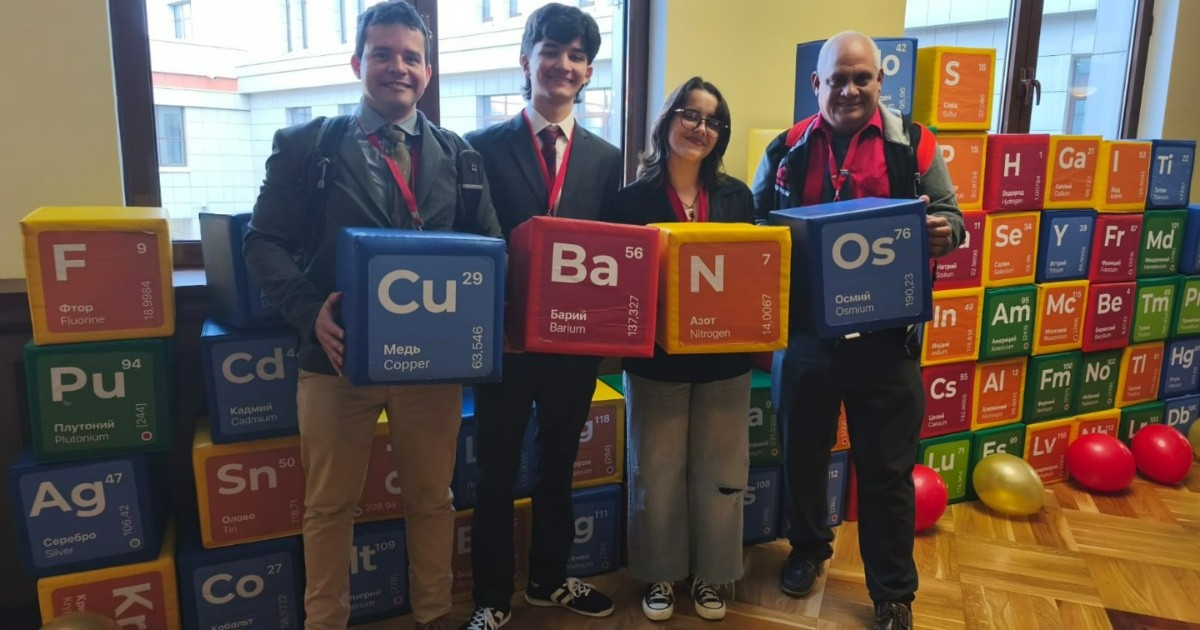
The catalyst was real and deserves recognition: Leticia María Merlo Alfonso and Ernesto Alejandro Barrera Ramírez from the IPVCE Eusebio Olivera Rodríguez in Sancti Spíritus, won bronze medals at the 60th Mendeleiev International Chemistry Olympiad, held from April 15 to 23 at Lomonosov State University in Moscow, with over 200 students from 35 countries.
The achievement is genuine: for Ernesto, it's his third international medal at chemistry Olympiads; for Leticia, it's her second.
However, Cubadebate was not satisfied with just celebrating the talent of these young individuals and turned the outcome into propaganda ammunition.
"It is not necessary to have extensive statistical data or a report from international organizations to refute the campaigns that attempt to present Cuba as a 'failed state.' It suffices to look at what happened at the 60th edition of the Mendeleiev International Chemistry Olympiad," wrote the state media.
The post added, with a tone of media conspiracy: "This information will not be known through the mainstream media."
The state media Escambray replicated the same approach with an article of identical title, reinforcing the regime's propaganda line.
The criticisms came quickly in the comments.
"Now I wonder what the intelligence of people and their good preparation have to do with a failed government! Both can coexist, and one has nothing to do with the other. They want to cling to a hot nail," a netizen questioned.
"It's not a failed government; it's a government that has failed in everything. By the way, I have friends with whom I studied at IPVCE, and they also won international competitions in Chemistry and Computer Science. Now they're in Belgium, Spain, the United States... is that also an achievement of the 'country,' or can it be considered a failure?" said another.
The instrumentalization stands in stark contrast to the reality of the Cuban educational system, which is experiencing its worst crisis in decades.
The 2025-2026 school year began with a deficit of 24,000 teachers nationwide —one out of every eight positions is vacant— with provinces such as Matanzas, Camagüey, and Sancti Spíritus —the same province as the medalists— among the most affected, each with around 2,000 vacancies.
Primary school teachers earn between 2,500 and 3,000 Cuban pesos per month, which is equivalent to between six and ten dollars at the informal exchange rate, while the basic food basket ranges from 25,000 to 50,000 pesos.
The most revealing data came just the day after the news of the bronze: a teacher showed on TikTok how her salary of 3,000 pesos barely covered the cost of chicken and rice, and she declared: "I feel like I'm going to starve."
More than 10,000 Cuban schools are in poor condition: dampness, leaks, roofs coming off, and destroyed furniture.
In February 2026, a ceiling panel fell in a Havana primary school and injured two children.
The famous Mixta Victoria de Girón School in Nuevitas, Camagüey —once the largest primary school in Latin America, inaugurated in 1979— is now in a state of complete abandonment.
While the system collapses from within, the regime sent teaching brigades abroad, including to Jamaica, in August 2025.
The tactic of Cubadebate is not new: the regime has spent decades using specific achievements—whether in sports or science—as a shield against structural criticism, a practice that in March 2025 was reiterated by Díaz-Canel's press chief in response to the concerns of singer-songwriter Silvio Rodríguez regarding the "loss of national dignity" in Cuba.
The political context makes the instrumentalization even more evident: a survey from 20 independent media outlets published this Saturday revealed that Díaz-Canel has a 92.2% rejection rate among Cubans on the island and a 97.7% rejection rate in the diaspora.
Leticia and Ernesto prepared for months with online training, independent study, and laboratory practice — even Canal Caribe acknowledged that they achieved this without high-tech laboratories — which makes their accomplishment even greater and the political appropriation by the regime all the more outrageous.
Filed under: