
Related videos:
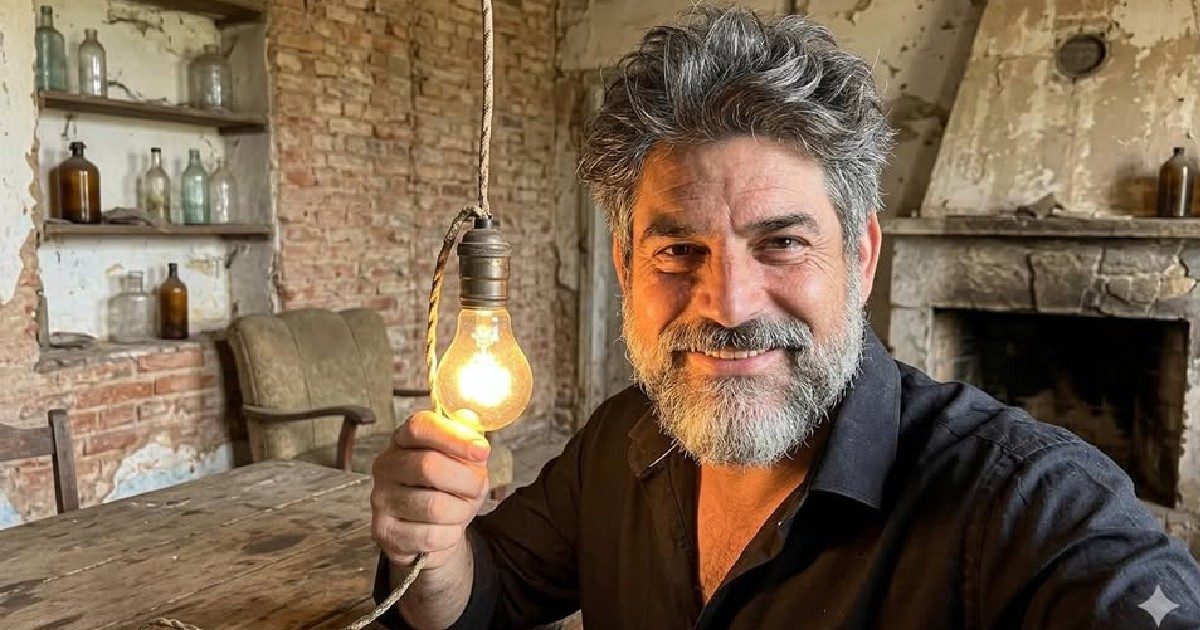
The Cuban playwright Irán Capote posted this Saturday on Facebook a reflection filled with sarcasm about the Cuban government's announcement to achieve energy independence by 2050 through a 100% renewable energy grid, accompanying the text with an AI-generated image depicting him as an elderly man holding a lit lightbulb.
"By 2050, we will have energy independence. How wonderful! Truly... how great that we already have a plan, a path, a hope, an improvement!" Capote wrote, before posing the question that encapsulates all the absurdity: "What could another 25 years mean? Just nonsense! A quarter of a century, no more, no less!"
The announcement that prompted the post was made on April 23 by the Cuban Minister of Energy, who detailed the stages of the official plan: 24% renewable penetration by 2030 —up from the current 10%—, 40% by 2035, and 100% by 2050 to achieve "total sovereignty." The regime presented it as a historic achievement of the Revolution, with customs tax exemptions for renewable equipment and tax benefits for investors over eight years.
Capote, however, did not settle for the 25 years. With the precision of someone who knows the system well, he pointed out that the margin of error could extend the timeline: "Perhaps it won't be 25 but 30, you know, leaving room for those unexpected occurrences: a pandemic, three or four more rearrangements, four or five collapses of all systems, twenty-seven or twenty-eight scandalous cases of corruption, seventy-five thousand budgets misallocated to acts of repudiation, to anti-imperialist platforms, not to mention numerous natural phenomena... just the usual."
The playwright then envisioned a future scene worthy of any of his works: "I can already see myself at 61 telling my grandparents: 'We did it, we finally did it. Just look at how much those years of retirement spent sleeping in the dark and working magic to pay for medications have been worth.'"
And for those who may have left the country, he also reserved some words: "You see that it was worth it not to leave. You see that it was worth it to wait. You see that it was worth it to dedicate the years of youth to a cause that you said was not yours."
But the devastating punchline came when the creator, hailing from Pinar del Río, extended the logic of the official plan beyond 2050: "Then, we will be ready to start fixing everything else. In 2050, we will create a plan so that by 2075 we can eat and live off our salaries. And by 2100, we will have everything else!"
Capote's sarcasm is not unfounded. Cuba closed 2025 with the worst electrical crisis in decades, experiencing blackouts of up to 24 hours daily in the interior of the country and more than 12 hours in Havana. The generation deficit exceeded 2,147 MW on December 17, 2025, and on December 5, it was forecasted that up to 61% of the country would be without power simultaneously. The Minister of Energy himself, Vicente de la O Levy, acknowledged that 2025 was "a very difficult year, characterized by the greatest lack of fuel" and warned that disruptions would continue into 2026.
On March 16, 2026, the sixth total national blackout occurred in 18 months, with nine out of 16 thermal units out of service. Renewable sources accounted for only 4.6% of generation in 2024, far below the goals set by the government itself since 2014.
It is not the first time that Capote has used dark humor to highlight the contradictions of the regime. In 2022, UNEAC prevented him from taking a position as a professor at the School of Theater Instructors in Pinar del Río due to "ideological issues." In April 2024, he published the poem "My people have fled in droves," about the massive migratory exodus. His technique of feigning patriotic enthusiasm to expose the absurd has become a recognizable trademark among Cubans who are critical of the regime.
At the end of his publication, Capote anticipated the criticism he would receive and disarmed it with a final twist, alluding to the oft-repeated concept of Revolution by Fidel Castro that is heavily used by Cuban official propaganda: "One just has to have confidence. And common sense, a lot of common sense about the historical moment."
Filed under: