
Related videos:
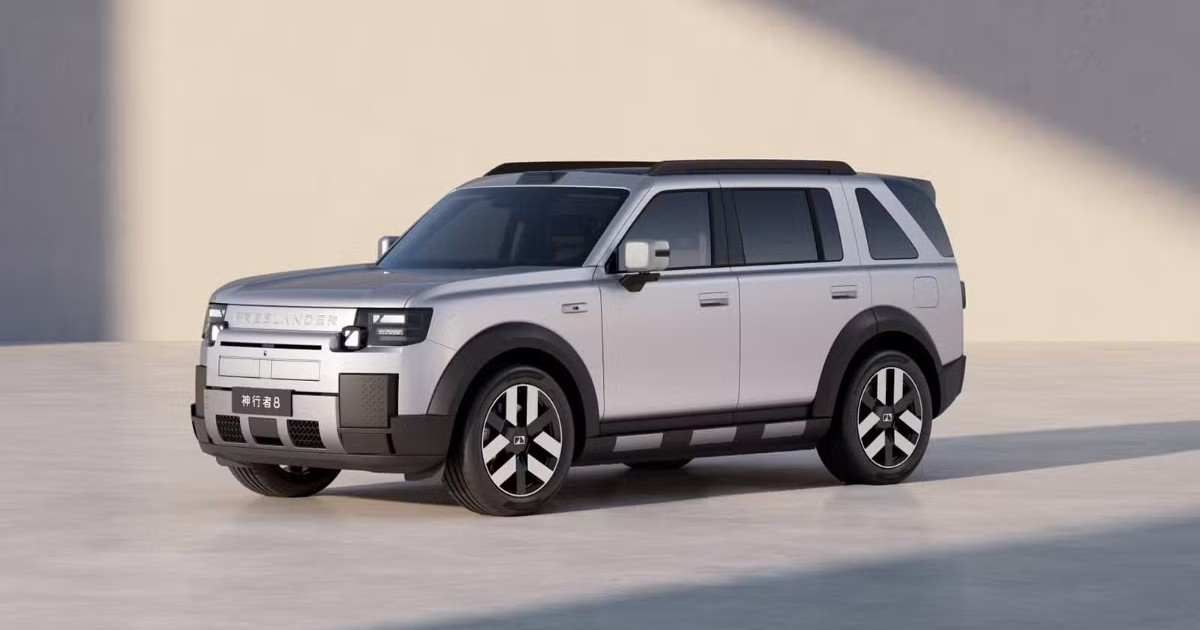
The brand Freelander, revived as a joint venture between Chery and Jaguar Land Rover, revealed this Monday the official name and the first production images of its first model: the Freelander 8, a luxury all-terrain SUV featuring autonomous driving technology from Huawei, high-performance battery from CATL, and processor from Qualcomm, expected to debut in the Chinese market in the second half of 2026.
The most revealing detail of the project is not the return of a historic name, but rather who is in charge: the Chinese team led the product definition and smart technological development, while the Jaguar Land Rover team focused on aesthetic design and preserving the brand's luxury legacy.
The Freelander 8 is built on the iMax platform, capable of supporting pure electric propulsion, plug-in hybrid, and range extender, with an 800-volt architecture.
The battery was co-developed with CATL under the name "Freevoy All-Terrain": it offers 6C charging with a peak power of 360 kilowatts, enough to add approximately 400 kilometers of range in ten minutes, and incorporates third-generation CTP technology with specific protection for off-road use.
The autonomous driving system is the Huawei Qiankun ADS 5.0, standard across the entire range, and the Freelander 8 will be one of the first production vehicles in the world to integrate Huawei's 896-channel LiDAR, capable of detection over 1,000 meters.
The processor is the automotive-grade Qualcomm Snapdragon 8397, which triples the computing capacity compared to the previous generation and is also one of the first to be implemented on a global scale in a production vehicle.
The exterior design of the Freelander 8 follows the aesthetics of the Concept 97 — presented at the Beijing Motor Show in April 2026 — featuring the characteristic boxy silhouette of the SUVs from the Land Rover family, under the supervision of JLR's creative director, Gerry McGovern.
The Freelander brand was globally launched on March 31 in Shanghai as an independent new energy vehicle brand, headquartered in that city, with a design center in Gaydon (United Kingdom), a research institute in Suzhou, and a manufacturing base in Changshu.
The journey to this point began in June 2024, when JLR formally authorized the joint venture to use the "Freelander" brand for electric vehicles, elevating it from a model lineup to an independent brand.
In December of that same year, the Changshu factory committed an investment of 3 billion yuan (434 million dollars) for its electrification upgrade.
The model embodied by the Freelander 8 is not new to the industry: Huawei is already implementing its automotive technology ecosystem with Seres under the AITO brand—over 500,000 units delivered by the end of 2024—and with Chery under the Luxeed brand.
This Sunday, Dongfeng and Huawei presented the Yijing X9 at the Beijing Auto Show, another SUV built on the same framework: a brand with history + a Chinese platform + Huawei technology.
The Freelander 8 case confirms that global alliances in the automotive sector are no longer centered around Western engines or mechanical platforms, but rather around batteries, software, and Chinese digital ecosystems: Dongfeng also revived its alliance with Stellantis under a similar logic.
The brand plans to launch six new models over the course of five years, introducing new vehicles every six months, starting with the Chinese market where competition in the luxury electric segment is, according to the company itself, "fiercely competitive."
Filed under: