
Related videos:
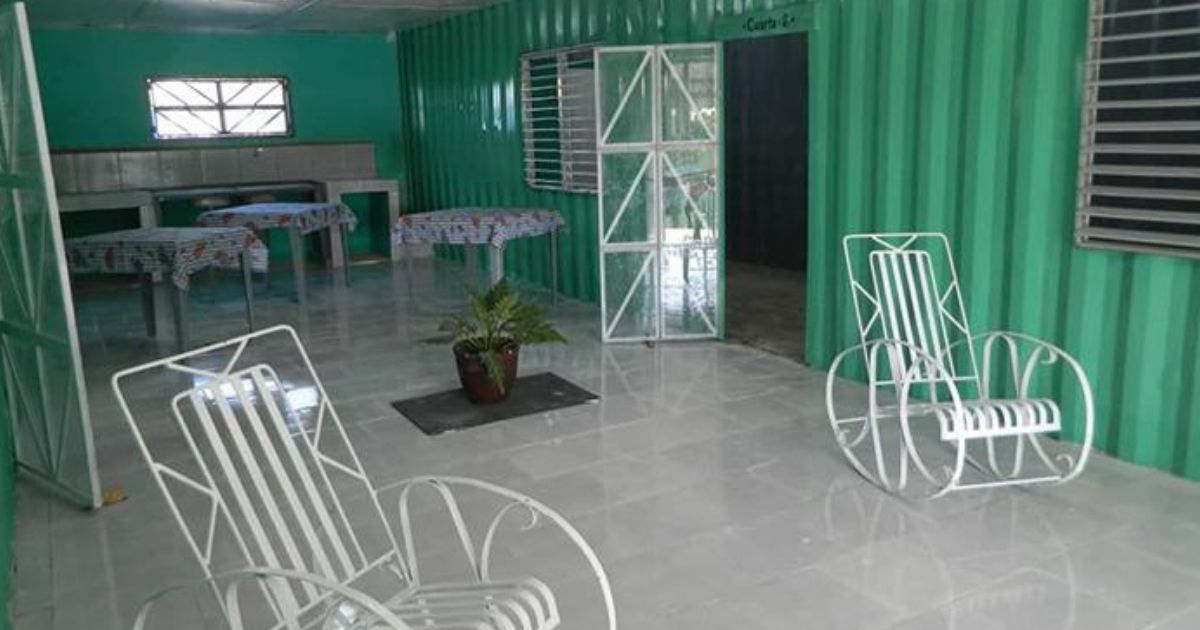
The Electromechanical Company of Villa Clara inaugurated the first elder care home located within a state-run workplace in Cuba, a facility designed from the adaptation of two containers with the capacity to accommodate around 20 retirees from the company itself.
The head of the entity, Justo Rodríguez Gattorno, described the initiative as "an act of justice for those who dedicated years to production, and which holds even more value as it originated from the collective itself." Although the official press presents this place as an achievement, it refrains from mentioning the hardships that retirees endure on the island.
The facility includes a medical post, dining area, bathroom, television, and space for exercise, as detailed by the manager, who specified that the operational costs will be covered by resources generated by the company itself, without reliance on state funds.
The nearly 20 retired individuals welcomed will not only receive care but will also share their experiences with the new workers joining the center and support the company’s organoponic initiative.
The opening occurs in the context of a serious crisis in the care for the elderly in Cuba, the oldest country in Latin America: 25.7% of its population is over 60 years old, according to data from the end of 2024, which amounts to about 2.5 million people.
Villa Clara is precisely the most aged province in the country, with 29.1% of its population in that age range.
The state care system is clearly insufficient: Cuba has only 156 nursing homes and 12,697 beds for the entire national territory, leaving 51 municipalities without any such service.
The Ministry of Labor and Social Security admitted in March 2026 that "there are no resources to care for vulnerable individuals", a statement that impacts 1,774,310 retirees registered in the country.
A survey conducted by the organization ASIC among 506 retirees revealed that 98.8% feel institutional abandonment, and 99% claim that their pension does not cover basic needs, in a context where civil pensions do not exceed 4,000 pesos per month, which is less than ten dollars at the informal exchange rate.
Mass migration—over 1.4 million Cubans since 2020—has further exacerbated the situation, leaving 17.4% of older adults without close family members, according to 2024 data.
In response to this crisis, the regime authorized in February 2026 for micro, small and medium-sized enterprises, cooperatives, and self-employed workers to open nursing homes through Agreement 10249/2025, while Resolution 247/2025 from the Ministry of Public Health, published on April 21, established the operational standards: a maximum capacity of 60 people, mandatory electrical generator, and a 10% reservation of spots for vulnerable individuals.
Several internet users celebrated the opening of the senior center in Villa Clara and called for the initiative to be replicated. María Abreu Rodríguez noted, "There are many centers that have abandoned and deteriorating facilities, and they can be used to give back something to the many contributions made by the former workers of this country."
The foreign press has also highlighted the abandonment of the elderly in Cuba as one of the most visible symptoms of the collapse of the social model under the dictatorship, a problem that worsens with each passing year without structural reforms.
Filed under: