
Related videos:
The activity of Genry Almenarez, known on social media as "The Titan of Cuba," starkly illustrates the type of spokespersons that the Cuban regime promotes both inside and outside the island: figures who merge political propaganda with an aggressive, exclusionary, and openly violent language.
Based in the United States for over two decades, Almenarez has become a vocal amplifier of the official discourse of Castrosim, while taking advantage of the freedoms offered by that country to engage in political promotion for a system that represses those same freedoms in Cuba.
In recent days, the influencer joined the campaign "My Signature for the Homeland", promoted by the Communist Party of Cuba (PCC), urging Cubans both on and off the island to support an initiative that has been highlighted by testimonies of coercion in workplaces and communities. However, their activism is not limited to propaganda.
During a live broadcast, Almenarez went further by publicly celebrating the beating inflicted by State Security on the Cuban fighter Javier Ernesto Martín Gutiérrez, known as "Spiderman".
Far from condemning the violence, he mocked the situation and justified it, explicitly showing support for the repression of the totalitarian Cuban state, which has spilled blood, blinded lives, and crushed thousands of Cubans and their families with imprisonment, exile, and ostracism over the course of 67 years.
The tone used is not informal. His speech is rife with insults, disparagements, and homophobic expressions directed against activists, opponents, and critical members of the Cuban diaspora.
It is a rhetoric that not only degrades public discourse but also reproduces patterns characteristic of the political culture of the regime: dehumanizing the opponent to legitimize the attack.
Far from being a marginal figure, Almenarez has been highlighted and promoted in spaces aligned with the government.
It was presented on the propaganda program “Chapeando Bajito” - hosted by the official journalist Arleen Rodríguez Derivet - as “a very original YouTuber” who denounced alleged “inciters of violence.” He has also participated in initiatives such as the International Colloquium Patria, one of the main events of the regime's communication apparatus.
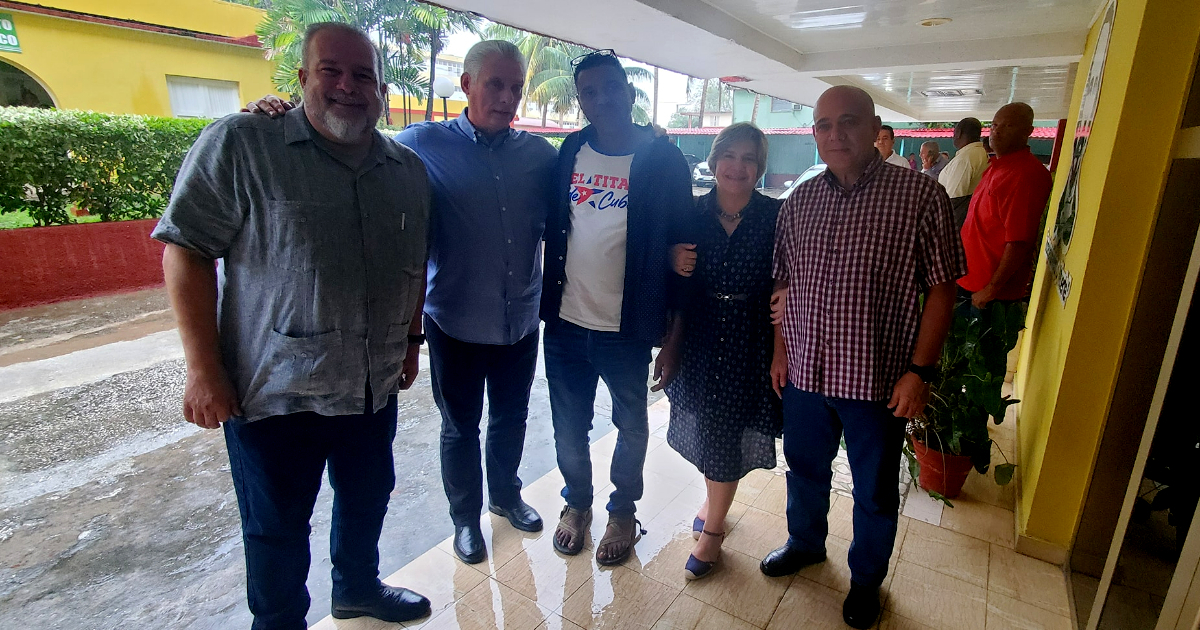
Moreover, his proximity to the power elite is evident in images where he appears alongside Miguel Díaz-Canel, Manuel Marrero Cruz, Roberto Morales Ojeda, and Lis Cuesta Peraza, at meetings that are far from casual.
According to reports from independent platforms, the creator has traveled to Cuba several times and has met with officials from the Communist Party, reinforcing his role as a figure aligned with the official narrative.
In parallel, media outlets aligned with the dictatorship such as Cubainformación present him as the “voice of the Cuban emigration” and part of a “battleground against the media war,” validating his role within the regime's digital strategy.
All of this occurs while Almenarez resides in the United States, a circumstance that adds a particularly delicate dimension. From U.S. territory, he not only openly defends an authoritarian government but also justifies the violence against citizens exercising their right to dissent in Cuba.
In this context, it is worth recalling that during the administration of President Donald Trump, measures were taken against individuals linked to regimes considered adversarial or who actively participate in promoting their interests. Cases involving actors associated with governments such as those of Venezuela, Nicaragua, or Iran have resulted in sanctions, immigration restrictions, or status reviews.
Without establishing automatic equivalences, Almenarez's activity raises a legitimate question: to what extent is it acceptable for a person residing in the United States to use that space to promote and justify the repressive practices of a foreign regime?
The question becomes even more significant when observing the contradiction between the official rhetoric of the Cuban regime and the leaders of the so-called "continuity" —who insist on concepts such as "love" and "peace"— and the promotion of figures who, like "El Titán de Cuba," make verbal aggression, homophobia, and mockery of violence their main communication tools.
More than just a controversial influencer, Almenarez represents a symptom of a broader strategy: the use of spokespersons in the diaspora to amplify the regime's message, even when that message involves normalizing repression.
And that, inevitably, transcends the realm of social media.
Filed under: