
Related videos:
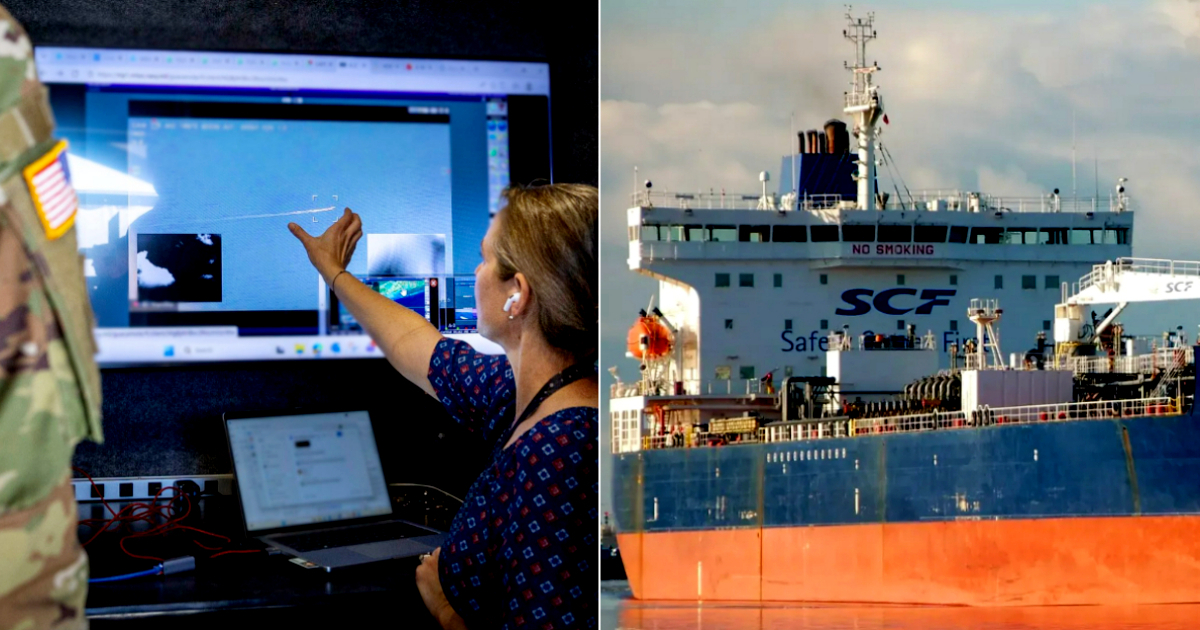
The Russian tanker Universal, sanctioned by the United States, the European Union, and the United Kingdom, continues its journey across the Atlantic amid growing questions about its final destination, in a context marked by Washington's geopolitical and military pressure in the Caribbean.
According to the specialized site marinetraffic.com, the most recent maritime tracking data places the vessel at 30.534433 N, -52.156906 W, with an update received about 14 hours ago.
This position indicates a shift from the previously recorded location (31.077833 N, -51.449000 W), suggesting that the tanker has traveled approximately 80 to 100 nautical miles to the southwest during that time.
The change is significant. While in the previous report the Universal was showing a course of 323 degrees (northwest), it now appears to be sailing at 2.2 knots on a course close to 246 degrees (west-southwest), although with typical inconsistencies of the AIS system.
In practical terms, this implies a partial correction towards the Caribbean, but with an even slower speed that reinforces the perception of a cautious and slow navigation.
Despite this correction, the ship still does not declare a final destination in the automatic identification systems, which keeps the uncertainty open about whether it is actually heading to Cuba or if it is adjusting its course based on external factors.
The context in which this behavior occurs is especially sensitive. The Universal is part of the Sovcomflot fleet and is subject to Western sanctions, while U.S. regulations — particularly the OFAC General License 134A — explicitly exclude Cuba from operations involving Russian oil under U.S. jurisdiction.
In parallel, the United States has notably intensified its military presence in the vicinity of the island. The FLEX2026 exercise, taking place in Key West, integrates drones, artificial intelligence, combat ships, and autonomous systems into an architecture capable of detection, tracking, and intercepting vessels in real-time.
This deployment is not seen as an isolated movement. Analysts point out that it fits into a pattern of stepped pressure similar to that applied in Venezuela before the fall of Nicolás Maduro, combining surveillance, naval presence, and maritime interdiction capability.
In this context, the trajectory of the Universal may not be solely a technical decision. The combination of sanctions, recent precedents of ship diversions under regulatory pressure, and the operational capacity deployed by the United States in the Caribbean opens the door to a scenario where the tanker is operating under external conditions, waiting for political definitions or security guarantees to complete its route.
For now, the ship moves forward, but it does so slowly and without a completely clear course. And in an environment where every movement at sea can be monitored in real time, that apparent drift could indicate much more than just simple navigation adjustments.
Filed under: