
Related videos:
From Little Havana in Miami, families of Cubans imprisoned by the communist regime in Havana raised their voices this week to denounce the situation of their loved ones, amidst a moment of high tension between Washington and Havana, as reported by Local 10.
The political context is crucial: last Wednesday, the U.S. Senate rejected by a vote of 51 to 47 the resolution proposed by Democratic Senator Tim Kaine, which aimed to limit President Donald Trump's war powers regarding Cuba.
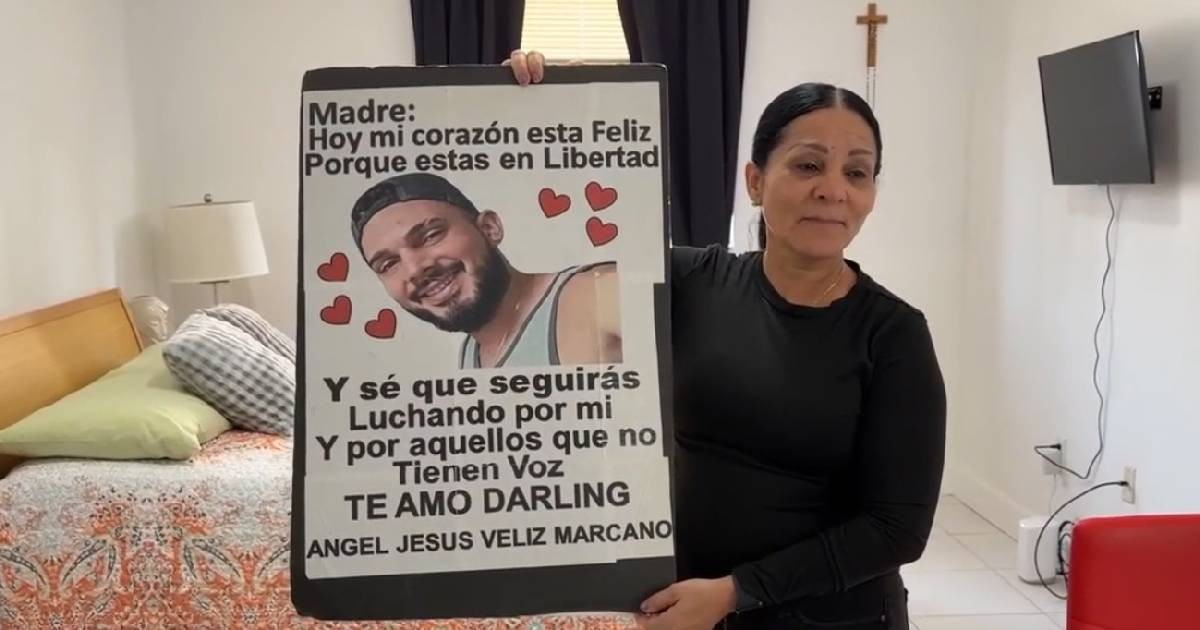
Ailex Marcano has lived in prayer and pain for the past five years, since her only son, Ángel Jesús Véliz Marcano, was arrested in Camagüey after participating in the historic protests of 11J in 2021.
"Freedom for my son, I beg you, Sir," Marcano said to the Local 10 channel.
The young man, a 31-year-old physical education teacher, was sentenced to six years in prison and is currently held at Kilo 9 Prison in Camagüey, where, according to human rights organizations, he is suffering from malnutrition.
Marcano, who previously traveled to Geneva with the Cuban Human Rights Organization to bring visibility to the case before international bodies, claims he is speaking publicly at the request of his family.
Jorge Luis García Pérez, known as Antúnez, a historic Cuban dissident who spent over 17 years imprisoned on the island for opposing communism, also spoke.
Antúnez reported that his brother, the religious leader Loreto Hernández García, and his sister-in-law, Donaida Pérez Paseiro, are serving sentences of seven and eight years, respectively, for their involvement in human rights demonstrations in Placetas, Villa Clara.
"I am pained by the issue of political prisoners," declared García Pérez, who also warned that Cuba will not experience change without a complete transformation of the government.
Donaida Pérez, a Yoruba priestess, was temporarily released in January 2025 but was re-incarcerated for rejecting the conditions imposed by the authorities, including not conducting live broadcasts.
While these families cry out for their loved ones, Díaz-Canel insists on denying reality: in an interview with NBC News broadcast on April 12, the Cuban leader referred to the existence of political prisoners on the island as a "great lie" and "slander".
This stance contrasts sharply with the figures documented by independent organizations: Prisoners Defenders recorded a historical high of 1,250 political prisoners at the end of March 2026, including 145 women and at least 33 minors, while Justicia 11J reported 775 political prisoners in April, of which 338 correspond to sentences for the protests on July 11.
The energy crisis further worsens the situation: since the Executive Order signed by Trump on January 29, 2026, which imposes secondary tariffs on countries that export oil to Cuba, the island has only received one shipment of fuel per month when it needs eight, with blackouts affecting 64% of the country in March.
The Easter pardon on April 2 benefited 2,010 individuals for common crimes, but expressly excluded the categories of sedition and disrespect, which the regime uses to imprison those who protest.
Filed under: