
Related videos:
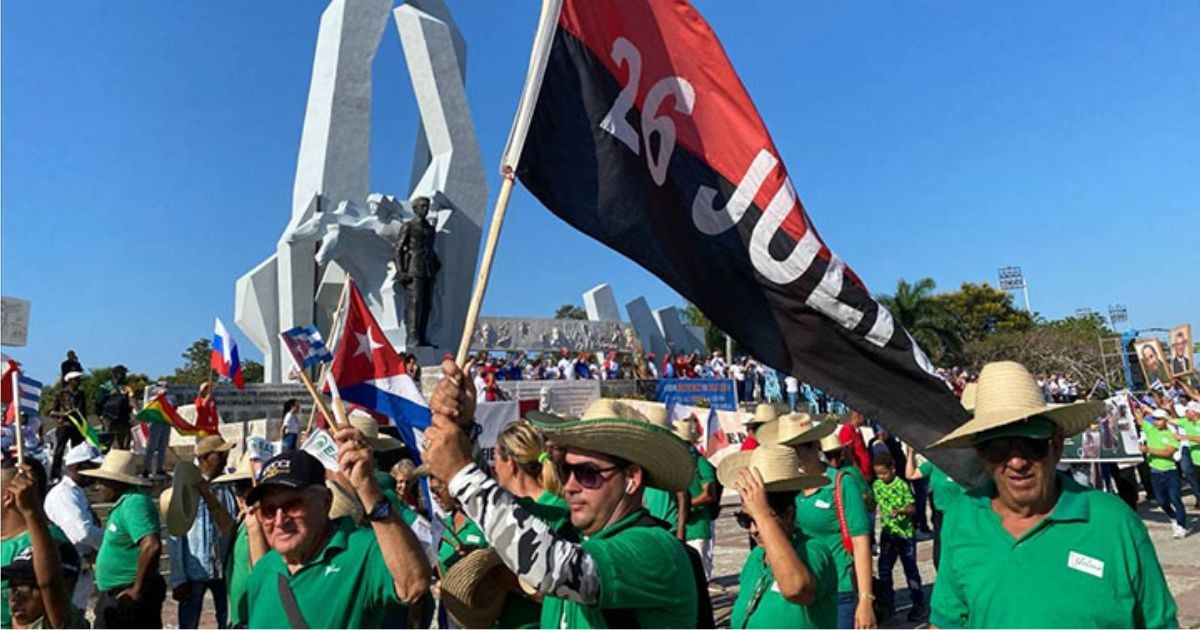
The Cuban News Agency (ACN) described the May Day parade in Camagüey on Friday as an event "marked by unity and efficiency", featuring "massive participation of workers from all sectors" in the Plaza de la Revolución Mayor General Ignacio Agramonte Loynaz. The contrast with the reality faced by those same workers outside the plaza is hard to overlook.
According to the official report, labor collectives from the Beverage and Soft Drink Company (Ember), the Project and Engineering Company (ENPA), the Select Fruits Company, and the Agro-Industrial Grains Company marched alongside small and medium-sized enterprises (mipymes) and other forms of non-state management, all presented as evidence of the "progress of productive linkages." The theme of the parade was "The Homeland is Defended," dedicated to the centenary of Fidel Castro's birth and the 65th anniversary of the Bay of Pigs.
Luis Norberto Díaz Gómez, director of ENPA, stated to ACN that "thanks to the productive chain, the company is currently able to solve various issues related to equipment maintenance and energy deficits." A notable statement in a province where power outages exceed 12 and even 20 hours a day, halting basic services and daily activities.
The "efficiency" praised by the regime's press occurs in the same territory where, in February, there was only one bus daily to Havana due to a diesel shortage, with the rest of the interprovincial transport suspended. The telecommunications base stations, on the other hand, were operating only between two and six hours a day due to lack of fuel, leaving areas like Minas, Senado, Lugareño, and Redención without phone signal or internet.
Jenry Puentes Rodríguez, the General Secretary of the Central Workers' Union of Cuba (CTC) in the province, intensified the militant tone of the event by declaring that "in the face of the empire's threats, the spirit of struggle grows larger, whether in the fields, in classrooms, hospitals, the thermoelectric plant, scientific centers, or in every space where solutions are sought, innovations take place, and rationalization occurs." What he did not mention is that just weeks ago, the CTC itself was asking workers to solve the country's energy deficiencies, shifting the responsibility for a crisis created by 67 years of dictatorship onto the workers.
Participation in these parades is formally "voluntary," although in practice it is mandatory for state workers. This year, the regime took children out of schools to bolster the May Day marches, a practice that undermines any claim of popular spontaneity.
The parade in Camagüey was attended by Vice Prime Minister Jorge Luis Tapia Fonseca, Governor Jorge Enrique Sutil Sarabia, and Yudí Rodríguez Hernández, a member of the Secretariat of the Central Committee of the Communist Party of Cuba (PCC).
The backdrop makes the spectacle even more grotesque. The average state salary in Cuba is 6,930 pesos per month—equivalent to about 15 dollars at the informal exchange rate—while the basic cost of food for one person exceeds more than five full salaries. The UN acknowledged in April the need for humanitarian assistance in 60 Cuban municipalities, and five provinces are experiencing extreme levels of food insecurity, according to the food monitoring program report from that month.
Nationally, the central event for this May Day was moved from the Plaza de la Revolución to the José Martí Anti-Imperialist Tribune —across from the U.S. Embassy on the Malecón in Havana— under the pretext of "austerity." The regime that called for the march with a warlike tone in the midst of its worst economic crisis found no better way to celebrate Cuban workers than to remind them once again that the "empire" is to blame for everything. A narrative that very few still believe.
Filed under: