
Related videos:
The current fees for document legalization in Cuba establish a difference of up to 25 times between what a permanent resident on the island pays and what a Cuban living outside the country pays, according to the updated breakdown published by Directorio Cubano this Friday.
The tax is paid using stamp seals and varies according to the type of procedure and the applicant's residency status. This fee structure was established by the Resolution 486/2025 of the Ministry of Justice, published in the Official Gazette on December 27, 2025, which replaced Resolution 171/2022.
Documents for use abroad
For academic documents, notarized writings, and copies of judicial sentences intended for abroad, permanent residents pay 40 Cuban pesos (CUP), while non-residents must pay 1,000 CUP.
For other official certifications—such as those from the Civil Registry, the identity card, the Registry of Sanctioned Individuals, the Historical Archive, the Archdiocese, employment certificates, or professional licenses—residents pay 20 CUP and non-residents pay 500 CUP.
This pricing structure has faced harsh criticism. The organization Cubalex described it in January 2026 as "economic apartheid" and "legalization of inequality," noting that it institutionalizes unequal access to legal services and reflects a state-driven pattern aimed at extracting foreign currency.
Certifications in specialized law firms
Collective law firms also handle documents for use abroad. The certification of citizenship and legal capacity costs 10 CUP for residents and 250 CUP for non-residents.
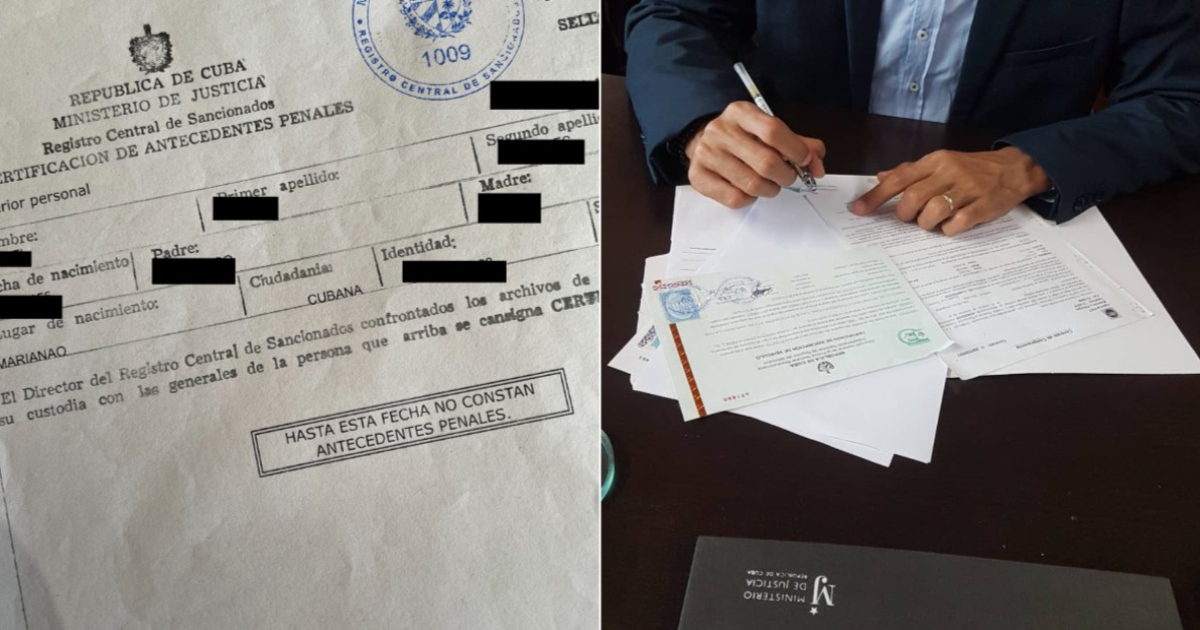
Criminal record certifications, birth, marriage, death, or others based on official records have the lowest prices: five CUP for residents and 125 CUP for non-residents.
This type of paperwork has generated increasing discontent among Cubans living abroad, who report the high costs of the procedures and the difficulties in managing them from a distance.
Foreign documents valid in Cuba
For documents issued by diplomatic or consular officials accredited in Cuba that need validity in the country, the fee is 20 CUP for residents and 500 CUP for non-residents.
The same amount applies to documents issued abroad and subsequently certified by Cuban consular authorities.
A significant change: documents issued directly by Cuban diplomatic or consular officials no longer require additional legalization by the Ministry of Justice.
Payment methods
The tax can be paid using physical stamp duty stamps, which can be purchased at the offices of Correos de Cuba.
Digital payment is also available through Transfermóvil, an option enabled by Resolution 4 of 2023 from the Ministry of Justice, or through the digital purchase of a stamp at post offices with a receipt.
However, before opting for the digital format, it is advisable to check if the destination country accepts it, as some procedures still require a physical paper seal.
In 2024, over 1,500,000 documents were legalized in Cuba, a figure that reflects the high demand driven by the massive Cuban emigration in recent years.
As of February 3, 2025, the Ministry of Justice has taken on the legalization functions that previously belonged to the Ministry of Foreign Affairs, under Agreement 10034 of the Council of Ministers.
Filed under: