
Related videos:
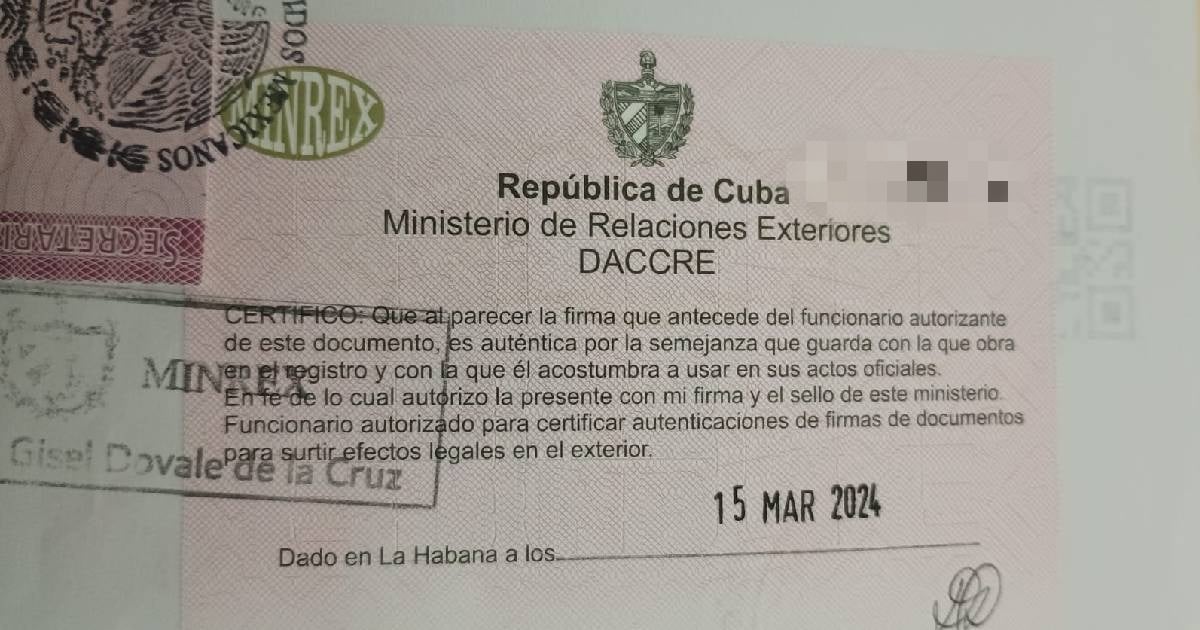
The Ministry of Foreign Affairs of Cuba (MINREX) has announced that it will cease to provide the document legalization service, a function that will now be handled by the Ministry of Justice (MINJUS).
This measure was formalized through the Agreement 10034 of the Council of Ministers, adopted on December 30, 2024, and published in the Official Gazette of the Republic of Cuba, extraordinary edition of February 3, 2025.
According to the official text, the modification addresses the need to update administrative procedures and improve the efficiency of the certification and legalization of both Cuban and foreign documents that must take effect in the country or abroad.
To this end, Section Six of Agreement 7538 of the Council of Ministers dated March 4, 2014 was amended to establish that authorized legal service entities will submit document legalization requests to the Ministry of Justice.
Regarding this, Ana Teresita González, Director General of Consular Affairs and Care for Cubans Residing Abroad (DGACCRE), confirmed on the social network X that the transfer of legalization functions aims to integrate all phases of the process, from the registries to law firms and consultancies.
"With the aim of integrating all phases of the process for the legalization of Cuban and foreign documents that takes place through registration entities, law firms, and consultancies, today we are transferring the legalization functions from CubaMINREX to Minjus_Cuba," he expressed in his post.
González also affirmed that the established pathways for the legalization of documents remain in place, allowing the population to continue accessing these services normally.
No disruptions to the apostille processes or existing international agreements are anticipated.
In 2023, MINREX acknowledged a significant increase in the demand for document legalizations, which caused delays in the processing of documents.
This increase was attributed, in part, to the opportunity for many Cubans to obtain Spanish nationality through the Law of Democratic Memory, which has been in effect since October 2022.
To address these challenges, MINREX has implemented measures that have managed to reduce the legalization process to a period of 10 days since May 2024.
Digitization of Services
In August 2024, the International Consulting and Legal Firm (CONABI) launched a digital platform that allows citizens to request and legalize criminal records without the need for prior appointments, making payments through Transfermóvil and EnZona.
This service, initially available only to residents in Cuba, aims to streamline processes and reduce the burden on physical offices.
Posteriormente, en enero de 2025, Digitalization was expanded al permitir la gestión en línea de certificaciones del Registro del Estado Civil.
This service offers advantages such as the elimination of prior appointments, the ability to carry out procedures at any time, and real-time tracking of application status.
During its pilot phase, it was developed with a limited capacity of 50 requests per week, with plans to gradually increase this number.
Study of Adherence to the Apostille Convention
In light of the increasing volume of procedures, the Cuban government has considered the possibility of joining the Apostille Convention.
This international agreement would simplify the validation of documents for use abroad, reducing the need for additional legalization by up to 60% of cases.
Although this option is under consideration, it would represent a significant solution to expedite the legalization processes.
Frequently Asked Questions about Document Legalization in Cuba
Who will now be responsible for the legalization of documents in Cuba?
The Ministry of Justice (MINJUS) will be responsible for the legalization of documents in Cuba, replacing the Ministry of Foreign Affairs (MINREX). This measure was formalized through Agreement 10034 of the Council of Ministers.
What motivated the change of responsibility in the legalization of documents?
The change responds to the need to update administrative procedures and improve efficiency in the certification and legalization of both Cuban and foreign documents. The aim is to integrate all phases of the legalization process from the registration entities to law firms and consultancies.
How will this measure affect the Cuban population?
According to the authorities, no impact on the population is expected regarding the legalization processes, as the established channels for these services remain in place. The public will be able to continue accessing document legalization through registry entities, law offices, and consulting firms.
What measures have been taken to expedite the document legalization processes?
A digital platform has been implemented by the International Consultants and Lawyers Office (CONABI) that allows online management of certain documents such as criminal records and certifications from the Civil Registry. This eliminates the need for prior appointments and enables users to carry out procedures from anywhere at any time.
Filed under: