
Related videos:
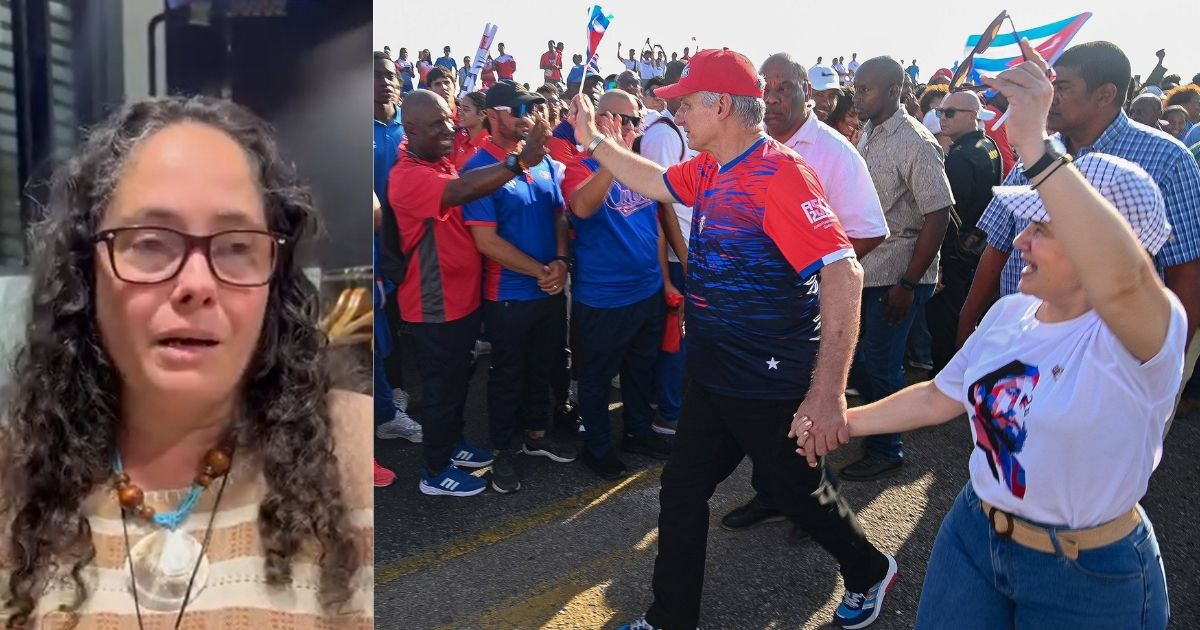
The May Day march in Cuba was, according to Cuban academic Hilda Landrove, little more than an empty representation: "more akin to a performance of a corpse insisting on behaving as if it were alive, than to a display of revolutionary fervor."
The researcher, who holds a doctorate in Mesoamerican Studies from UNAM, published an analysis on Facebook this Saturday, where she dismantles the official narrative regarding the May Day marches in Cuba, called by the official Central de Trabajadores de Cuba under an anti-imperialist slogan and in the so-called "Year of Preparation for Defense."
The figures released by the official press and its international allies — "more than half a million" or simply "millions" of participants, according to La Jornada, Cubainformación, Resumen Latinoamericano, etc. — are, in Landrove's view, simply "propaganda."
According to the academic, the mobilization follows "a sustained trend of decreasing participation in ideological reproduction rituals in recent years," and the regime's capacity to rally operates under "the usual logics: coercion, oppression, and apathy that lead to repeating what is required even when it no longer makes sense to do so."
It warns that attendance should not be interpreted as genuine support: "This does not mean that participation should be directly read as loyalty, support, or willingness to defend the regime to the last drop of blood."
One of the most revealing signs of the weakening was the relocation of the central event: instead of being held in the Plaza de la Revolución —where the low turnout would have been evident—, Raúl Castro presided over it at the Anti-Imperialist Tribune in front of the United States Embassy on the Malecón in Havana.
The contrast between the official discourse and reality was particularly striking. While the regime called for unity against imperialism, President Miguel Díaz-Canel paraded in Adidas sneakers valued at approximately 1,449 dollars, and his wife Lis Cuesta wore a watch valued at over 5,000 dollars. Days earlier, children were taken out of schools in San Miguel del Padrón and Santiago de Cuba to participate in preliminary marches, illustrating the structural coercion described by Landrove.
The setting in which this march took place is one of deep collapse. Cuba has gone four months without receiving regular crude oil shipments, experiencing blackouts that regularly affect more than 60% of the national territory, and a projected GDP contraction between 6.5% and 7.2% for 2026, the worst in the region. More than 200,000 Cubans were left without water in April due to failures in electric pumping, and hundreds of popular protests have been recorded in Havana alone since January.
In this context, Landrove identifies the only strategy left to the regime: "To persist in portraying an image of popular support." To achieve this, it organizes brigades of foreign supporters who march on May 1st and the following day hold a Solidarity Meeting, so they can return to their countries to praise the revolution. "In the end, the revolution is merely a relic for external consumption, devoid of any meaning for those who have to live under its imposition," the essayist points out.
Landrove also addresses the pressure from Washington and acknowledges that the fear of military intervention is the only internal fuel that can still generate some energy for the regime. However, he warns that this argument has a clear limit: “The anti-imperialist fervor loses its meaning because the horror stories of what might happen pale in comparison to the daily horror that Cubans have been living under in the country for many years.”
"Yes, Trump is a disgrace, but the Cuban regime is one as well, and there is nothing about it that makes it defensible. For a large number of Cubans, the most terrible thing at this point is that the regime responsible for their misery continues to exist," concludes Landrove.
Filed under: