
Related videos:
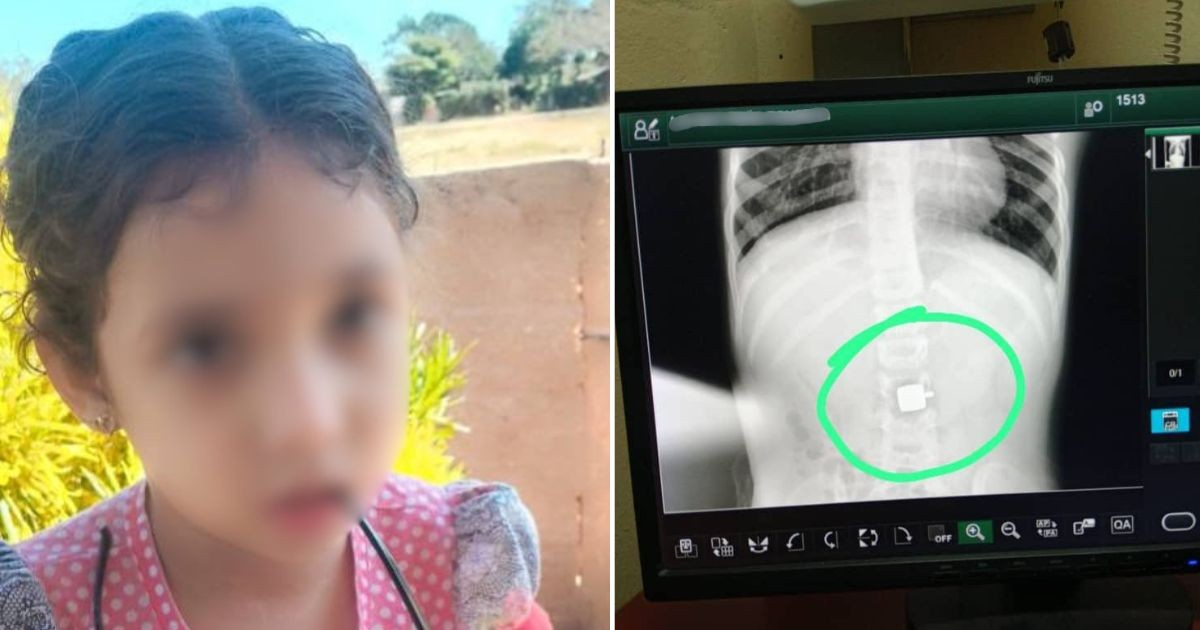
Lisnayi, a girl with cerebral palsy (CP) living in Matanzas, experienced a major scare when she accidentally swallowed a charm from her mother's necklace, as reported on Facebook by the Cuban activist and writer Guillermo Rodríguez Sánchez, known on social media as Guillermo Rodsan.
According to the account, the mother was holding Lisnayi in her arms when the girl, in a sudden movement, "snapped the necklace from her neck, and unfortunately, it fell into her mouth and she swallowed the pendant instantly."
The family immediately went to the emergency room, where X-rays were taken that confirmed the presence of the object lodged in the digestive tract.
The X-ray clearly shows the square-shaped foreign object in the abdominal region.
Fortunately, the incident did not require surgery: "it only needed monitoring for a couple of days until the golden stool came out," Rodsan wrote with relief.
The activist took the opportunity to issue a direct alert to other families with children who have PCI: "no clothing, earrings, or accessories when she is carrying it."
The warning is significant. As Rodsan explained, "children with PCI tend to grab everything within their reach," which exposes them to the risk of accidental ingestion of objects that can lead to serious medical emergencies.
From a medical standpoint, 80% of foreign objects ingested by children pass through the digestive system without complications, but the remaining 20% can become lodged in the esophagus, posing a risk of perforation, especially if they are metallic.
In this case, the object followed its natural course without causing harm.
Lisnayi is originally from Ciego de Ávila and moved with her family to Matanzas a few months ago.
Thanks to the supportive network that Rodsan has built on social media, the family received appliances —a refrigerator, washing machine, rechargeable fan, and kitchen equipment—, more than 250,000 Cuban pesos in food, 100,000 pesos in cash, as well as toys and clothing while living in Ciego de Ávila, and took all of it with them when they moved.
The case of Lisnayi is set against a reality that affects many Cuban families: children with cerebral palsy face institutional neglect in Cuba, along with a chronic shortage of medications, challenges in accessing specialized educational centers, and a near-total dependence on community solidarity networks.
Activists like Rodsan have filled that gap left by the State, channeling donations to vulnerable families with children with disabilities across the island, in the face of a system that turns its back on them.
Other documented cases show the same pattern: Cuban mothers report that the Ministry of Education denies them basic services for their children with disabilities, while families with children with cerebral palsy struggle alone against hardship.
"A scare that could have been worse, but that's all," Rodsan concluded his post, filled with the gratitude of someone who knows that this time the outcome was the best possible.
Filed under: