
Related videos:
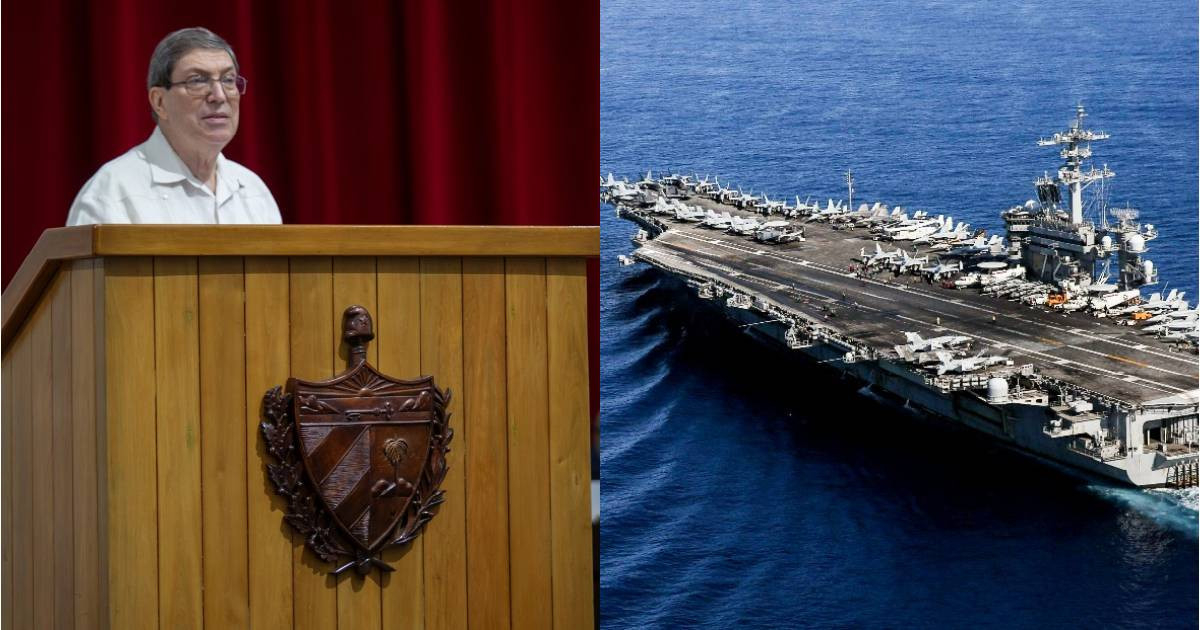
The Cuban chancellor Bruno Rodríguez Parrilla responded with irony this Saturday to the threat from President Donald Trump to send the aircraft carrier USS Abraham Lincoln to the shores of Cuba, asking, "What will we do with that huge mass of metal?"
The statements from the Foreign Minister were made during the International Solidarity Meeting with Cuba "For a World Without Blockade: Active Solidarity in the Centenary of Fidel," which took place today at the Convention Palace in Havana, and a day after Trump outlined a scenario in which the warship would stop about 100 yards (91 meters) from the Cuban coast to force the surrender of the Cuban regime.
Rodríguez quoted the U.S. president verbatim: "Upon returning from Iran, we will bring one of our greats, perhaps the aircraft carrier USS Abraham Lincoln, the largest in the world. It will stop about 100 yards, roughly 90 meters, off the coast of Cuba, and the Cubans will say, thank you very much, we surrender," he recalled.
In light of that scenario, the Chancellor responded with sarcasm. "Could it become a bulk carrier, a tanker for international trade? Today, Cubans are also joking that it could be a dance floor," he scoffed.
The head of Cuban diplomacy also cited another statement from Trump that same night, in which he referred to "a place called Cuba, which we will take control of almost immediately."
The Chancellor warned, however, that any military action would have serious consequences. "Cuba would become a hornet's nest, Cuba would be a deadly trap, Cuba would be the stage for a war involving the entire people if U.S. imperialism dared to attack us," he said.
The speech takes place against the backdrop of the most intense escalation in relations between Cuba and the United States in decades. Trump signed a new executive order on May 1 that dramatically expands sanctions against the island and introduces, for the first time, secondary sanctions against foreign companies and banks that engage with Cuban entities in the energy, defense, mining, and finance sectors.
Rodríguez described the energy blockade imposed by Washington as "an act of war," equivalent to a naval blockade as defined in international law.
He also recalled a radio interview with Trump from January 8 in which the president acknowledged having exhausted his economic pressure arsenal. "I don’t believe much more pressure can be exerted than entering and destroying everything," he specified.
The USS Abraham Lincoln, the aircraft carrier mentioned by Trump, is currently operating in the Northern Arabian Sea as part of Operation Epic Fury against Iran.
In this regard, Trump conditioned his potential deployment to Cuba on first concluding those operations. "I like to finish a job first," he said.
Rodríguez confirmed that Cuba has begun exchanges with the Trump administration, although he made it clear that the internal political and economic order is not on the table.
"We will never discuss with the United States matters that pertain solely to the sovereignty, independence, and self-determination of the Cuban people," he asserted.
The president Miguel Díaz-Canel also responded to Trump’s threats with a similar message. "No aggressor, no matter how powerful, will find surrender in Cuba," he reacted.
The Secretary of State Marco Rubio warned days earlier that "the Cuban regime has only two destinations: neither is good", which represents the strongest stance from Washington towards Havana in recent years.
Filed under: