
Related videos:
Not that way, Fernández de Cossío. The process of nationalizations and confiscations of all private property rights in Cuba was absolutely illegal and, furthermore, did not result in proper compensation for the owners. Any other interpretation of this process is a distortion of the truth. Additionally, viewed from a historical perspective, the nationalizations should never have occurred. There are plenty of arguments to justify this conclusion. The most significant of all is the disaster inflicted on the Cuban economy over these 67 years.
All of this relates to some statements made by Cuba's Deputy Minister of Foreign Affairs, Carlos Fernández de Cossío, on the social media platform X, in which he now asserts, without any justification, that "the nationalizations of foreign properties carried out in the 1960s were legitimate and were in accordance with the Constitution of 1940, national laws, and the practice of International Law." The first recommendation. It is not advisable to use the format of platform X to address such a complex issue as this one. For example, referring only to foreign properties overlooks the most important aspect of the nationalizations, which were the assets that belonged to Cubans.
Second consideration. The reason the communist leader does not address this issue and only focuses on the nationalization of foreign properties carried out in Cuba in the 1960s must have its reasons. Castroism has always had an advantage in this game because it conceals the truth from its interlocutors.
But there should be no doubt in anyone's mind. The confiscations of foreign private capital were not legitimate, and violated what was stipulated in the Cuban Constitution of 1940, and, above all, the practice of international law that prevailed at that time. In fact, the Castro regime established a compensation formula that became a repugnant mockery towards those who were expropriated, as it opted for the most difficult and controversial path, which was the partial and asymmetric negotiation of government-to-government agreements. Through this formula, it was possible to get by with some governments, such as Canada, Spain, France, Great Britain, and Switzerland, which initially found that effective payments were not fulfilled until the 1980s, as happened with Spain, for example.
Here, Fernández de Cossío acknowledges that the United States did not accept the advantageous proposal for compensation, and in defense of its citizens' interests, declined any offer of negotiation, especially once it became clear that the Cuban communist regime had decided to take a decisive stand and opt for the aforementioned country-to-country negotiation formula. In reality, the concentration of expropriated value among United States citizens made this kind of negotiation unfeasible, requiring a unique treatment that never materialized. On the contrary, at no point did the revolutionaries facilitate negotiations, casting false and deceptive accusations against their northern neighbor, claiming it was secretly planning an alleged action to overthrow the new regime in Havana.
Then came Playa Girón, and from that point on, the Castro regime hardened its positions against the neighbor to the north, aligning itself with the Soviet Union during the height of the Cold War, and accelerated the “socialist” transformations of the Cuban economic model, distancing itself from Western society. Most importantly, from then on, the claims from the United States went unaddressed, and the search for a possible solution was never pursued. The obstruction from Havana was so great that even claims made by private individuals, independent of the U.S. government's positions, were ignored. Former American property owners in Cuba were never compensated, as the Castro regime ideologically fortified itself, securing economic and political support from the USSR, and the issue of nationalizations was never mentioned again.
Fernández de Cossío states in his note on X that this confrontation between the two countries, which the United States never wanted for the defense of its interests, resulted in “immense human and material damage through military aggression, terrorism, material support for criminal gangs, economic sabotage, biological warfare, and the brutal economic blockade.” And with that, he shamelessly lies again, because in reality, no one in Havana referred to this accumulation of damages during the prolonged period of Soviet dependency between 1959 and 1991, but rather the issue of the “embargo” rose like a phoenix from its ashes after the collapse of “real socialism” in Eastern Europe and the loss of economic and political support from the USSR and its satellite states of the Warsaw Pact.
Fernández de Cossío says nothing about this, and he really isn’t young enough to forget those recent times. No. The communist leader is more interested in presenting the U.S. government as a “threat to Cuba,” a “provocateur” attempting to inflict harm in order to exert pressure on Havana. From this perspective, he makes an incomprehensible leap forward to assert that “the U.S. government has provoked Cuba and Cubans (...) and therefore, it is the Cuban people who deserve compensation for such ruthless and prolonged damage, affecting several generations of our compatriots. Naturally, this damage far exceeds that which the former owners could have experienced due to the actions of their government.”
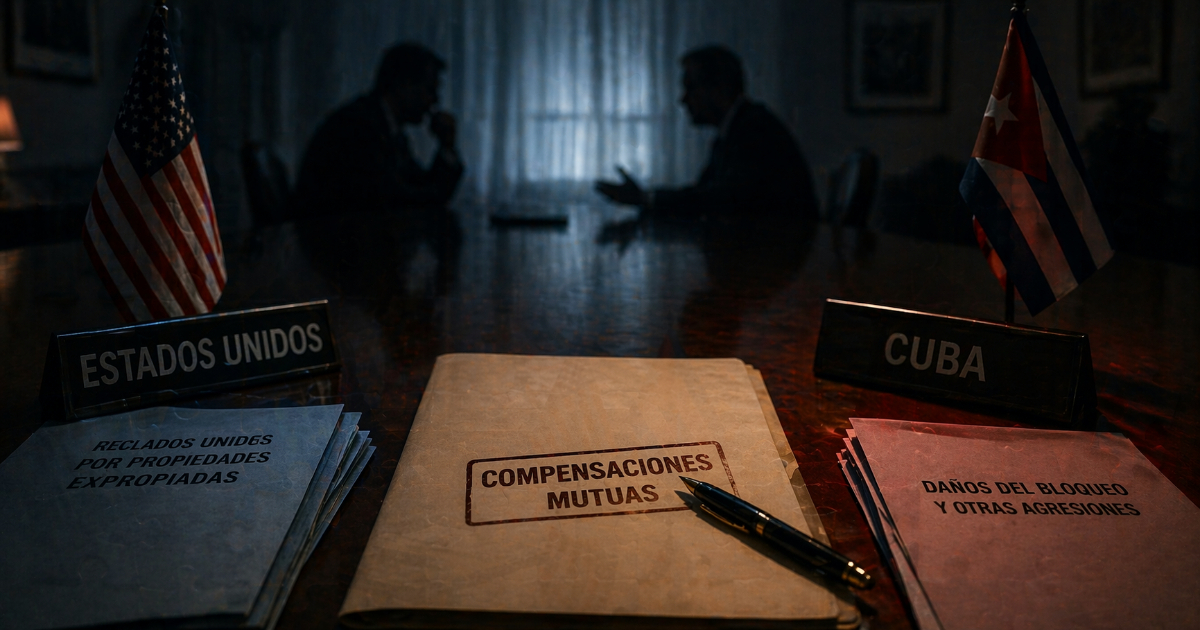
Since 1991, after losing Soviet support, the regime in Havana has expressed its willingness to sit down and discuss the issue of mutual claims and compensations, with each party's demands on the table. This position is supported by national legislation. However, in reality, the offer received by the United States must be far from the stances of a negotiation stalled due to political reasons, and that is reflected in the results. Nothing.
The twisted argument of Fernández de Cossío, claiming that sanctions have caused significant harm to the Cuban people, has even served to promote reports at the United Nations that are completely detached from reality, estimating the economic impact of the blockade on the Cuban economy with utterly impossible figures. On the contrary, no one seems to care about the harm caused to confiscated private property owners, many of whom are individuals who saw their personal assets destroyed overnight. For this reason, one might ask Fernández de Cossío how the Cuban economy could have developed over these 67 years if the communist confiscations had not occurred, and the answer would not be very difficult to provide. But that is science fiction, and the economy operates under different coordinates that must be analyzed and taken into account.
It seems that Fernández de Cossío has stated these things on platform X for some reason, and as in Castro's regime, there is a pendulum that swings to address issues in one way and then in the opposite way; it does not seem strange that this matter of compensations is being raised within the ongoing discussions between the United States and Cuba. If that is the case, it would not be a bad matter and certainly, as a starting point, it is impeccable, as long as all interests that were confiscated are considered, those of the United States, but especially those of Cubans who in many cases had to flee with nothing to exile. It is the only way to achieve justice.
Filed under:
Opinion article: Las declaraciones y opiniones expresadas en este artículo son de exclusiva responsabilidad de su autor y no representan necesariamente el punto de vista de CiberCuba.