
Related videos:
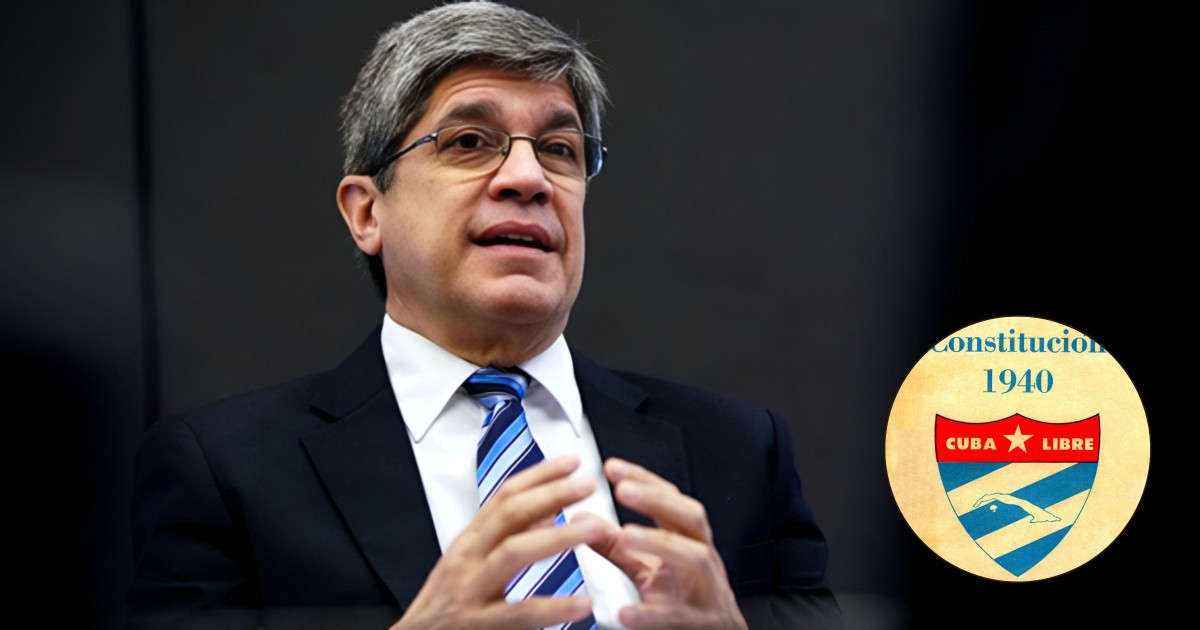
The Deputy Minister of Foreign Affairs of Cuba, Carlos Fernández de Cossío, appealed to the 1940 Constitution to legitimize the nationalizations of the 1960s. However, he not only cited a historical text but also
The diplomatic slip is not insignificant. Curiously, the same regime that today invokes that Magna Carta as a source of legal legitimacy was the one that, after coming to power, dismantled the political, institutional, and rights system that that Constitution enshrined.
In his desperate search for arguments to bring to the table (for negotiations that the deputy minister himself claimed were not taking place), Fernández de Cossío has shot himself in the foot; or to put it in Cuban terms, he has messed up, he has gotten himself in over his head.
Let's see: the 1940 Constitution defined Cuba as a "unitary and democratic Republic" aimed at enjoying political freedom and social justice. It was not only an economic framework, but a complete order based on popular sovereignty and the existence of effective limits on state power.
That context is inseparable from any rigorous interpretation of its provisions on property and expropriation.
In that context, the 1940 Charter recognized private property "in its broadest concept of social function" and allowed for its limitation for reasons of public necessity or social interest.
That is to say, the expropriation was not illegal in itself. But it was not discretionary either. It was part of a system that required guarantees, procedures, and institutional checks and balances to prevent abuses.
The legal framework that the "revolution" dismantled
That same constitutional text guaranteed essential freedoms that today are uncomfortable, if not discredited and violated by the “revolutionary” discourse and practice.
It recognized the right of citizens to assemble, associate, and participate in political life without arbitrary restrictions, and established that any provision limiting those rights would be null. It even contemplated the legitimacy of resistance against violations of fundamental rights.
The Constitution that Fernández de Cossío references was not merely a tool for regulating property; it was, above all, a democratic framework.
There is where the historical fracture appears. The so-called "Cuban revolution" came to power in 1959 promising to restore that constitutional order after the dictatorship of Fulgencio Batista. However, instead of reinstating it, Fidel Castro quickly replaced it with a system of "revolutionary laws."
The Fundamental Law of 1959 dissolved Congress and concentrated power in the Executive, initiating a process that eliminated the separation of powers, political pluralism, and judicial independence.
At the same time, since 1959 and on a mass scale from 1960, the new revolutionary power made progress in nationalizations and structural reforms while dismantling the system of guarantees that was supposed to support them.
In that context, the 1940 Constitution was, in practice, rendered ineffective long before it was formally replaced in 1976.
That context is crucial for assessing the nationalizations. They did not occur within a fully operational system of guarantees, but rather in the midst of a radical transformation of the political-legal order.
Therefore, those nationalizations are not supported by the constitutional regulatory framework established in 1940 and completely lack the legitimacy that the regime now claims through its spokesperson Fernández de Cossío.
The underlying issue: compensation in International Law
From the perspective of International Law, the issue is not with the existence of nationalizations, but rather with how they were carried out.
International law recognizes the authority of states to expropriate, but it sets clear conditions: there must be a public interest, there can be no discrimination, and, above all, adequate, effective compensation must be provided without undue delay.
This standard is the weakest point of the official Cuban argument.
Cuba reached compensation agreements with several countries, which confirms that the government itself acknowledged the need for indemnification.
However, in the case of the United States, where thousands of certified claims are concentrated with a value that now exceeds 9 billion dollars, effective compensation did not occur.
The explanation from Havana —which Washington refused to negotiate— does not eliminate the fundamental issue: the obligation to compensate does not depend solely on the political will of the other party.
The regime's double standards in the present
At this point, Fernández de Cossío's argument introduces another weakness: the blending of different legal frameworks.
The deputy minister argues that the damage caused by the United States to Cuba exceeds that suffered by the former owners. However, in legal terms, these are separate issues. Claims for expropriated property do not vanish due to political conflicts between states.
This approach is part of a broader pattern. While the propaganda apparatus insists that “Cuba owes nothing,” the authorities themselves acknowledge in diplomatic settings that there is an outstanding issue of compensations.
Fernández de Cossío himself has proposed a global payment scheme, and the Cuban ambassador to the UN has described the process as a “two-way highway.”
On one hand, the internal discourse denies any obligation. On the other, diplomatic practice acknowledges the existence of an economic conflict that requires resolution.
This duality of political (internal) and diplomatic (external) discourse undermines the credibility of the argument and strengthens the impression that law is used instrumentally.
A legitimacy that is difficult to uphold
The current moment explains part of that tension. The secret conversations with the Trump administration, the pressure it exerted on the Cuban regime, the emergence at the table of figures without political or institutional authority such as Raúl Guillermo Rodríguez Castro -grandson of Raúl Castro known as 'El Cangrejo'- have left the dictatorship exposed, without the arguments it once tried to build its legitimacy upon.
It is no longer just the legal pressure stemming from the application of the Helms-Burton Act, the lawsuits in U.S. courts, or the economic crisis always justified as a consequence of the "criminal and genocidal blockade." Now the regime is facing a critical moment, with the issue of claims at the center of the agenda and the dismantling of the totalitarian regime built by Castroism.
And it is at this moment that the dictatorship has been laid bare, when Miguel Díaz-Canel and his government have been portrayed as puppets and fools of the "royal family," those who truly hold power, who have retained control for 67 years, and who now decide the fate of the nation and
Then is when slip-ups occur, like that of Fernández de Cossío, that deputy minister deserving of the so-called "revolutionary diplomacy", which is nothing more than the exercise of manipulation, crying, and institutionalized lying to insert itself into the "international community" as a "heroic, sovereign, and blockaded nation," and not as what it is, a "rogue state."
In the current scenario, with 'El Cangrejo' and his uncle Alejandro Castro Espín ('El Tuerto') pulling the strings of all their puppets, the reference to the 1940 Constitution takes on an extremely problematic, if not grotesque, character.
Not only because it is invoked selectively, but also because it is used as a legal pretext without assuming the political model that the Constitution itself established: that Cuba which in 1940, after decades of tumultuous and vibrant national construction, was constituted as "an independent and sovereign State organized as a unitary and democratic Republic, for the enjoyment of political freedom, social justice, individual and collective well-being, and human solidarity."
That Cuba that Castroism destroyed down to its foundations in order to perpetuate itself in power, ultimately imposing the spurious Constitution of 2019, which enshrined the stripping away of the political and civil rights and freedoms of Cubans—carried out through blood and fire during decades of tyrannical rule—and subjected citizens to the "irrevocable" nature of the socialist system and the leading role of the Communist Party, thereby nullifying any real limits on the power of the totalitarian state.
Filed under: