
Related videos:
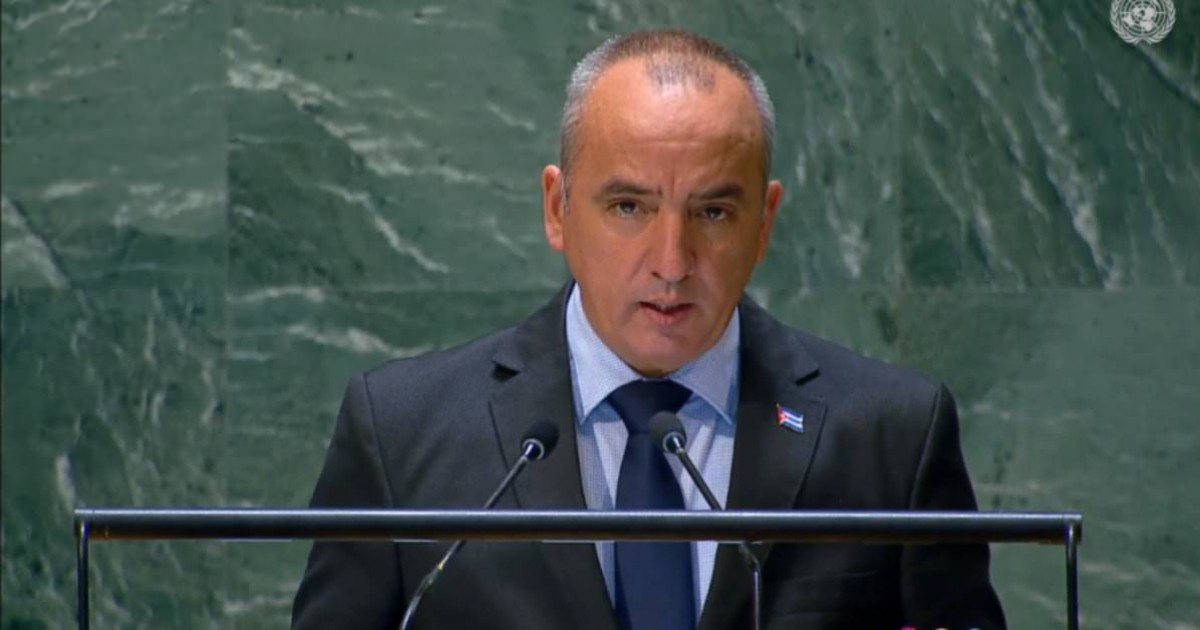
The Cuban ambassador to the UN, Ernesto Soberón Guzmán, appeared this Monday on the program "America's Newsroom" from Fox News to respond to statements made by President Donald Trump, who claimed last Thursday that the United States "will take Cuba almost immediately" after completing operations in Iran.
Soberón Guzmán firmly rejected any scenario of capitulation: "If anyone thinks that words like surrender, capitulate, or collapse are in the Cuban dictionary, in the dictionary of the Cuban people, that person, those people, are completely mistaken. In the Cuban dictionary, you will find words like resilience, resistance, defense of sovereignty, and defense of our independence."
The diplomat's statement comes days after Trump described, at a private dinner of the Forum Club in West Palm Beach, Florida, a scenario in which the aircraft carrier USS Abraham Lincoln would stop "about 100 yards off the Cuban coast" and the regime would respond: "Thank you very much, we surrender."
When the Fox News interviewer asked him if he would accept humanitarian aid from the Abraham Lincoln if the ship were off the coast of Havana, Soberón Guzmán dodged the direct question and referred to the May Day parade as evidence of popular support.
The official stated that 500,000 people marched in Havana and over five million across the country, "saying that we are ready to talk with the U.S., but at the same time, we are prepared to defend our sovereignty and independence."
However, those figures are the official ones from the regime and have not been independently verified. Aerial images of the Malecón and the José Martí Anti-Imperialist Tribune showed a turnout that was significantly smaller than what was claimed by the Cuban authorities.
The appearance of Soberón Guzmán on Fox News is part of a chorus of defiant statements that the regime has issued since last Thursday.
The foreign minister Bruno Rodríguez Parrilla described Trump's words as a "new clear and direct threat of military aggression" and assured that "Cubans will not be intimidated".
For his part, Miguel Díaz-Canel posted on social media that "no aggressor, no matter how powerful, will find surrender in Cuba." Meanwhile, the Communist Party issued an institutional statement to the same effect.
This rhetoric of resistance contrasts with the reality faced by the Cuban population. Trump signed a new executive order last Thursday that blocks all assets in the U.S. of individuals or entities linked to the regime in the energy, defense, mining, and financial services sectors, and imposes secondary sanctions on foreign banks that conduct business with sanctioned Cuban entities.
Since January 2025, the Trump administration has imposed over 240 sanctions against Cuba and intercepted at least seven tankers carrying oil destined for the island, reducing energy imports by 80% to 90%.
The outcome is devastating for the Cuban people: blackouts lasting up to 25 consecutive hours affecting more than 55% of the territory and a projected economic contraction of 7.2% for 2026, according to the Intelligence Unit of The Economist.
The regime also launched the campaign "My Signature for the Homeland" with an alleged 6,230,973 signatures against the sanctions. Foreign Minister Rodríguez claimed that 81% of the population had signed, a figure that analysts and opponents deem impossible without mass coercion in workplaces and schools.
In that context, Díaz-Canel had already warned on April 16 that Cuba was "ready to face serious threats, including military aggression," during the event marking the 65th anniversary of the proclamation of the socialist nature of the revolution.
The U.S. Senate rejected on Monday, by a vote of 51 to 47, a Democratic resolution from Senator Tim Kaine that aimed to limit Trump's war powers over Cuba, clearing the way for the administration to maintain maximum pressure on the regime.
Soberón Guzmán had already rehearsed this same message in March when he stated in Bloomberg that "if anyone tries to invade Cuba or attack it, they will find a whole people, 10 million individuals, ready to defend our sovereignty and independence," a formula that the regime repeats in multiple international forums while the Island sinks into its worst economic and energy crisis in decades.
Filed under: