
Related videos:
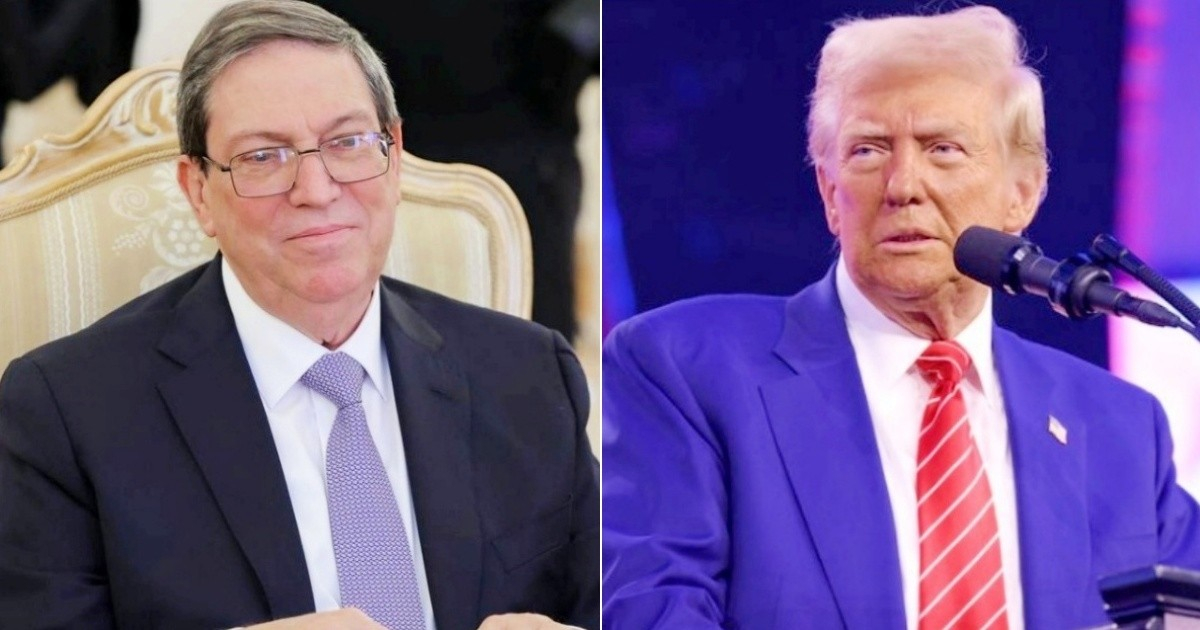
The Cuban Foreign Minister, Bruno Rodríguez Parrilla, responded on Tuesday to the statements made by U.S. President Donald Trump, who claimed that Cuba is "devastated" and that "it would be an honor to liberate it."
The new verbal exchange is once again straining the discourse between both governments.
"The U.S. government insists that it intends to take military action against Cuba because 'the country is devastated... and it would be an honor to liberate it,'" the chancellor began, not mentioning Donald Trump by name.
"The cynical and hypocritical thing is that the U.S. has been trying for decades to devastate the country with an economic war, and this government is doing so with even greater determination in recent months with two genocidal Executive Orders," Rodríguez asserted next.
The Cuban chancellor concluded his message by referring to both the sanctions and the threat of military intervention as "international crimes."
"Both the economic and energy blockade, as well as the new extraterritorial coercive measures; along with the threat of military aggression and the aggression itself are international crimes," he concluded.
What did Trump say about Cuba?
The statements that provoked the response were made during a phone interview on May 4th on Salem News Channel, when Trump was asked if Cuba was on his agenda.
"I don't talk much about Cuba, beyond saying that, perhaps, after finishing with Iran, something could be done afterwards, one after another," he replied.
The president even described a scenario of military pressure, with the aircraft carrier Abraham Lincoln positioned just a few hundred meters off the Cuban coast.
Trump insisted on the state of the country as justification: “The reality is that the country is devastated right now, completely devastated. It would be an honor to liberate it.”
He also linked his stance to political support in the United States: "I received 94% of the Cuban vote in the United States, and frankly, I have an obligation to do something."
And he added: “What has been done to Cubans and their families living in the United States is unthinkable, very similar to what is happening with Iran.”
Previously, on May 2, at a private dinner of the Forum Club in West Palm Beach, Florida, Trump stated that the U.S. would "take Cuba almost immediately" after concluding operations in Iran, describing the scene of the USS Abraham Lincoln stopping "about 100 yards off the coast" until the regime responded: "Thank you very much, we surrender."
The context of executive orders
The "two Executive Orders" referenced by Rodríguez are Executive Order 14380, signed on January 29, 2026, which declared Cuba to be an "unusual and extraordinary threat" and imposed an energy embargo; and the new executive order signed on May 1, which expands sanctions on energy, defense, mining, and financial services, and blocks the assets in the U.S. of officials from the regime—both current and former, as well as their associates and adult family members—imposing secondary sanctions on foreign banks that engage with sanctioned Cuban entities.
Since January 2025, the Trump administration has imposed over 240 sanctions against Cuba and intercepted at least seven tankers, reducing energy imports by between 80% and 90%.
The regimental choral response
Rodríguez is not the only official who has reacted.
Miguel Díaz-Canel posted on social media that "no aggressor, no matter how powerful, will find surrender in Cuba."
The Cuban ambassador to the UN, Ernesto Soberón Guzmán, appeared last Sunday on Fox News to state that words like "surrender," "capitulate," or "collapse" are not "in the Cuban dictionary."
This rhetoric of resistance contrasts sharply with the reality faced by the population: extended blackouts, widespread shortages, and a projected economic contraction of 7.2% for 2026, according to the Intelligence Unit of The Economist.
Last Monday, the U.S. Senate rejected, with 51 votes against 47, a resolution by Democratic Senator Tim Kaine that aimed to limit Trump's war powers regarding Cuba, leaving the president with complete freedom of action in this area.
The exchange highlights two narratives that confront each other without truly connecting.
On one hand, Washington appeals to the idea of "liberation" and the internal crisis in Cuba as a political argument; on the other hand, Havana counters by attributing that very crisis, to a large extent, to external pressure.
Filed under: