
Related videos:
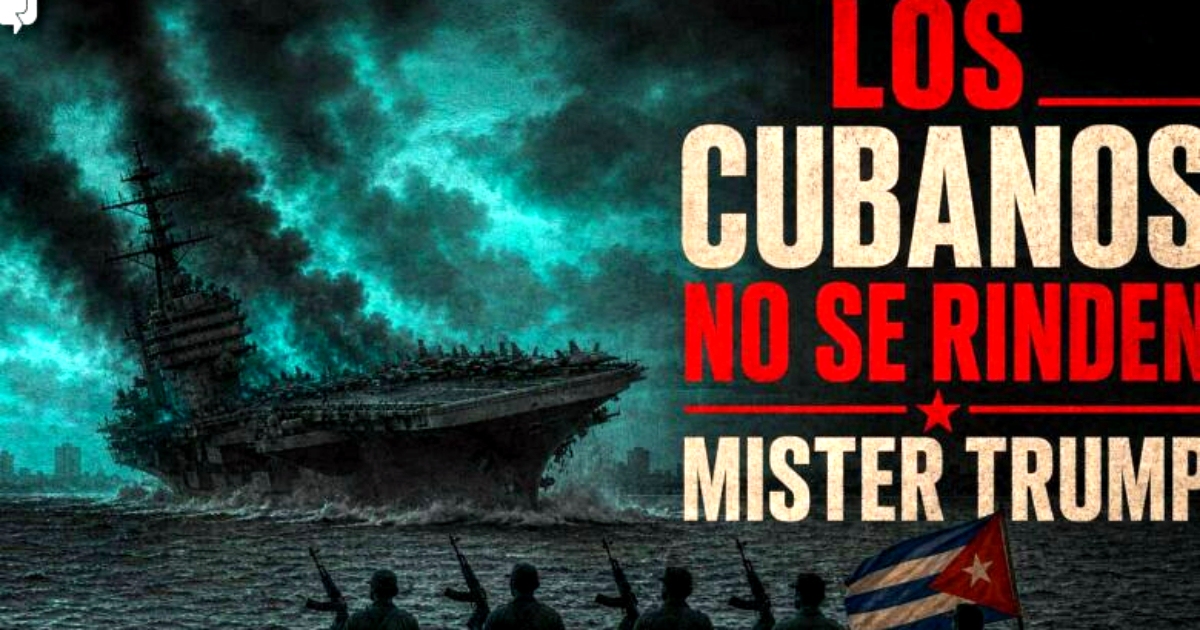
The recent text disseminated by the official site Razones de Cuba, titled "Cubans Don't Surrender, Mister Trump," once again stressed the "courage and heroism" that the regime frequently glorifies in its propaganda.
It is not an isolated fact, but rather the most complete expression of a type of political discourse that has characterized the regime's communication for decades: epic, emotional, and built around the idea of permanent resistance against an external enemy.
The problem lies not in the tired jargon of the State Security bards, but in their increasingly limited ability to describe the reality of the country. And this is where the Venezuelan case offers an uncomfortable mirror to Humberto Dionil López Suárez and his masters in Counterintelligence.
A familiar narrative
The official text once again articulates the classic narrative of the dictatorship: a heroic people, a story of sacrifices and victories, and an external threat that reinforces national identity.
The reference to episodes such as Playa Girón, the October Crisis, or military missions in Africa is not aimed at providing context, but rather at establishing a symbolic continuity of Castroism: that of a country that never surrenders.
That same scheme was used for years by Chavismo in Venezuela. In the face of sanctions, economic crises, and international isolation, the official discourse insisted on resistance, sovereignty, and confrontation with the United States as the driving force.
For a while, it seemed to work. Until reality, that is, the population's exhaustion in the face of abusers and corrupt officials, reached a breaking point.
The limit of the epic
In Venezuela, that narrative began to crumble when daily life stopped sustaining it. Scarcity, uncontrolled inflation, and mass emigration ultimately imposed a reality that the propaganda discourse learned in Havana could neither explain nor resolve.
The rhetoric of resistance continued, but with increasingly less capacity for real mobilization. It remained, to a large extent, a pantomime of internal reaffirmation rather than an effective tool for social cohesion.
Rifles and missiles for the peasant force! To defend the territory, sovereignty, and peace of Venezuela. Rifles and missiles for the working class, so that they can defend our homeland!” said Nicolás Maduro at the end of August 2025, as the U.S. military deployment began in the Caribbean and he was accused from Washington of leading a "narcoterrorist cartel."
The Chavista ruler and his leadership spoke of deploying 4.5 million militia members to respond to what they described as "extravagant threats" from the United States, asserting that they were "prepared, activated, and armed."
The conclusion on January 3, 2026, with the capture of Maduro following a U.S. military operation, further highlighted that gap: the epic narrative did not translate into a real ability to maintain power in the face of extreme pressure.
The Cuban Parallels
In Cuba, the discourse follows a similar logic. The text of Razones de Cuba emphasizes that external pressure will only generate more resistance.
However, it insidiously avoids any reference to internal factors that currently define the daily experience of Cubans: prolonged blackouts, structural shortages, deterioration of basic services, and unprecedented emigration.
The real country is not one of epic tales, but rather one of daily survival.
There lies the main weakness of the discourse: it presents a homogeneous, cohesive society ready for sacrifice, while in reality, fatigue, uncertainty, and in many cases, desperation and a desire to escape prevail.
More narrative than diagnosis
Another key element is the use of the January 3 incident in Venezuela as proof of the "unyielding" nature of Cubans.
Beyond the versions and figures, the text elevates it to a symbol, reinforcing the idea that even in extreme conditions, the response will always be the same: to resist.
"We knew they would act like titans even in their final battle. They offered their lives in a fierce battle," said Díaz-Canel in mid-January, praising their "heroism" from the Anti-Imperialist Tribune.
However, this type of narrative construction tends to operate more as myth than as diagnosis. It simplifies complex scenarios and aims to turn them into moral examples, but it does not provide the tools to understand real challenges.
A speech in tension
The insistence on this type of narrative reveals, rather than strength, an increasing tension. When a discourse constantly needs to rely on history to explain itself, it is often because the present is more difficult to justify.
The parallel with Venezuela is not exact, but it is illustrative: there, the epic lost its effectiveness when it stopped connecting with the concrete experiences of the population. In Cuba, that process seems to be moving in the same direction.
The issue, ultimately, is not the appeal to resistance, but its disconnection from a country that has changed. Because when reality no longer fits the narrative, the narrative ceases to persuade.
Filed under: