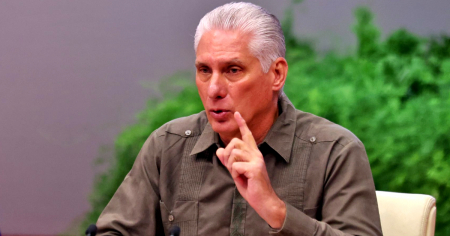
The Cuban leader Miguel Díaz-Canel once again set social media ablaze with a new speech during the XI Plenary of the Central Committee of the Communist Party of Cuba (PCC), stating that “no one will surrender here.” The message, shared through the official Presidency account on X emphasized the need to keep the Revolution alive, in an exalted tone that contrasted sharply with the crisis the country is facing.
Díaz-Canel stated that “the responsibility that has fallen on us as generations living through this moment of the Revolution, and the legacy we can leave, is to feel that we were people of our time, that the Revolution continues to triumph, despite the intensified blockade, and that the country progresses”. He added that it was not enough to merely resist, but that Cuba must “advance,” and insisted that “yes, it is possible,” attributing daily evidence of that resilience to the people.
"The country is moving forward in squalor, in misery, in hunger, and diseases."
The statement of a citizen on Facebook encapsulated the wave of outrage provoked by Díaz-Canel's speech. Her words, posted on the official Presidency page, were shared hundreds of times and reflected the sentiment of a population exhausted by promises that no longer persuade. In the comments, phrases such as “we are moving towards the Stone Age” or “each speech is emptier than the last” were repeated.
In X, where the video was also shared, the reactions were equally critical. “The revolution is not defeating anyone; it is destroying Cuba and its citizens,” wrote one person, while another exclaimed, “Stop with the nonsense of revolution, enough already, and free the people.” Users questioned the contrast between the slogans and the daily life marked by blackouts, hunger, and emigration. “If we look at the progress, from eleven million we’re down to two,” quipped another comment that received dozens of endorsements.
Many messages pointed directly to the privileges of the ruling elite: "Obviously, with how you live, no one is going to give in; you don't lose power or lack food," wrote one person, while another added, "You live like the wealthy, and the people are dying from selfishness." The criticisms also appealed to social fatigue and the decline in quality of life: "The country is sinking, and you keep talking about resistance," wrote a user, while another responded, "Every year we move further into misery."
Only a few comments defended the leader or repeated the official slogans such as "no one surrenders here" or "Fatherland or Death, We Will Overcome." However, those messages of support were in the minority compared to the overwhelming wave of responses filled with irony, frustration, and anger. The general feeling was that of a people who listen to a speech from a distance, one that no longer inspires or convinces.
A speech repeated in the midst of the crisis
Díaz-Canel's new statement comes just a day after another of his interventions in the same party meeting, where he asserted that “every day of the Revolution is a victory.” This statement also sparked a wave of responses on social media, where Cubans reminded him of the hunger, darkness, and neglect faced by the people in contrast to the privileges of the ruling elite.
The contrast between the celebratory narrative of power and the daily experiences of millions of citizens has become a constant. Comments on social media, which are increasingly direct and critical, reflect a growing gap between political discourse and the real lives of Cubans, characterized by scarcity, blackouts, inflation, and hopelessness.
Filed under: