
Related videos:
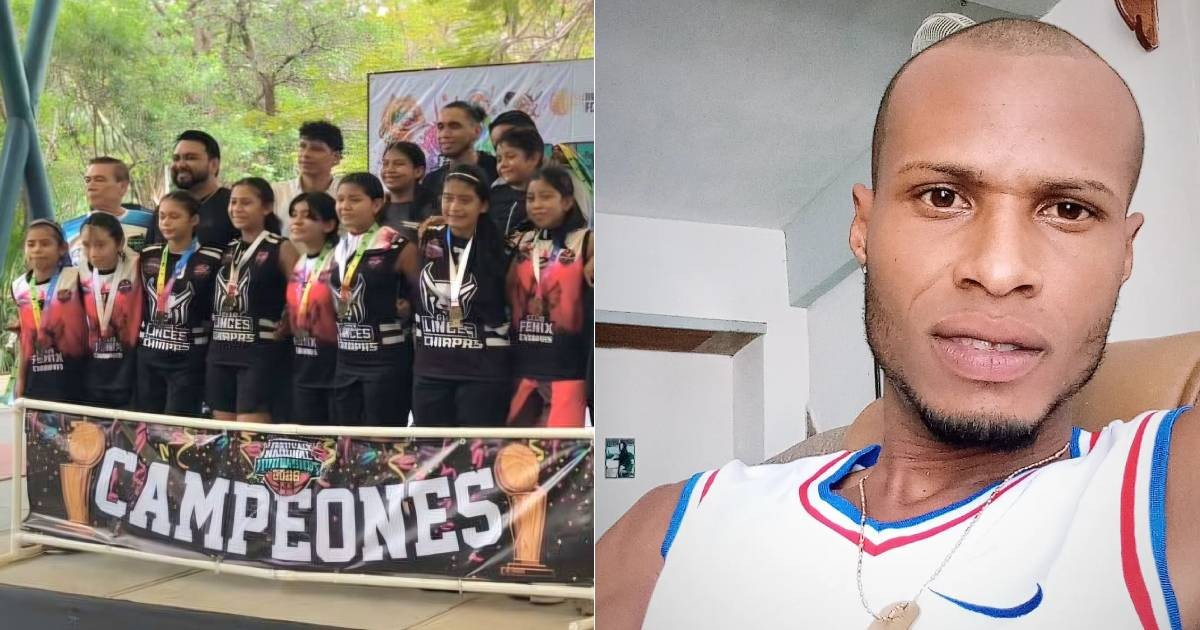
David Nelson Mediaceja Padilla emigrated from Cuba due to the economic crisis and the blackouts affecting the island, and today he coaches children in basketball in Tapachula, Chiapas, where he found in sports a way of life and a means to contribute to his host community.
Originally from the province of Santiago de Cuba, David explained to Diario del Sur that his income as a professional was not enough to cover his basic needs, that essential products exceeded his monthly salary, and that power and water outages were frequent.
From childhood, David had a close relationship with basketball, starting in makeshift spaces in his community alongside older individuals, and eventually integrating into the formal Cuban high-performance system.
As an athlete, he represented the Santiago de Cuba team in district, provincial, and national competitions, and won a gold medal and a bronze medal in the 13 to 15 age category.
At the age of 18, an injury cut short his career in high performance and led him to focus on his university studies, which he completed in 2018.
After settling in Tapachula, David became involved with the Fénix club through local contacts and is currently training a group of children under the supervision of Professor Adrián Cárdenas Ramos, who is in charge of the project.
The youth team, known as Linces, aims to participate in the mini basketball national championship in Tamaulipas, as confirmed by Cárdenas himself on social media.
"We have great celebrities in this little school. David Nelson Mediaceja Padilla, an excellent coach and a great brother. The accomplice in achieving success with the Linces team that will represent Tapachula and Chiapas in the national mini basketball tournament in Tamaulipas," Cárdenas wrote.
David's method revives practices from the training system he learned in Cuba, although adapted to local conditions.
While on the island the training sessions could last up to six hours and eight for high performance, in Tapachula the training sessions last between an hour and a half and two hours.
Despite that difference, David notes that the team has shown improvements in their pace of play and participation on the court.
Regarding his stay, David mentioned that he plans to remain in Tapachula regardless of his immigration status, in order to not disrupt his work with the team or have to restart his employment process elsewhere.
Her story is set within a broader context: Tapachula is home to around 800 deported or stranded Cubans in 2026, part of the nearly 6,000 that the Trump administration has sent to Mexico since the beginning of the year as part of an unspoken agreement that designates the country as a third safe country.
Many of these migrants live in a legal limbo, without documents to work or move freely, surviving in informal jobs under very precarious conditions.
It is not the first time that a Cuban athlete has found in sports a way to integrate into Tapachula: in 2022, Cuban boxer Gabriel Moya promoted the project "Boxing for Peace" among stranded migrants in the city, seeking to reduce stress and steer young people away from drugs.
The crisis that drove David to emigrate is not an isolated case: Cuba lost more than 300,000 inhabitants in 2024, with an external migration balance of -25.4 per thousand, according to the National Office of Statistics and Information.
Since 2021, more than a million people have left the island, driven by decades of economic decline under the dictatorship and an energy crisis that left 63% of the country without electricity at the same time on January 31, 2026.
The results of the Linces team in the regional competitions and at the national event in Tamaulipas will be, according to David, the main reference for evaluating the work done with the children of Tapachula.
Filed under: